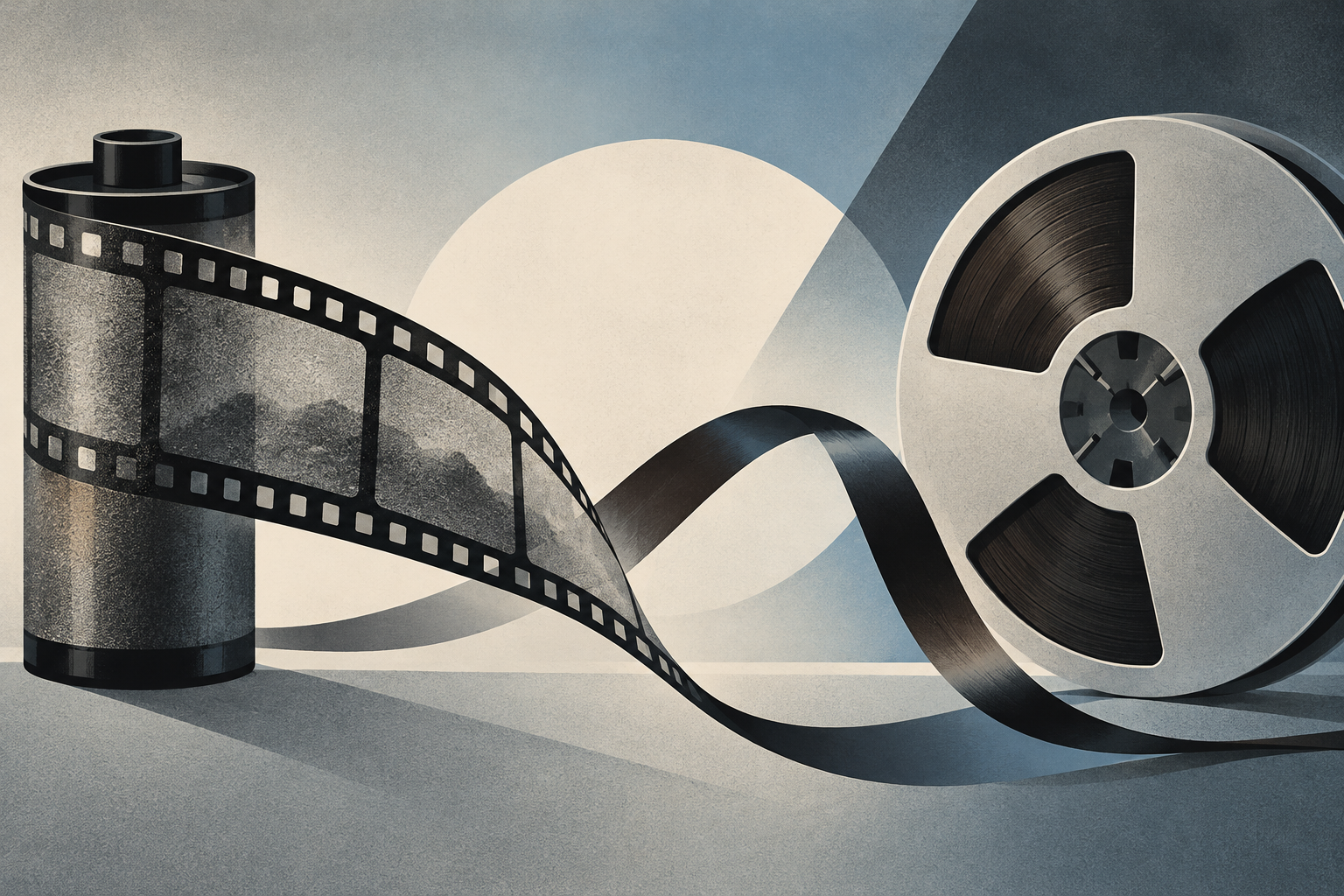
The boundary between photography and video during the analog era was not merely a question of movement, but a dispute over the temporal structure of perception. During the 1970s to 1990s, photography was forced to abandon its monopoly on fixed visual recording to redefine itself in an ecosystem where video emerged as an autonomous medium. This transition was not only technical but ontological: the viewer shifted from consuming frozen instants to experiencing edited flows of time. Recent academic evidence suggests that rhythm and the temporal factor are the elements that truly distinguish these formats, determining how the brain processes visual information based on the duration and sequence imposed by the support.
Materiality as a Narrative Determinant
The physical support was not a passive container, but an active agent in the construction of reality. Photographic film, with its grain and chemical development process, imposed a temporal discontinuity. Each frame was an isolated decision, an instant that required mental sequencing by the viewer to connect it with others. In contrast, the magnetic tape of video offered linear continuity. Tape recording did not allow the same immediacy of selection as the photographic camera; time flowed uninterrupted, forcing the creator to think in terms of duration and editing from the moment of capture. This material difference directly conditioned the possible narrative, limiting or expanding expressive possibilities depending on the medium chosen.
The Case of US Street Photography
In the US context, street photography from the 1970s to 2000s illustrates this temporal tension. Authors like John P. Walsh documented how the film camera allowed capturing urban spontaneity without the pressure of narrative continuity. Street photography relied on the photographer's ability to anticipate the decisive moment, a perceptual exercise that video, with its continuous flow nature, transformed into a post-editing exercise. Film allowed a more intimate relationship with chance, while video demanded more rigorous time planning. This divergence was not only aesthetic but practical: the weight of the camera, the cost of development, and the limitation of frames per roll created a discipline of scarcity that video, with its prolonged recording capacity, did not share.
Experimentation in Europe and Latin America
While the US explored photography as a document of everyday reality, Europe and Latin America leaned towards video experimentation. In Latin America, photography and history intertwined in projects seeking to document identity and collective memory, often using video as a tool of resistance and political expression. Video experimentation in these regions was not limited to technique but questioned the canons of visual representation. Video allowed an immersion in time that photography could not offer, creating a more enveloping and often more critical experience. This geographical and thematic bifurcation reflects how the chosen medium conditioned the message, not just its form.
The Sala Parpalló and the Transition in Valencia
In Spain, the Sala Parpalló in Valencia became a key space for the contribution to photography in the transition to digital between 1980 and 1995. This space did not only exhibit works but facilitated dialogue between traditional photography and new technologies. The Sala Parpalló was a laboratory where how photography could dialogue with video and other audiovisual media was explored, blurring the boundaries between both. The contribution of this space was crucial for understanding photography not as an isolated medium, but as part of a broader visual ecosystem. The transition in Valencia was not just an adoption of new tools, but a reconfiguration of photographic practice in response to the presence of video.
The Genesis of Video as an Autonomous Medium
The genesis of video marked an innovative debut in audiovisual creation, laying the foundations for its consolidation as an autonomous medium. Unlike photography, which had centuries of history, video was a young medium still defining its own rules. Its debut was not only technical but cultural: video introduced a new way of understanding time and space in the image. The possibility of recording, editing, and reproducing moving images changed the relationship between creator and viewer, allowing a more dynamic and complex interaction. This genesis of video did not only affect photography but transformed all audiovisual creation, setting the stage for subsequent digital convergence.
Limitations of Evidence and Historical Context
It is important to note that the available evidence, while solid, has limitations. The cited academic studies, such as the Mosaic article on the temporal factor and rhythm, offer a theoretical perspective but do not always translate into a complete understanding of the artistic practice of the time. Additionally, documentation of video experimentation in Latin America and Europe is scarcer than that of US street photography, which may generate a biased view of the transition. The Sala Parpalló, while an important case study, does not represent the entirety of the Spanish photographic scene. Therefore, it is necessary to interpret these findings with caution, recognizing the gaps in documentation and the diversity of artistic practices of the time.
Conclusion: One Capacity, Two Relationships with Time
Photography and video are not opposites, but variants of the same recording capacity, differentiated by their relationship with duration and sequence. The analog transition of the 1970s to 1990s was not a rupture, but an expansion of the visual field. The materiality of supports, from film frames to magnetic tape, influenced the perception of time and space, laying the foundations for subsequent digital convergence. Understanding this relationship is key to appreciating the evolution of visual media and its impact on contemporary culture. The lesson of this analog era is that the medium is not neutral: the way we capture reality determines how we experience it.
- Decade
- 1980s
- Region
- Global
- Level
- Enthusiast
- Entities
- Monopoly, Sala Parpalló
Sources and references
- El factor temporal y el ritmo como distintivo entre fotografía y vídeodoi.org · 2026-10-17
- La Sala Parpalló y su contribución a la fotografía en Valencia (1980-1995)openalex.org · 2026-10-17
- La génesis del vídeo y su debut innovador en la creación audiovisualopenalex.org · 2026-10-17
- Mi fotografía callejera: Estados Unidos, décadas de 1970 a ...translate.google.com · 2026-10-17
- Fotografía e historia en América Latinaissuu.com · 2026-10-17
- Historia de la fotografía - Wikipedia, la enciclopedia librees.wikipedia.org · 2026-10-17


