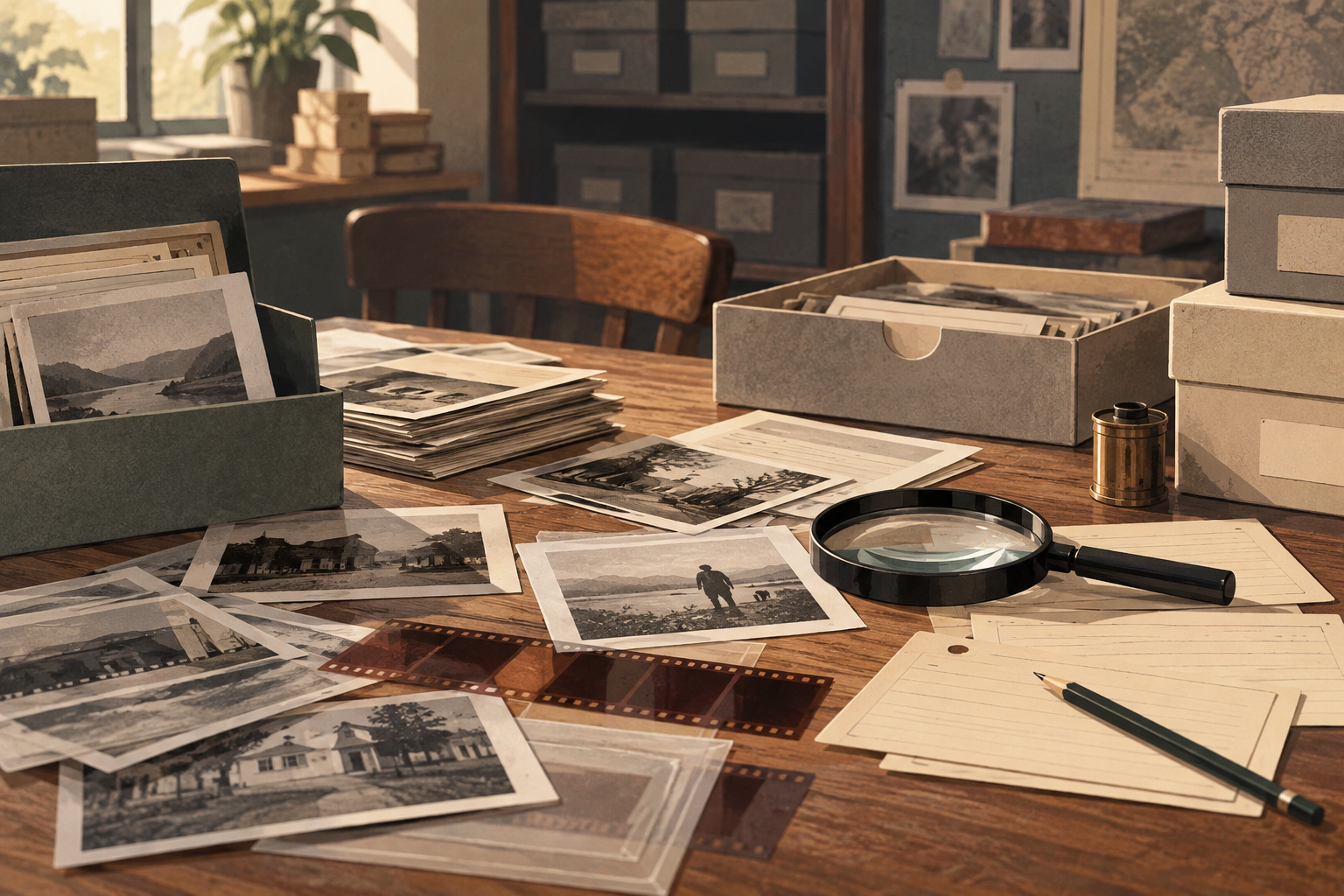
Seeing an image is not the same as knowing its history
A photograph seems to offer immediate answers. It shows people, objects and places; sometimes information about the date or the identities of those pictured survives as well. Yet an intelligible image is not necessarily a well-understood document. Reconstructing its historical value also requires asking who produced it, for what purpose and as part of which activity. This distinction is particularly clear in photographs relating to business and industry: an image may record a workplace or a task, but its meaning changes depending on whether it was commissioned by a company, created for an institution or made by an independent individual.
A study of archival photographic documents makes this point directly: knowing the date, vehicle and people depicted is not, by itself, enough to establish a photograph’s archival character. Its producer must also be accounted for. This does not diminish what can be seen; it places the image within a wider documentary history.
Provenance is part of the content
In an everyday reading, we tend to look first at the subject: which building appears, who stands in the foreground or what activity is taking place. The archival perspective adds another question: how is this photograph related to the group of documents in which it was created, assembled or preserved? The producer may be an individual, a company or a collective organization. Identifying that producer allows us to ask why the image exists and what function it served.
This does not mean that every photograph has a simple answer, or that its maker can always be identified. It means that missing information should be recorded as a limitation rather than filled in through an intuitive attribution. Provenance is a way to describe what is known and to mark the boundaries of what cannot be stated with confidence.
The company appears inside and outside the frame
Images relating to businesses can tell us more than what they depict. The supplied research article emphasizes that their production can also reveal how everyday tasks were carried out in companies and industries. Photography can therefore offer two kinds of clues: those concerning the subject shown, and those concerning the practices that made producing the image possible.
That distinction matters. A photograph of a workplace may look like a neutral window, but its framing selects part of an activity and leaves other parts out. If we know who commissioned or preserved the image, we can examine that selection alongside the rest of its documentary context. If we do not know, we should avoid assigning it a specific intention. Critical reading does not mean inventing a purpose; it means distinguishing what is visible from what the evidence can support.
From an isolated image to a documentary group
Press photographic archives offer a useful example of why each photograph needs an orderly description. The academic text supplied on this subject includes descriptive elements such as format, a summary of the document and its condition. It also recognizes that author and producer may be the same person, but need not be. These distinctions matter in practice: the photographer, the person who commissioned the image and the person who preserved it may have had different roles.
A catalogue record does not replace research, but it prevents an image from being reduced to an isolated caption. A description can retain identifying details and observations without turning a hypothesis into a fact. At collection level, organizing images alongside their documentary relationships can help reconstruct series and uses that may not be visible in a single print.
Preservation also means documentation
Historical archive management must respond both to the fragility of materials and to changes in how people access them. The National Museum of Natural Sciences notes that the spread of digital technology coincides with growing public interest in historical photography, and that this change calls for new management strategies. The supplied material mentions tasks such as digitization, the handling of resulting files and cataloguing.
Digitization can make consultation and circulation easier, but it does not, by itself, answer questions about an image’s origin. A digital copy needs a description that preserves its relationship to the original object or group and distinguishes the original from its derivatives. Technical work gains historical meaning when the associated information remains available and intelligible.
What can be said, and what remains open
The available sources support the view that photography is valuable for studying industry and business as a visual record, and that the production of images can offer information about everyday practices. They also establish the importance of provenance, description and photographic collection management. They do not, however, identify a particular collection or justify assigning authorship, date or purpose to a specific image without supporting documentation.
This caution does not make historical photography less compelling. It makes the reading more precise. Looking at the image and asking how it was produced are complementary acts: one attends to what appears; the other to the conditions that allowed the image to exist and reach us. An archival photograph is not simply a preserved scene. It is also a documentary relationship we must learn to read.
- Decade
- Before 1950
- Region
- Global
- Level
- Enthusiast
- Entities
- Museum, Museo Nacional de Ciencias Naturales
Sources and references
- Documentos fotográficos de archivo: extendiendo los ...dialnet.unirioja.es · 2026-09-28
- Censo-Guía de Archivos de España e Iberoaméricacensoarchivos.cultura.gob.es · 2026-09-28
- ISSN: 1578-4282 ISSN (cd-rom): 1695-9884 Deposito legal: J-154-2003revistaselectronicas.ujaen.es · 2026-09-28
- Gestión de los archivos de fotografía historica por Gabriel Betancor Quintana | Museo Nacional de Ciencias Naturalesmncn.csic.es · 2026-09-28
- 165 5.3. Fondos y colecciones fotográficas en Archivos Estataleswww.cultura.gob.es · 2026-09-28
- 1 ARCHIVOS FOTOGRÁFICOS DE PRENSA Juan Miguel Sánchez Vigilrevistas.ucm.es · 2026-09-28