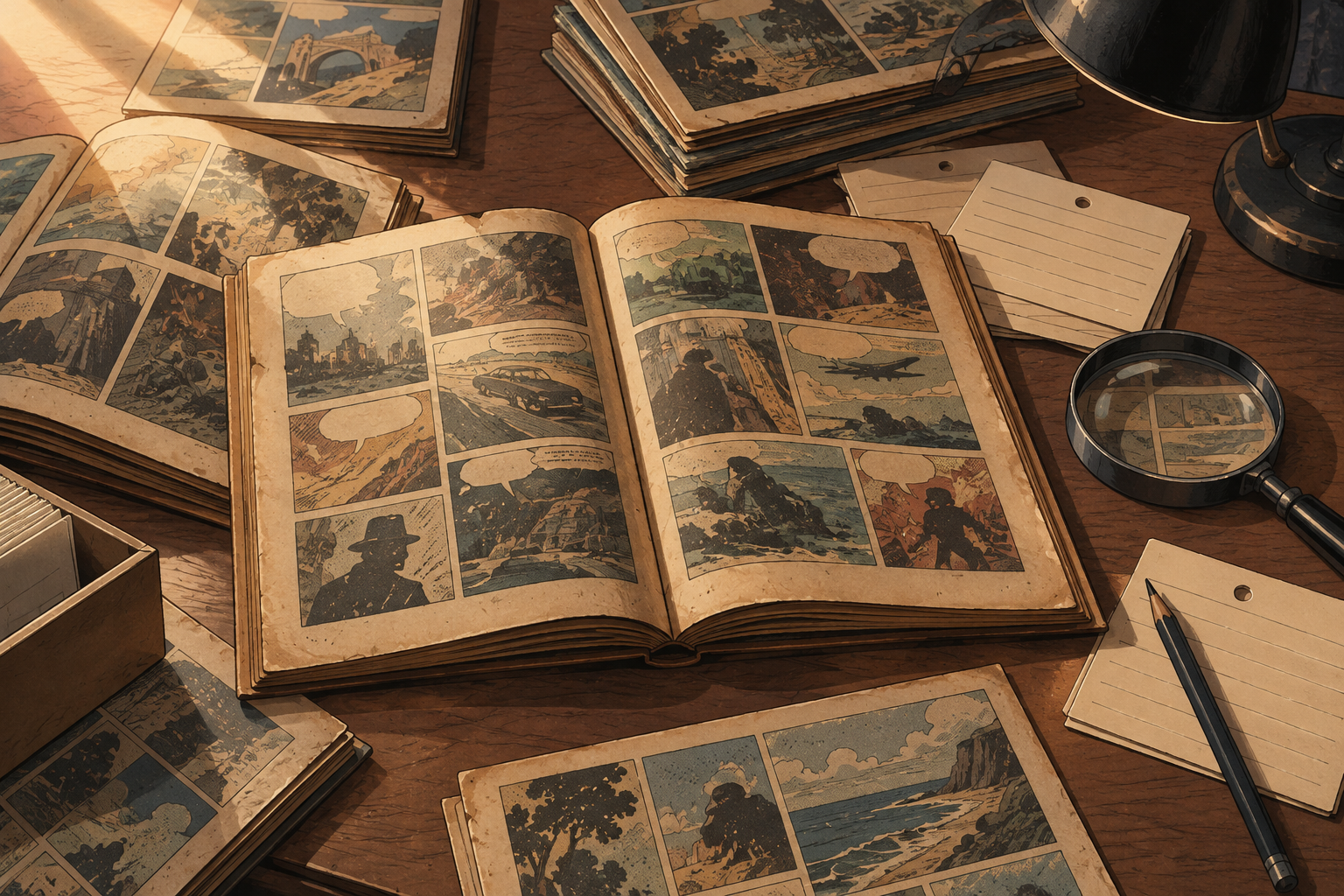
A magazine is not merely a container
A comics magazine is a periodical editorial object: it brings together text and images and may focus on a particular subject. That apparently simple definition prevents a common collecting mistake: treating an issue as nothing more than a folder of pages. Its issue number, format, arrangement of contents, and route to readers are historical information.
For much of the twentieth century, magazines held a central place in comics publishing. That position does not mean that every title worked in the same way. A masthead could contain serialized episodes, self-contained material, advertising, children’s content, or sections unrelated to comics. Identifying a magazine therefore starts with describing the copy in hand before making claims about an entire run.
Dates: what can be stated
When a cover carries a date, record it exactly. It does not automatically establish the creation date of a story or its first circulation in another country. Alberto Albarrán’s visual chronology specifically notes that, in series, a date may refer to a character’s first appearance, while in other cases it refers to a later collection of previously published parts.
A catalogue should separate at least four fields: the date of the examined issue; the documented first-publication date of the comic; the date of a collected edition; and the date of a reprint. When one is not verified, leaving it unknown is better than guessing. This discipline protects a personal archive and later research alike: an appealing cover does not by itself prove that its contents were new.
Serialization and collected editions
Installments are one of the essential ways to read magazines. A work now encountered as a book or graphic novel may first have appeared in fragments in a periodical. Albarrán notes that, in certain periods, it was common to publish a comic in chapters in a magazine and later gather those parts in an album or graphic novel.
That changes the collector’s useful questions. Rather than asking only, “What volume is this?”, ask whether the episode begins or ends here; whether it refers to earlier issues; whether the contents page identifies chapters; whether the cover or spine signals a series; and whether pagination appears continuous. Such answers help reconstruct the original reading experience without assuming that a later edition preserved the same order, scale, or editorial material.
Advertising, readership, and editorial purpose
The support carrying a comic can also explain its purpose. The Library of Calahorra places Chiquilín in 1924 as a Madrid publication used as advertising support for Federico Bonet, a manufacturer of children’s pharmaceutical products. The case is a reminder that a publication containing comics can belong to a commercial strategy rather than to the same model as a magazine sold as a comic.
The same source dates Pinocho to 1925 and describes it as a comic published in Madrid by Saturnino Calleja, where major American comics began reaching Spanish readers. These details make it worthwhile to inspect publisher, city, advertised brands, stated audience, and material provenance. Without the copy itself and further bibliographical sources, one should not infer print runs, sales, exclusivity, or licensing arrangements.
Cataloguing without over-attribution
A useful record can include masthead title, visible issue number or date, named publisher, city when printed, dimensions, page count, language, printed price when present, physical condition, and a carefully transcribed contents list. It is also useful to identify an original, facsimile, reprint, or bound volume, but only when the object itself or a reliable source supports that identification.
Categories should remain distinct. A “publication containing comics” does not always mean a comic magazine in the strict sense. Tebeosfera stresses, in its study of the recent Spanish market, that some publications include complete comics but were not conceived as comics publications. This distinction matters when classifying children’s, institutional, or promotional magazines.
From newsstand to archive
The magazine’s reduced relative role does not make it historically minor. Jot Down Cómics writes that the format has changed and occupies a small place in the contemporary market; it notes Alta Tensión and Planeta Manga in 2019, and La Resistencia ending with its tenth issue. This is better understood not as a simple story of disappearance, but as a format changing scale, audience, and function.
Institutions preserve evidence for examining that path. The Museu del Còmic i la Il·lustració says its holdings include satirical press, weeklies, children’s press, booklets, magazines, graphic novels, and original art. That list shows why a comics collection should preserve not only isolated works but also the material frames that shaped reading.
Conclusion
Reading a comics magazine historically means holding two ideas at once: each issue is a material object and a fragment of an editorial chain. A visible date, serialized installment, advertising, publisher, and binding can guide research, but none replaces verification. A precise record that separates observation from source-backed attribution is more valuable than an overly certain narrative built from a cover alone.
- Decade
- Before 1950
- Region
- Spain
- Level
- Collector
- Entities
- No linked entities
Sources and references
- Historia visual del cómic, la novela gráfica, el manga y los tebeos – Alberto Albarránwww.albertoalbarran.com · 2026-09-17
- Manuel Barrero (2022): "La industria del cómic en España en 2020 y 2021", Documento en Tebeosferarevista.tebeosfera.com · 2026-09-17
- Historia del cómic - Bibliotecas de la Riojabibliotecas.larioja.org · 2026-09-17
- Pasado y presente de las revistas de cómic – Jot Down Cómicscomics.jotdown.es · 2026-09-17
- Inicio - Museu del Comic i la ilustraciónmuseudelcomic.org · 2026-09-17
- Historia del cómic | Biblioteca de Calahorracalahorra.biblioteca.larioja.org · 2026-09-17

