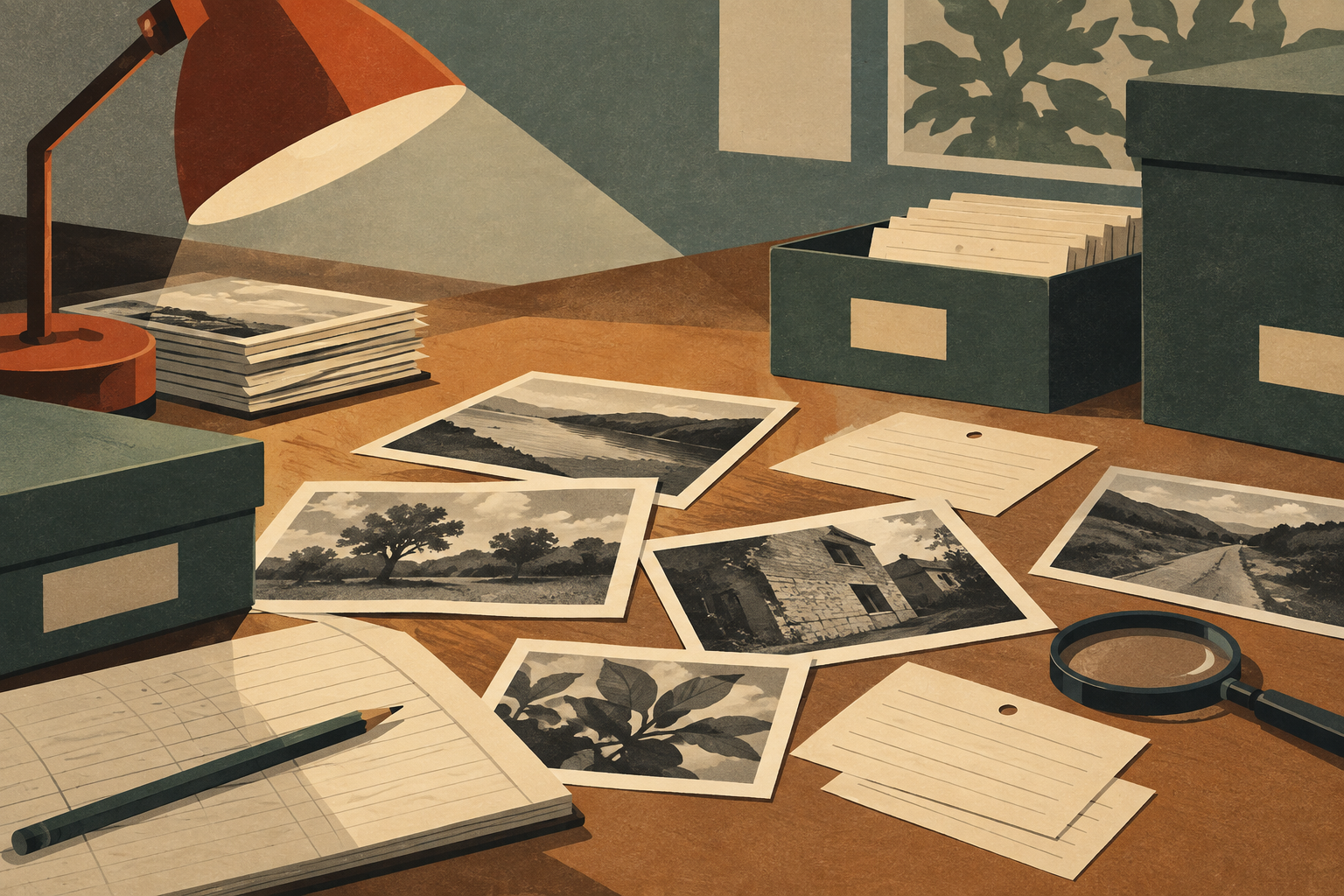
A photograph can seem to provide an immediate answer: it shows a street, a factory, a group of workers or an urban transformation. Yet the image cannot, by itself, explain who decided to make it, what purpose it was meant to serve, or how it came to belong to an archive. Studies of photographic documentation stress this distinction: what is visible is a source of information, but understanding the document also requires reconstructing its production and context. This matters especially when an image is used to tell the history of a company, a community or a place.
The image shows, but does not explain everything
Photographs let us observe details that other sources may describe differently: spaces, objects, the arrangement of work and the ways an activity was represented. A study of photographic documents relating to industrial history highlights two possibilities: analysing the visual information about what is depicted, and studying the photograph as the result of everyday documentary practices. The second approach shifts the question. It is no longer enough to ask what appears in the image; we must also ask who commissioned or produced it, and for what purpose.
The limit is clear: a visible scene does not automatically prove an interpretation. A photograph of a workplace may help us study its facilities, but framing, scene selection and the survival of a particular print all affect what we can observe today. The image offers clues, not a complete account.
Who produced the photograph?
Archival context helps distinguish an isolated image from a document connected to a series of activities and records. An article on archival photographs argues that knowing the subject, an approximate date and the identities of the people pictured does not necessarily settle the question of provenance. It may also be necessary to identify who produced the photograph: an individual, a company or another organisation, for instance.
That requirement does not make images of uncertain origin worthless. It does mean we must describe carefully what is known and what remains to be established. Attribution, dating and connections to other documents may be partial. Presenting a guess as fact turns a suggestive image into a deceptively certain source.
From image to industrial history
Photographs of companies and workplaces can help researchers examine both the activity depicted and the institutional memory of those who produced or preserved the images. The research on industrial photographic archives cited here addresses, among other subjects, images connected with Argentine companies and the importance of placing them within a broader documentary production. Photography is therefore not merely an illustration of industrial history: it can also document how that history was organised and recorded.
Interpretation becomes more precise when an image is compared with written records and with information supplied by the archive itself. Research on press photography archives and on photographs as historical sources also stresses the value of describing and classifying images and relating them to other evidence. The material available here does not allow detailed reconstruction of particular cases, but it does support this combined approach.
Preservation also means organisation
Preservation involves more than keeping a physical print. For an image to be consulted and understood, it needs information that makes it identifiable and connects it to the collection it belongs to. Spanish documentation on photographic holdings in state archives lists collections transferred to institutions and records details about their deposits. The Censo-Guía, in turn, describes the creation of the Museo Archivo de la Fotografía in Mexico City and sets out its mission to organise, preserve, manage and share a graphic record.
These examples reveal a practical dimension of photographic heritage: an archive preserves images, but also creates the conditions for finding them again and explaining their provenance. A catalogue entry does not replace research, but it can make the difference between an identifiable photograph and an image with no verifiable history.
What digitisation changes
The growth of digital imagery has not erased interest in analogue holdings. A text from the National Museum of Natural Sciences describes the overlap between the commercial decline of chemical-analogue photography and growing social interest in old photographs. It also notes that digital expansion creates new needs for those managing historically significant documentary collections.
Digitisation can make access easier, but it does not solve problems of attribution, description or context on its own. A reproduction viewed on a screen still needs information about the original, the archive and the conditions of use. The available sources do not justify claiming that any single procedure is used by every archive: practice depends on the institution and the collection.
Read carefully, and record uncertainty
Archival photographs are most useful when we resist two simplifications: treating them as neutral windows onto the past, or dismissing them because their context is incomplete. They can provide valuable visual information, provided we distinguish what can be seen from what is inferred and explain what is known about their provenance alongside the gaps.
That care turns an attractive illustration into a document that can be analysed. Looking at a historical photograph means attending to what it shows, but also asking who produced it, how it was preserved and what information makes interpretation possible. The archive does not end these questions; it gives us a place from which to begin.
- Decade
- 2000s
- Region
- Global
- Level
- Enthusiast
- Entities
- Museum, Museo Nacional de Ciencias Naturales
Sources and references
- (PDF) Documentos fotográficos de archivo: extendiendo los límites del patrimonio industrialwww.researchgate.net · 2026-09-27
- Censo-Guía de Archivos de España e Iberoaméricacensoarchivos.cultura.gob.es · 2026-09-27
- 1 ARCHIVOS FOTOGRÁFICOS DE PRENSA Juan Miguel Sánchez Vigilrevistas.ucm.es · 2026-09-27
- 165 5.3. Fondos y colecciones fotográficas en Archivos Estataleswww.cultura.gob.es · 2026-09-27
- Gestión de los archivos de fotografía historica por Gabriel Betancor Quintana | Museo Nacional de Ciencias Naturalesmncn.csic.es · 2026-09-27
- ISSN: 1578-4282 ISSN (cd-rom): 1695-9884 Deposito legal: J-154-2003revistaselectronicas.ujaen.es · 2026-09-27