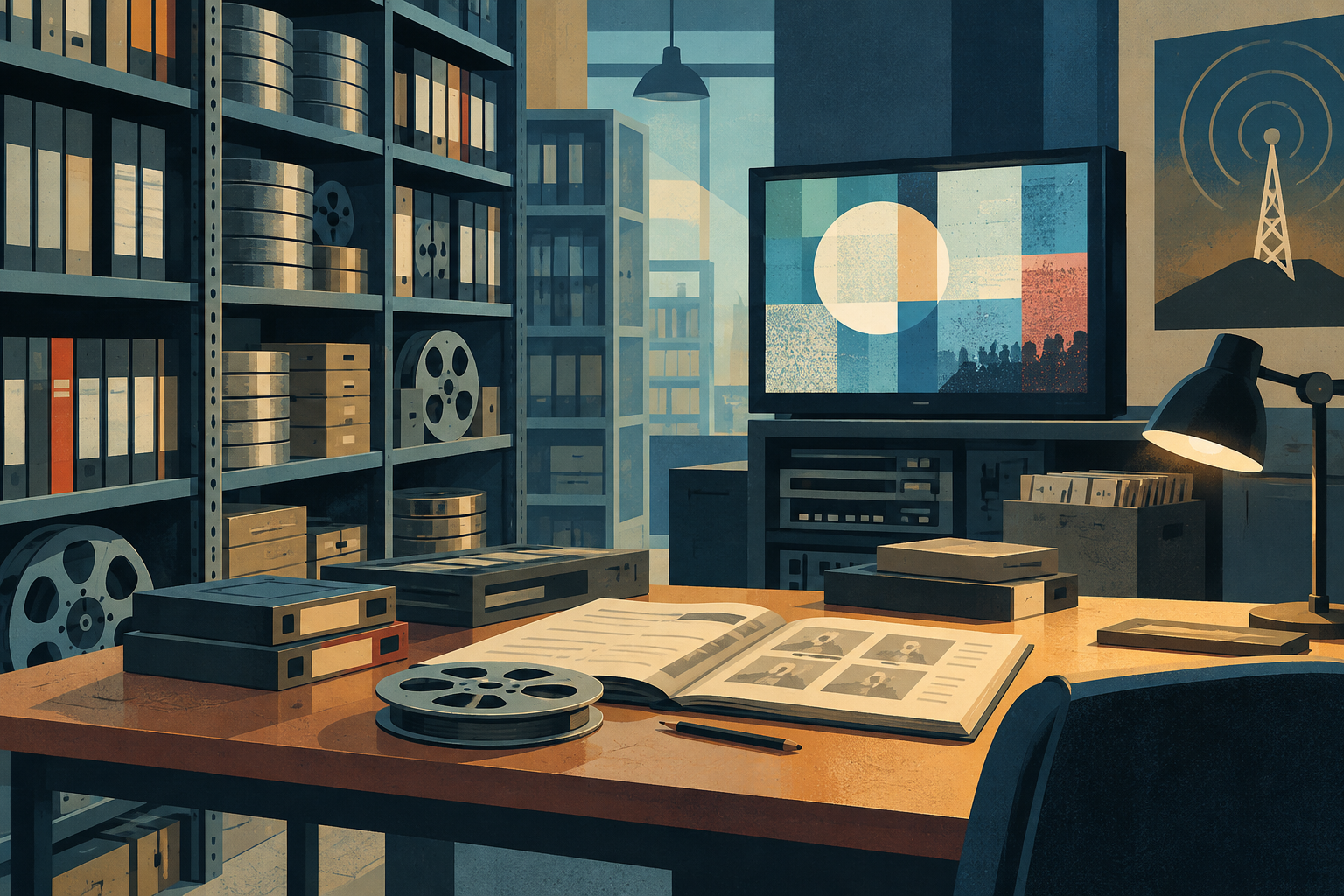
An archive is not a shelf of programmes
When television archives are discussed, attention usually falls on recovered broadcasts: a news report, interview, drama or event coverage. That view is understandable, but incomplete. A television archive brings together audiovisual documents as well as the equipment, descriptions and contexts that make them interpretable. Its value does not rest only on an image being viewable again; it rests on that image being identifiable, situated and understood.
RTVE Archive information illustrates this breadth. It preserves millions of documents in different media and formats, alongside a photographic collection of more than 800,000 images. Those photographs include shoots, studios, workplaces, portraits, and social and cultural scenes. A broadcast should therefore not be read as an isolated item: it may relate to written documentation, production photographs, scheduling data and the medium’s technical history.
First key: separate content, medium and device
The first tool for visiting, researching or interpreting a collection is to distinguish three layers. Content is what was recorded or broadcast. The medium is the material carrier. The device is the technology that captured, recorded, played back or transmitted it. Confusing those layers reduces television to a screen and conceals the material labour behind every image.
RTVC’s museum in Colombia makes this point clearly. Its tour highlights cameras, outside-broadcast units, videotape machines and media, proposing audiovisual heritage as technical, institutional and cultural memory. The point is not that a machine matters merely because it is old. Technologies shaped what could be recorded, where it could be made, how material circulated and what work was required of professional teams.
When facing an exhibited camera or videotape machine, ask: what was its role in production, which media did it use, what kind of record did it enable, and who needed to operate it? When an exhibition answers those questions, an object becomes evidence of how television was made rather than retro scenery.
Second key: follow preservation history, not only broadcast history
Images did not survive automatically. RTVE states that its oldest preserved recordings date from the late 1950s and that regular preservation of Televisión Española’s own production began in 1962. From the 1980s onward, according to the same source, the process was systematic. This chronology prevents a common assumption: that everything broadcast was necessarily kept under the same conditions.
Research hosted by Complutense University of Madrid adds an institutional milestone. Official archive policy at TVE began in 1968 with the creation of a Documentation Department in News Services, while a group-wide archival approach did not appear until the late 1970s. The study also identifies difficulties related to documentary volume, corporate structure and budget.
A rigorous reading acknowledges such discontinuities. Gaps, procedural changes and uneven holdings belong to archive history. They should not be filled with conjecture or treated as though a collection were a complete record of social life. A collection may be highly valuable while remaining partial.
Third key: seek the context around the image
Audiovisual documents can testify to historical and social events, but they do not explain themselves. RTVE describes its written documentation as material that complements and contextualises audiovisual and sound production. Its photographic holdings likewise reflect the history of public broadcasting and the country’s social, cultural and technological change.
This offers a practical rule: before drawing a conclusion from a clip, establish what is being seen, why it was produced, what date and provenance are documented, and what materials accompany it. A television image can inform us about its apparent subject, but also about formats, workplaces and representational conventions. Such readings require metadata and comparison, not personal recollection alone.
The RTVE Museum follows a similar logic by placing monitors showing historical milestones alongside devices. Joining equipment and image keeps technology connected to its period. It is a useful public model: show the apparatus, but also the cultural and institutional environment that gives it meaning.
Fourth key: understand preservation as access, responsibility and limitation
International recognition confirms that these holdings are not merely internal stores. Dialnet records that UNESCO recognised audiovisual archives as part of Humanity’s Cultural Heritage in 1980 and recommended their safeguarding. It also records FIAT/IFTA’s 2004 appeal and the UN-approved 2005 establishment of World Day for Audiovisual Heritage on 27 October.
Yet preservation is not simply storage. A text on the Archivo Histórico de RTA identifies a decisive tension: if materials lose cultural value and are governed only by market rules, preservation may be endangered; if they have high economic value, preservation may be better assured while access is restricted. Heritage therefore combines custody, description, resources, public policy and actual opportunities for consultation.
Digitisation belongs to this history, but does not justify imagining an absolute solution. RTVE explains that computer systems introduced in the Archive in the 1980s and digitisation of RNE production and broadcasting in the 1990s enabled complete preservation of broadcasts. This documents a major transformation in that case, not a universal guarantee for every archive or medium.
Fifth key: compare cases without erasing differences
Examples from Spain, Colombia and Argentina show that audiovisual memory depends on specific institutions and contexts. RTVC describes its museum as a developing space, available through guided visits, that offers a critical reading of Colombian public television and radio. Its approach connects devices with shared memory rather than a collection of curiosities.
The Dominican Cinematheque offers the other side of that ambition. The Censo-Guía de Archivos de España e Iberoamérica states that the institution, founded in 1978 as the National Cinematheque, closed in 1986 and remained closed for ten years; much of the film that formed its documentary source was lost during that period. The evidence does not allow every cause to be explained or the loss to be quantified here, but it does establish one lesson: institutional continuity matters.
Conclusion: viewing television through its memory infrastructure
Reading television archives as cultural heritage means changing scale. Broadcasts matter, but so do cameras, media, documentation systems, custodial institutions and the decisions that enable access. Museums and archives can turn this infrastructure into public knowledge when they connect objects to documents and production contexts.
Nostalgia may open a door, but it is not enough as a method. A responsible approach asks what is preserved, from when, through which procedures and with what limits. Television then becomes more than a memory of what was watched: it becomes a material and institutional system through which a society produced, organised and transmitted its own images.
- Decade
- 2000s
- Region
- Latin America
- Level
- Technical
- Entities
- No linked entities
Sources and references
- Museo RTVE. Un acercamiento único a nuestra historia a través de la tecnología televisiva. - TM Broadcasttmbroadcast.es · 2026-09-17
- ¿Qué conservamos?www.rtve.es · 2026-09-17
- Preservación del patrimonio audiovisual de televisión El archivo de Televisión Española (TVE): de los orígenes a la digitalización | Documents - Universidad Complutense de Madridproduccioncientifica.ucm.es · 2026-09-17
- Preservación del patrimonio audiovisual de televisión El archivo de Televisión Española (TVE): de los orígenes a la digitalización - Dialnetdialnet.unirioja.es · 2026-09-17
- Censo-Guía de Archivos de España e Iberoaméricacensoarchivos.cultura.gob.es · 2026-09-17
- Tecnologías de la memoria: el museo y el archivo de RTVCwww.senalmemoria.co · 2026-09-17
- El archivo en contexto | El Archivo Histórico de RTAwww.teseopress.com · 2026-09-17
