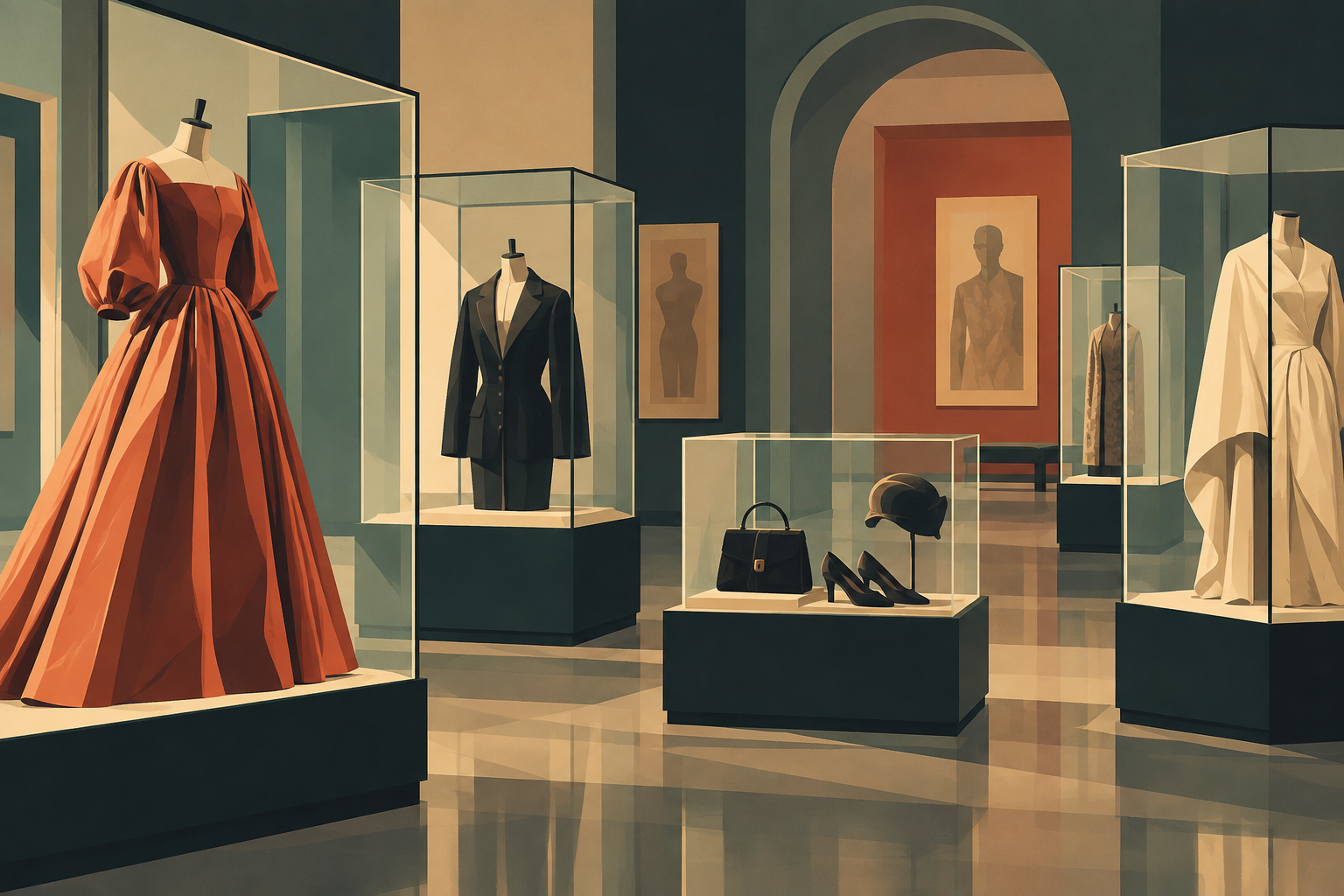
A garment in a display case may seem still, but it is not an object without a history. Its shape records choices of design and construction; its materials and wear may retain traces of use; and its placement beside other pieces creates an interpretation. When clothing enters a museum, its relationship with the body and everyday life changes. It becomes something to be observed, described and preserved. That change helps explain why fashion can be cultural heritage, but it also prompts questions about who chooses the story and what is left out.
From everyday object to heritage
Clothing is worn, altered and discarded. The museum interrupts that cycle by preserving objects that might otherwise have deteriorated or disappeared. The Museo del Traje describes its fashion and dress collection as a substantial holding of nearly 30,000 pieces, including regional dress, works by Mariano Fortuny y Madrazo, and creations by Cristóbal Balenciaga and Pedro Rodríguez. The institution also says it holds Pedro Rodríguez’s complete documentary archive, covering his work from 1940 to 1978. These details show that a fashion collection can bring together objects and documentation, not only striking garments.
A large collection does not mean that everything can be displayed at once. The display case presents a selection shaped by the condition of objects and by curatorial decisions. The academic study of textiles in Spanish museums notes that clothing and accessories have acquired aesthetic value in their own right and can be presented as cultural objects. It also describes conservation principles that seek to respect the original and preserve the history carried by it.
An exhibition history, not a straight line
Fashion’s place in museums developed over time; it was not accepted immediately or uniformly. A thesis abstract on fashion in museum spaces identifies the group exhibition Fashion: An Anthology, organized by Cecil Beaton in 1971, as a significant step. It also notes that in March 1982 Artforum put Issey Miyake’s Rattan Body on its cover, a wearable piece made with bamboo artist Koshige Shochikudo. These are milestones reported by that research, not evidence that every institution adopted the same position at the same moment.
In Spain, the academic study of textiles mentions Tras el espejo. Moda española, held in 2003 at the Museo Nacional Centro de Arte Reina Sofía. The reference links fashion to an art-exhibition setting, but the material available here is not enough to reconstruct the exhibition’s selection, installation or public reception. It is important to distinguish a documented exhibition from broader conclusions one might draw from it.
The display case interprets, too
A garment may appear to speak for itself, but its meaning depends on how it is presented. Its position, the label, neighboring objects and whether its inside or reverse can be seen all shape what visitors can infer. Dress can suggest techniques, ways of dressing or aesthetic values; without documentation, however, assigning a precise intention to a particular object would be speculative.
Fashion museology has also faced criticism. The thesis abstract identifies tensions between the commercial interests of companies and designers and museums’ institutional role. It raises questions about curatorial independence and the need for research, archives and educational content. These issues are not unique to fashion, but they become particularly visible in a field closely connected to brands, authorship, trends and consumption.
Conservation sets limits and makes display possible
Conservation is not an afterthought to exhibition. A garment’s condition affects what can be shown and how. An article by Culturas de Moda, drawing on conservation discussions, explains that the condition of dresses shaped the narrative of the exhibition Death Becomes Her. This concerns a particular exhibition and should not be treated as a universal rule; it does, however, show that conservation can influence curatorial storytelling.
The same publication describes the Brazilian “Replicar” project. Because the original dress belonging to a countess was not in a condition suitable for display, a replica was made, and digital images of the dress and the process were produced. A replica can make a form visible when the original cannot be shown, but it is not a substitute for the historical object. Clearly distinguishing original, replica and documentation is essential to helping visitors understand what they are seeing.
Archives extend what a garment can tell us
Documents associated with clothing can help place an object in context and prevent its story from resting on appearance alone. In the Museo del Traje example, the coexistence of garments and Pedro Rodríguez’s documentary archive points to the value of studying objects alongside working materials. The available source does not describe the contents of every document, so it cannot support claims about the precise questions they answer. It does support the importance of preserving and connecting records with collections.
This relationship opens a reading beyond silhouette: fashion enters the museum as material object, practice and system of meanings. Yet those dimensions are not automatically represented in full. Collections depend on acquisition, survival and institutional decisions; an exhibition therefore never amounts to a complete history of how a society dressed.
What the display case cannot settle
A museum can give garments and accessories cultural visibility, but displaying them does not resolve questions of selection, access and context. Nor can it, by itself, recreate how clothing moved on a body or what it meant to the people who wore it. A display case preserves and makes visible, but it also separates an object from its use. Photographs, archives, documented testimony and reproductions can broaden interpretation, provided they are clearly identified and not confused with the original.
Fashion in the museum is compelling precisely because of this tension. A garment becomes more than a used thing, yet it retains traces of its function and the controversies surrounding its representation. Reading it as heritage means attending to its material qualities, the available documentation and the decisions that bring it before the public. The display case does not close its history; it sets the conditions from which further questions can be asked.
- Decade
- 2000s
- Region
- Spain
- Level
- Enthusiast
- Entities
- Museo Nacional Centro de Arte Reina Sofía, Museum, Museo del Traje
Sources and references
- Moda e indumentaria - Museo del Traje | Ministerio de Culturawww.cultura.gob.es · 2026-09-26
- Los tejidos en las colecciones de los museos españoles, una ...revistas.ucm.es · 2026-09-26
- Resumen de La articulación de la moda en el espacio museístico en el cambio de milenio - Dialnetdialnet.unirioja.es · 2026-09-26
- Moda – EVE Museos + Innovaciónevemuseografia.com · 2026-09-26
- Una historia de la moda en los museos – Culturas de Modaculturasdemoda.com · 2026-09-26
- La moda en la historia - Museo del Trajemuseodeltrajevirtual.com · 2026-09-26