Conservation also happens beyond the gallery
A display case shows a selection, but it cannot by itself explain how an entire collection is cared for. The Museo Nacional de Artes Decorativas describes conservation as a task integrated into the institution’s operations, intended to preserve both the physical integrity of its collections and the historical and artistic information they convey. This definition shifts attention from visible treatment of an individual object to broader work: organizing, reviewing, documenting and enabling objects to be handled safely.
That distinction matters. Restoration is often imagined as a specific action performed on an object showing deterioration. Preventive conservation is better understood as continuous practice. The Museum Internacional publication on preventive conservation describes it as a systematic, responsive process of maintenance and improvement, and says it requires an institutional policy rather than an improvised response. The absence of a conspicuous intervention, then, does not mean that conservation work is not taking place.
Storage reflects practical decisions
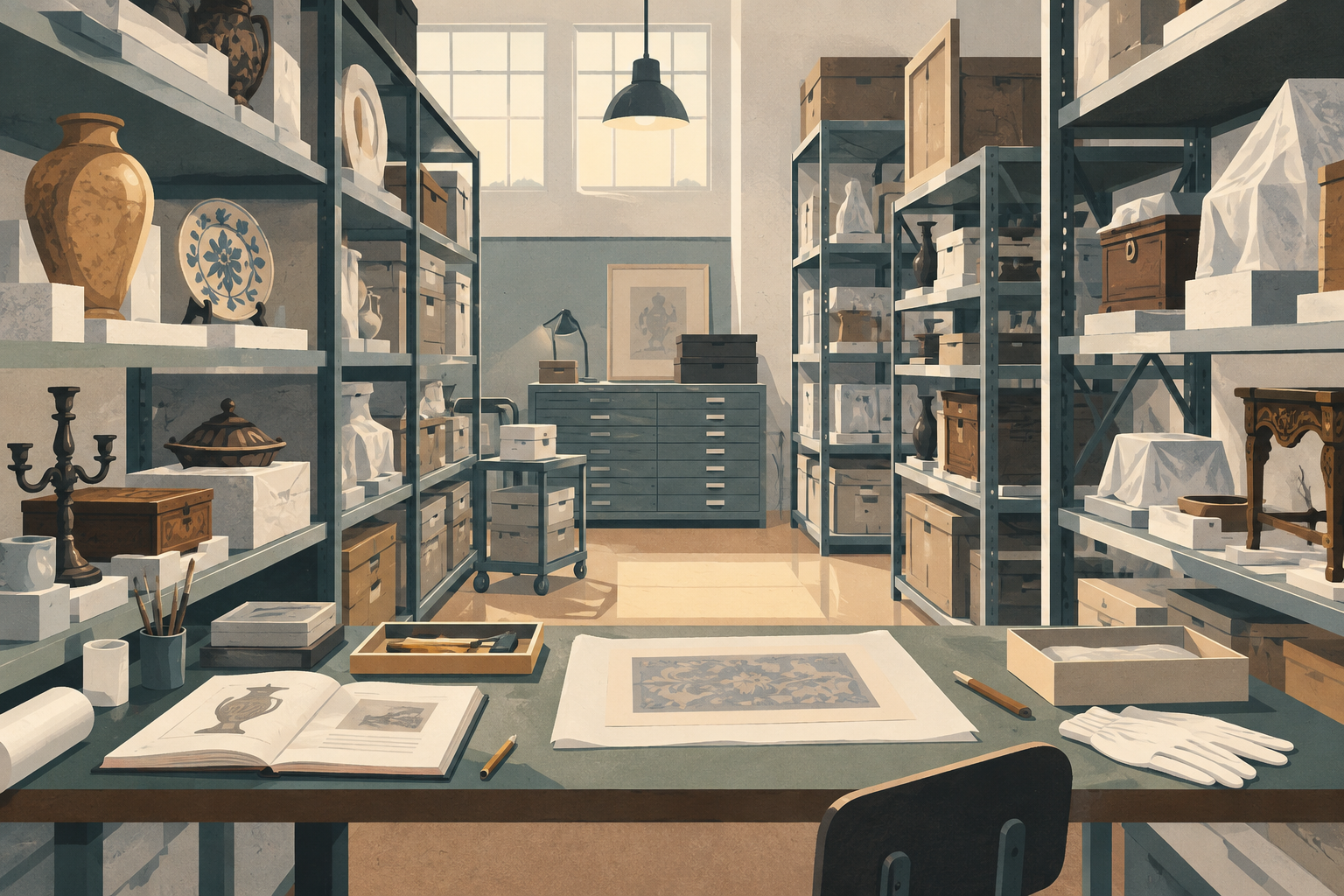
Organizing storage is not simply a matter of using every available centimetre. The Museo Nacional de Artes Decorativas says it reviews its collections and optimizes storage spaces to accommodate growth, improve conservation conditions and, especially, make objects more accessible. Storage is therefore part of the infrastructure that makes it possible to study, care for and consult collections.
The museum also explains that size and fragility affect how objects are positioned and removed: large, heavy pieces should be placed low enough not to require a ladder; small, fragile ones may need special supports, trays or boxes that allow them to be moved more quickly and securely. These guidelines show how the object’s safety and staff safety are connected to ordinary organizational decisions. They are not decorative details of a storeroom, but criteria for access and handling.
Documentation makes comparison possible
Conservation depends on observation over time. The museum says condition reports are accompanied by photographs and, whenever possible, maps of observed changes. It also notes that analytical techniques help identify materials and construction methods, understand changes and detect damage, and that collections require ongoing review and documentation.
A monitoring photograph does not replace examination of an object, but it provides a reference against which changes can be recognized. A condition map makes the locations of recorded observations visible. Together, these tools turn inspection into information that can be consulted later. This kind of care is less dramatic than restoration, but essential to deciding what an object needs and how to act without confusing observation with assumption.
Documentation is not separate from the object, either. Guidance on archive management issued by the Government of Navarra stresses that documents providing context for collection objects are inseparable from them and should remain within the institution. The associated record helps preserve provenance, history and observations; without that context, an object may remain physically present while losing part of what makes it understandable.
Preservation does not always mean intervention
Conservation and restoration are related, but they are not interchangeable. The Castilla-La Mancha cultural portal describes conservation-restoration as a discipline that assesses, establishes and carries out measures to stabilize and slow the deterioration of heritage objects. It also notes that the required specialization depends on the materials. This supports a cautious principle: there is no single recipe for every object, and treatment should respond to each piece’s nature and condition.
In his chapter on the conservation and restoration of museum collections, Francisco Javier Zubiaur Carreño places conservation among a museum’s central functions and discusses agents of deterioration and environmental factors. His chapter on documentation adds that catalogues may record condition, treatments, biography, bibliography and related incidents. Together, these approaches help explain why documentation and prevention are not secondary tasks: they inform decisions and record what has been done.
What storage makes it possible to tell
The organization of a collection also shapes what can be learned from it. If an object can be located, handled safely and is accompanied by records, it can be reviewed and studied more readily. This follows from the museum’s published principles on accessibility, storage and documentation; it does not mean every object is always available for consultation or that all collections have identical conditions.
That limitation matters. The available sources describe general principles and practices, but do not provide a complete object inventory, storage plan or comparable outcome data. They do not support claims about a specific treatment of a particular object. They do support the conclusion that caring for a decorative-arts collection begins before it reaches a display case: in the arrangement of spaces, careful handling, recording change and preserving the information attached to each piece. The exhibition shows one part of a museum; the quieter work that supports it allows that part to keep its meaning.
- Decade
- 1990s
- Region
- Spain
- Level
- Introduction
- Entities
- Museum
Sources and references
- Conservación - Museo Nacional de Artes Decorativas | Ministerio de Culturawww.cultura.gob.es · 2026-09-26
- Capítulo 9 - Conservación y restauración de los fondos museísticos. Criterios admitidos. Agentes destructores. Incidencia de los factores ambientales en la conservación de los bienes cultures. - Fco Javier Zubiaur Carreñowww.zubiaurcarreno.com · 2026-09-26
- Museum Internacional No 201 (Vol LI, n° 1, 1999) Conservación preventivawww.ibermuseos.org · 2026-09-26
- instrucciones para la gestión y organización de archivos ...www.navarra.es · 2026-09-26
- Estudio y documentación - Museo Nacional de Artes Decorativas | Ministerio de Culturawww.cultura.gob.es · 2026-09-26
- La importancia de la conservación y restauración del patrimonio cultural. ¿Qué es la restauración? | Portal de Cultura de Castilla-La Manchacultura.castillalamancha.es · 2026-09-26
- Capítulo 10 - El museo como centro de investigación. La necesidad de documentar las piezas en el museo. Tendencias documentales actuales. Normalización y gestión integral del museo. - Fco Javier Zubiaur Carreñowww.zubiaurcarreno.com · 2026-09-26