A change of scale, not an automatic story of progress
The 1990s repeatedly appear in accounts of contemporary board gaming. The presentation for Encrucijadas del juego de mesa. Historia, cultura e industria argues that the industry underwent its greatest transformation from that decade onward, linked to popularisation and a wider supply. Shangrila’s blog makes that description more concrete through Eurogames, festivals, and crowdfunding projects. This is a useful lead, but it is not, by itself, a worldwide measurement of production, audiences, or sales.
It is therefore wiser to speak of a change in scale and visibility than of the total replacement of everything that came before. Family games, card games, local traditions, and toy-linked products do not vanish from the picture. What changes, according to these sources, is the sector’s ability to multiply proposals and to generate a vocabulary through which designers, publishers, players, and researchers can discuss them.
Eurogames: a useful but contested label
Shangrila’s blog names Settlers of Catan, Carcassonne, and Ticket to Ride when referring to the popularisation of Eurogames. This allows us to recognise that particular titles became reference points in discussion of modern board games. Yet the same source warns that the expression “modern board games” produces terminological conflict.
That caution matters. A label can help a newcomer navigate the hobby—for instance, toward designs where rules, duration, interaction, and theme combine differently from familiar family classics—but it does not describe an unchanging essence or a precise boundary. Nor does it allow us to infer that every game published in Europe followed one model. In responsible historical writing, “Eurogame” should be a category of circulation and debate, not a final judgment on the quality or origin of any work.
The board as material object and social experience
The importance of the 1990s is not confined to individual titles. The Encrucijadas presentation proposes studying mechanics, narratives or metaphors, played worlds, simulated contexts, and the importance of physical materiality, including its transformation into digital media. That framework helps us see a game as more than a rulebook.
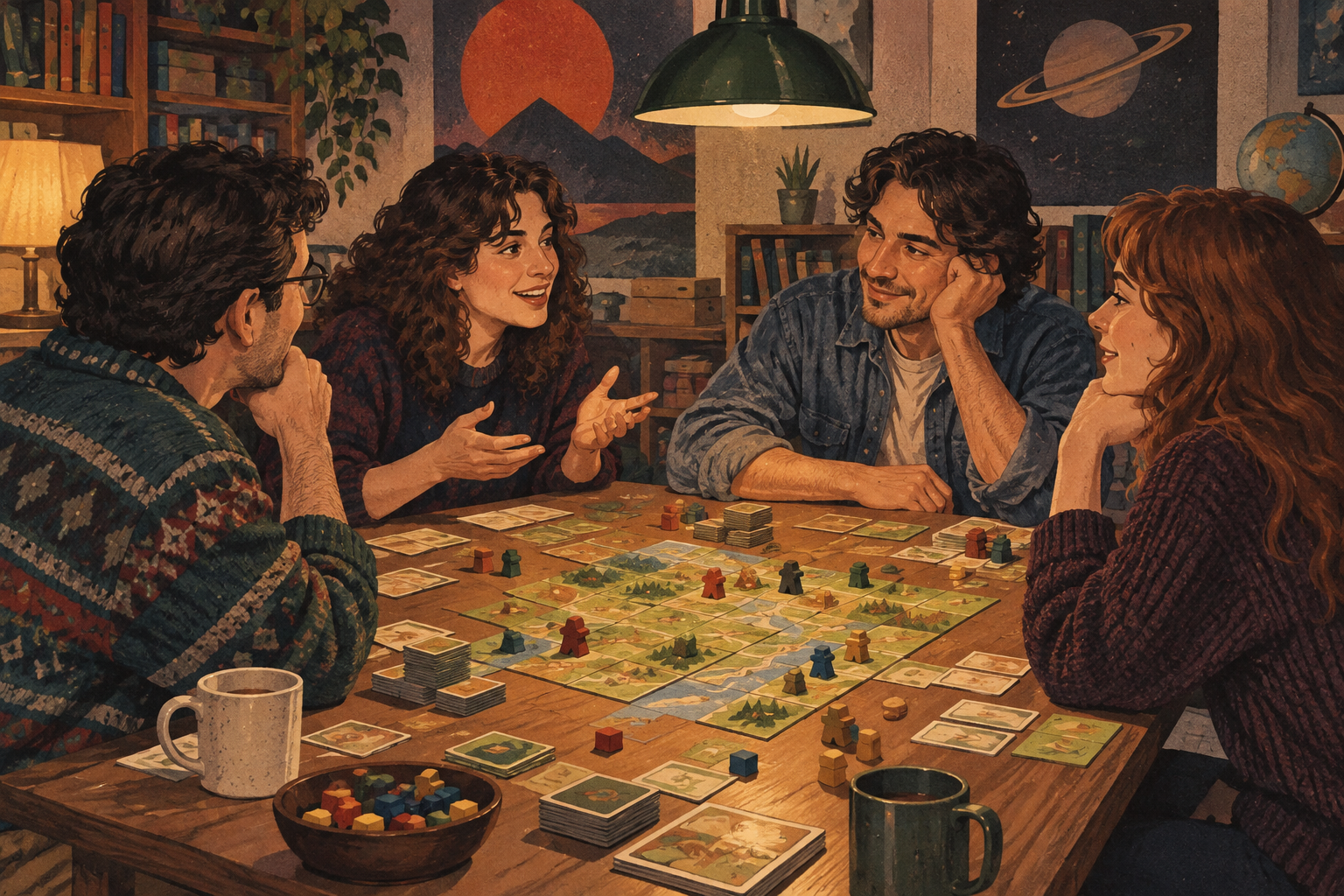
At the table, decisions take shape through pieces, cards, resources, markers, illustration, and conversation. The experience includes learning rules, negotiating their interpretation, waiting for a turn, reading other participants’ reactions, and packing the game away. Design therefore affects sociability: visual clarity may ease learning, a confusing layout may obstruct it, and a negotiation mechanism changes the mood of play. El Correo uses Diplomacy as an example in which verbal agreements and possible betrayal are central. It is not evidence of a universal trend, but it does remind us that games can arrange relationships among people, not merely moves on a board.
Fairs, popular writing, and a wider public
Shangrila’s blog links the new context to festivals, naming Essen’s Internationale Spieltage, and to the later rise of crowdfunding platforms. Such spaces matter because they make games visible: they can present new releases, enable comparisons between designs, form communities, and support debate about standards of value. A fair does not create an audience on its own, but it provides an infrastructure through which an audience can recognise itself.
Written mediation also grows. Jugamos Todos describes a general history that mentions more than one thousand games and gives roughly 144 references varying in length. That figure does not validate every interpretation, but it shows the ambition involved in assembling a highly scattered field. Xataka approaches games through historical and literary themes; its method illustrates how popular writing can enter through a recognisable setting before turning to rules.
The problem of documenting Spanish history
The research hosted on Academia.edu is especially useful for what it does not claim. In examining twentieth-century Spain, it notes missing data for both defunct and active companies and a lack of centralised records; it therefore acknowledges frequent reliance on oral transmission, with possible inaccuracies. It also describes board games as a cultural phenomenon long treated as an accessory product of the toy trade.
This limitation should alter how we collect and narrate. A surviving box, advertisement, catalogue, receipt, or dated rulesheet can be important evidence, but it cannot automatically establish print runs, exact national release dates, corporate authorship, or social reception. Missing archives do not prove that activity was absent. They also require a distinction between personal memory, publishing chronology, and verifiable evidence.
Legacy: studying without turning a hobby into myth
On the available evidence, the 1990s strengthened an ecosystem of supply, gathering, and reflection. There is no need to turn the decade into an absolute origin in order to acknowledge its importance. Shangrila’s texts place game study among history, industry, mechanics, narrative, and social use; the work on Spain reminds us that such history requires method and documentary humility.
For enthusiasts, the practical consequence is straightforward: playing and preserving can also be ways of observing. Recording an edition, language, provenance, components, and acquisition date helps prevent one particular copy from being mistaken for a complete history. The best conclusion is not that there was an unquestionable golden age, but that board games acquired stronger tools for speaking about themselves from the 1990s onward. Much remains to be documented before that conversation can become a fully settled history.
- Decade
- 1990s
- Region
- Global
- Level
- Enthusiast
- Entities
- No linked entities
Sources and references
- Encrucijadas del juego de mesa. Historia, cultura e industria – Shangrilashangrilaediciones.com · 2026-09-16
- textos en red - shangrila-blog: II. ENCRUCIJADAS DEL JUEGO DE MESA. HISTORIA, CULTURA E INDUSTRIA", Jan Gonzalo Iglesia (ccord.), Valencia: Shangrila, 2024.www.shangrila-blog.com · 2026-09-16
- La historia mundial, contada con juegos de mesa: del Paleolítico a la Era Espacialwww.xataka.com · 2026-09-16
- Breve historia de los juegos de mesajugamostodos.org · 2026-09-16
- (PDF) Acercamiento a las eras de la historia del juego de mesa en España: Siglo XXwww.academia.edu · 2026-09-16
- Los mejores juegos de mesa para amantes de la historia | El Correowww.elcorreo.com · 2026-09-16
