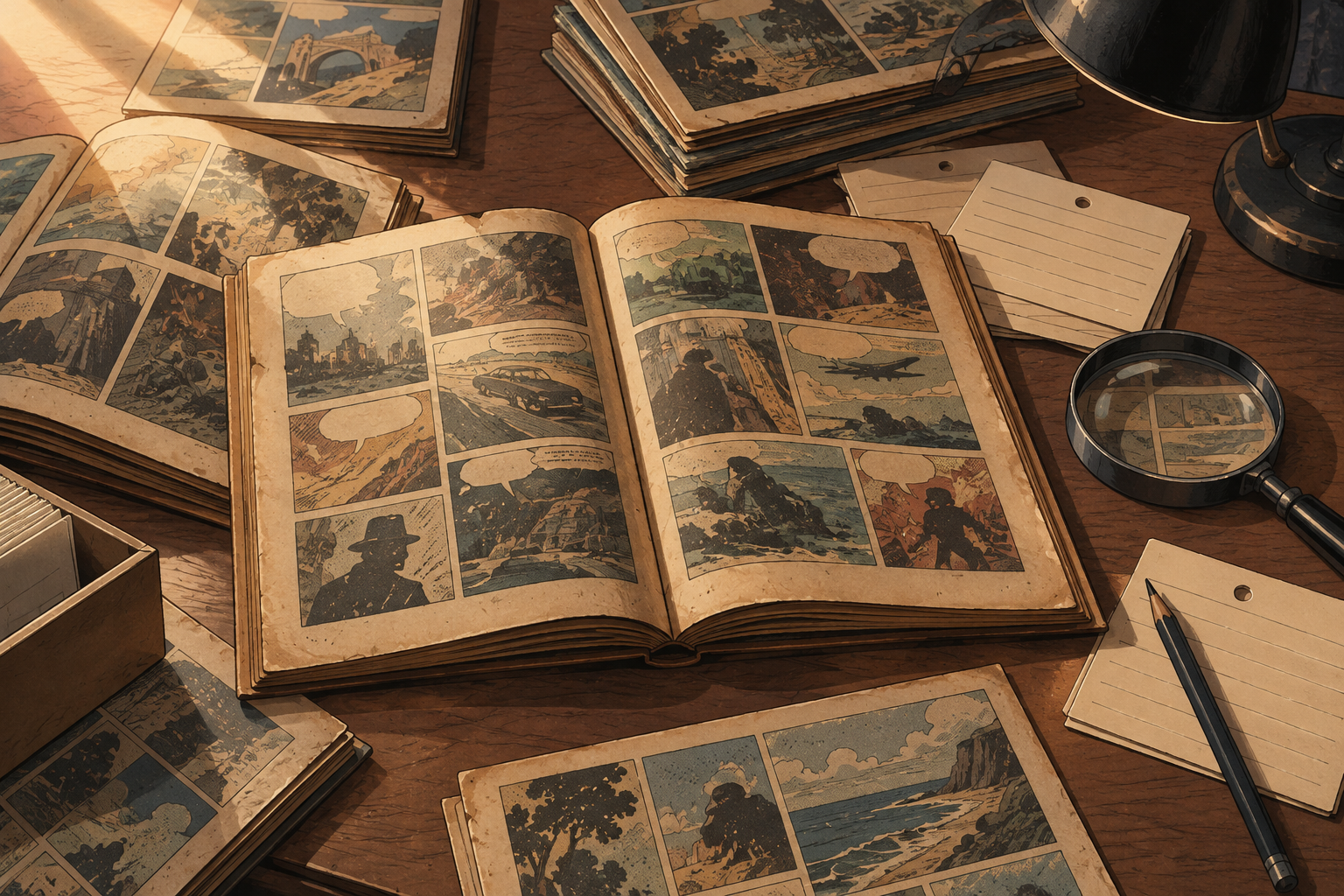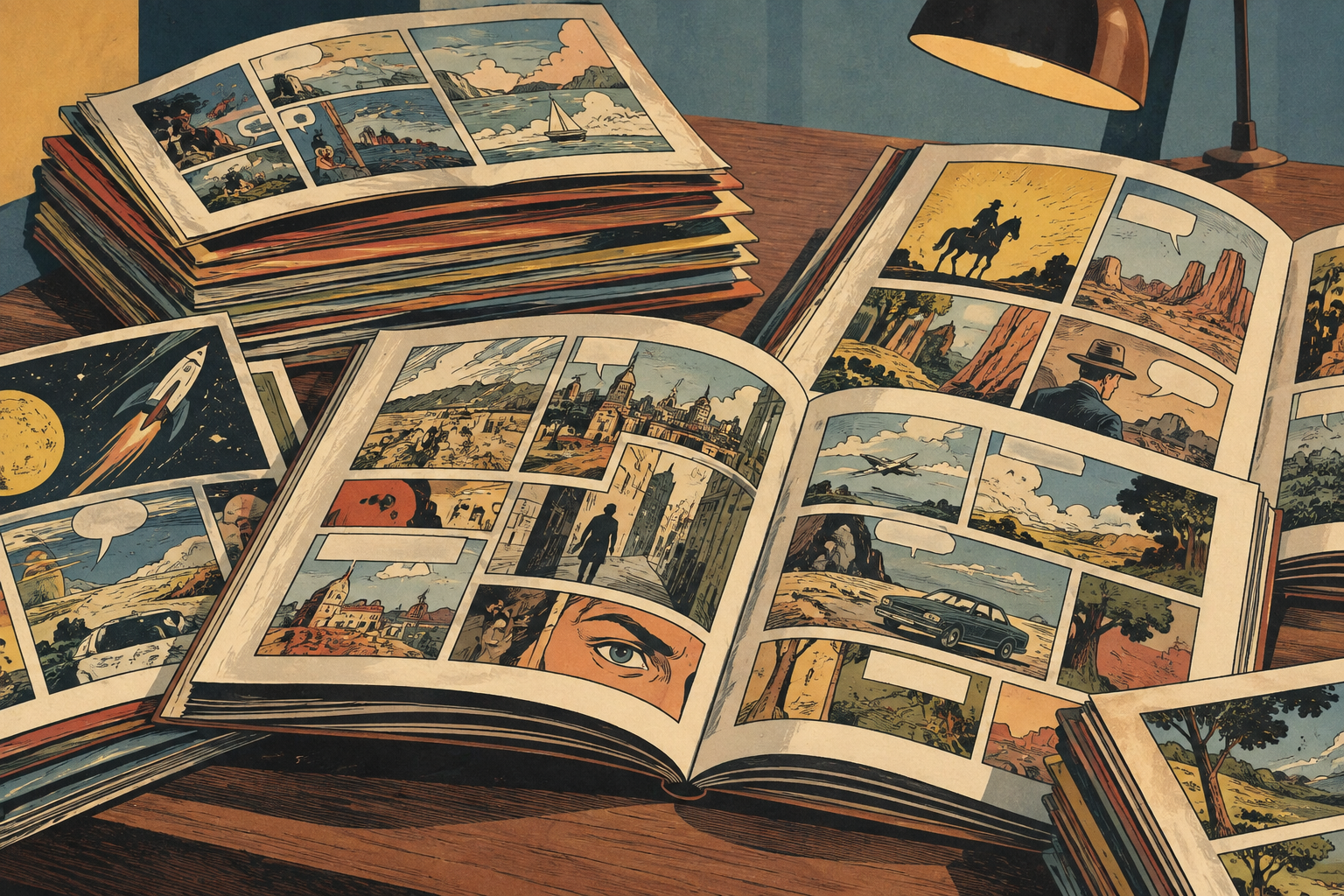
Comics history is often told through characters, creators or publishers. It can also be approached through a more material question: what kind of object did readers find the panels in? A story published in instalments in a magazine, a later collection and an album do not offer exactly the same experience. They change the unit of reading, the publication rhythm and the way stories reach an audience. The available sources reveal some of these shifts, although they do not provide a complete or universal chronology.
A history that changes with the format
Rubén Varillas addresses the issue directly in his study of comic magazines, fanzines, mini-comics, albums and graphic novels. The range of forms he lists helps avoid a common simplification: “comics” do not mean a single kind of publication. Format shapes how a story is presented, but also what is preserved and what becomes visible when its history is reconstructed.
A story in instalments may first appear in a magazine and later be gathered into an album or graphic novel. Alberto Albarrán notes that this practice was common in certain periods, and points out that his visual history dates some works to their first appearance or character creation, while others are placed according to a later collected edition. This is an important methodological caution: a date associated with a work may refer to different points in its publishing history.
Early Spanish publications
The chronology provided by the La Rioja Library dates Chiquilín to 1924 in Madrid, describing it as a high-quality publication that served as an advertising vehicle for Federico Bonet, a manufacturer of children’s pharmaceutical products. For 1925, it mentions Pinocho, published in Madrid by Saturnino Calleja, and states that major American comics began appearing there for Spanish readers.
These examples cannot by themselves reconstruct the Spanish market, but they do show that publications containing comics could serve different purposes. The source emphasizes a promotional connection for Chiquilín and a role as a channel for American comics for Pinocho. Those observations should remain distinct; two references do not constitute a complete history of children’s periodicals.
The comic book and original material
An Infobae feature identifies Famous Funnies, published in 1934, as the comic book commonly recognized as the first original one. It connects its appearance with the idea of offering a comic magazine containing material attractive to the whole family. The same source distinguishes this project from earlier collections of newspaper strips and describes how publications containing entirely new material followed in 1936–1937.
The distinction is useful: collecting previously published material and producing new comics for a magazine are different editorial operations. This account should not, however, be treated as a definitive definition of “first” across all comic traditions. The term and the criteria for priority can depend on what counts as an original comic book.
The magazine as a reading form
Jot Down recalls the general definition of a magazine as a periodical publication and argues that the comic magazine is a specialized publishing form whose shape and contents have changed over more than a century. This is a broad characterization, not a complete inventory of titles or readers.
Periodical publication can also allow a story to appear in chapters before it is collected. That sequence creates two possible units of reading: the issue encountered first and the volume that may later gather several parts. We need not assume that every reader followed both stages, or that every story moved from magazine to album, to recognize that format affects circulation.
A format with a smaller market presence
Jot Down states that in recent decades the magazine format has occupied a very small place in the market. It mentions 2019 releases such as Alta Tensión and Planeta Manga, and La Resistencia closing a cycle with its tenth issue. These details support discussion of recent change, but they do not identify a single cause or measure the whole market on their own.
The presence of recent publications alongside the claim of a reduced position shows that “reduced” does not mean “gone.” It also reminds us that a publishing chronology should distinguish the continued existence of a format from its relative position among other ways of publishing.
What can and cannot be concluded
The Museu del Còmic i la Il·lustració describes a documentary collection that includes satirical press, weekly publications, children’s press, comic booklets, magazines, graphic novels and original artwork. This range matters when considering preservation: comics survive not only as characters or plots, but also as publications and different kinds of editorial material. The institutional description, however, does not provide a detailed catalogue here that would allow specific copies or their provenance to be identified.
The sources support a limited conclusion: format is part of comics history, not merely a container. Magazines could publish new material, serialize stories or coexist with later collections; other publications combined comics with different functions. A more precise history would require accessible collections, comparable publishing data and sources from multiple countries. For now, looking at the printed object helps us ask better questions without mistaking partial examples for a universal rule.
- Decade
- Before 1950
- Region
- Global
- Level
- Introduction
- Entities
- No linked entities
Sources and references
- Historia visual del cómic, la novela gráfica, el manga y los tebeos – Alberto Albarránwww.albertoalbarran.com · 2026-09-27
- Las exposiciones de cómics. Historia y contexto global ...ebuah.uah.es · 2026-09-27
- Inicio - Museu del Comic i la ilustraciónmuseudelcomic.org · 2026-09-27
- Historia del cómic - Bibliotecas de la Riojabibliotecas.larioja.org · 2026-09-27
- Pasado y presente de las revistas de cómic – Jot Down Cómicscomics.jotdown.es · 2026-09-27
- Los increíbles orígenes de los cómics y cómo se convirtieron en una industria cultural - Infobaewww.infobae.com · 2026-09-27
- El cómic, una cuestión de formatos (2): revistas de cómics, fanzines, mini-cómics, álbumes y novelas gráficasdoi.org · 2026-09-27