More than one way into its history
Treating anime as a single style quickly leads to a dead end. The medium’s history includes shorts, series and feature films, and its production and storytelling practices have not stood still. The available sources place its beginnings in the early decades of the twentieth century, while also describing the later growth of companies producing animation for television and cinema. That variety matters: no single way of drawing, editing or telling a story can explain anime as a whole.
From television series to audiences abroad
The examples of Mazinger Z, Heidi and Marco, cited as productions that reached audiences beyond Japan, help illustrate the range of serial animation. International circulation does not mean that every work shares the same tone or purpose. It is more careful to treat these titles as evidence of circulation and variety than as a definitive list of milestones.
Ambiguity as a narrative device
A study of narrative ambiguity in postclassical commercial Japanese animation offers a framework for asking what a story leaves unresolved and how that uncertainty affects its audience. Ambiguity does not automatically equal depth, nor does it guarantee that a work is difficult. It is one narrative possibility. It may encourage viewers to reconsider what they have seen, hold several interpretations at once, or accept that no explicit answer is given. The effect depends on the particular work; the sources consulted do not justify assigning the same strategy to all anime.
What moves, and what stays still
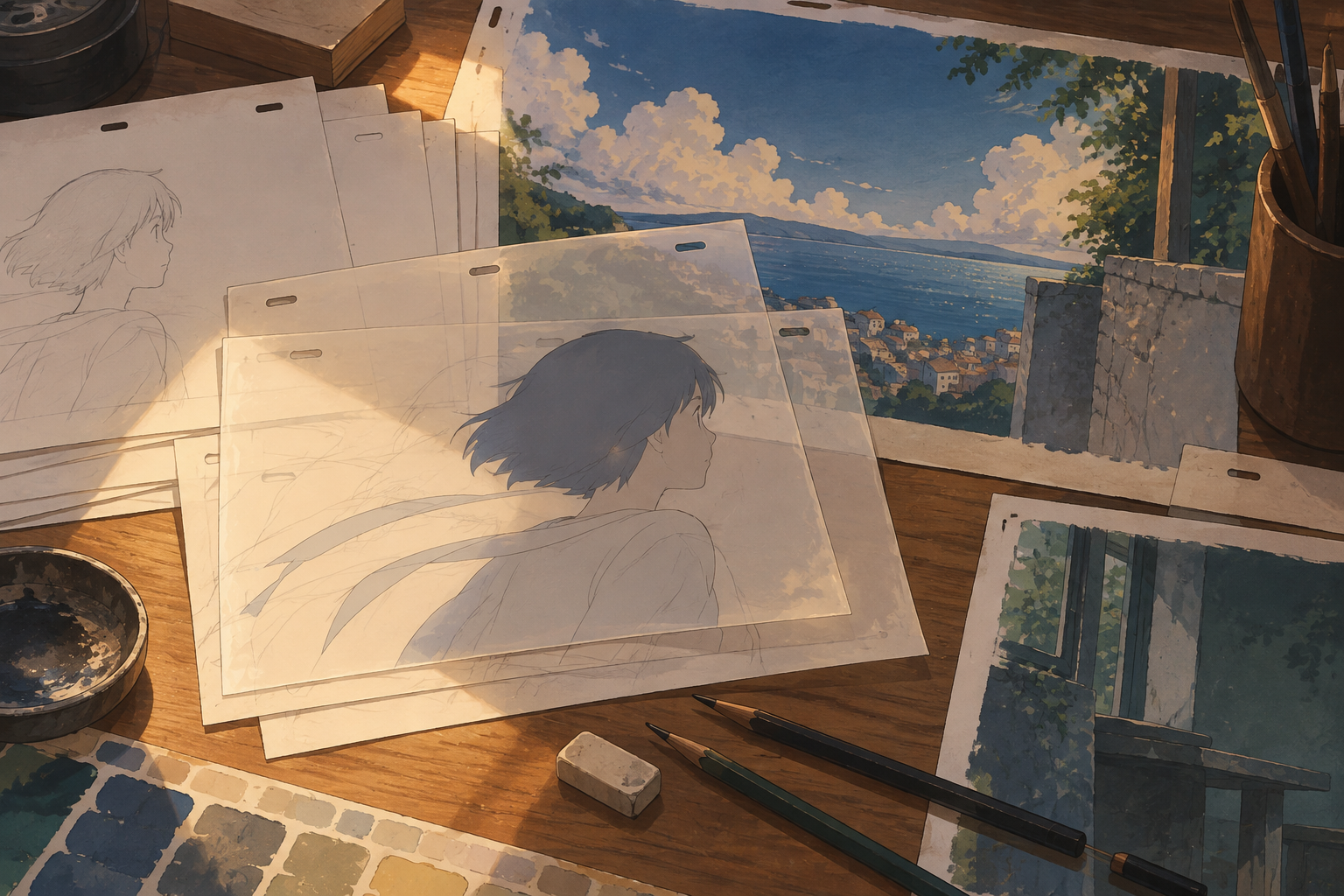
Animation can also choose where to concentrate movement. Research on selective animation in contemporary anime series draws attention to that formal choice: not every element needs to move constantly for a scene to communicate. Rhythm, composition and the shift between stillness and action can guide the eye. This should not be turned into a universal technical rule; the cited research addresses a specific question and does not, on its own, document every production method.
A medium and its communities
Reception cannot be explained solely by what appears on screen. The material on otaku culture describes the formation of fan communities and the growth of their presence from the late twentieth century. It is useful context, but a diverse subculture should not be mistaken for a uniform audience. Likewise, academic work on connections between manga, anime and literature invites discussion of media crossing paths; it does not show that every adaptation works in the same way.
What the evidence supports
The sources support the view that anime has a long history, has circulated in different formats and contexts, and is the subject of specific research into narrative ambiguity and the selective use of movement. They do not establish a linear progression from one technique to another, or an unchanging national style. The soundest reading is also the most open: examine the choices made by each work rather than letting the label “anime” stand in for analysis.
That approach gives viewers a simple, productive task: notice what is shown, what is held in suspension and which questions remain open. Sometimes a work’s way of telling its story lies precisely in what it chooses not to explain completely.
- Decade
- 2000s
- Region
- Japan
- Level
- Enthusiast
- Entities
- No linked entities
Sources and references
- Historia del anime - Wikipedia, la enciclopedia librees.wikipedia.org · 2026-09-26
- CIEN AÑOS AMANDO EL ANIME | FX Barcelona Film Schoolfxanimation.es · 2026-09-26
- Historia del Anime, ¡una locura a nivel mundial! desde sus orígenesikigaimatsuri.com · 2026-09-26
- Historia de la animación: los comienzos en el siglo XIXwww.esdip.com · 2026-09-26
- La narración compleja en el anime postclásico: La ambigüedad narrativa en la animación comercial japonesadoi.org · 2026-09-26
- El arte de la animación selectiva en las series de anime contemporáneasdoi.org · 2026-09-26
- Ver para leer: una lectura diacrónica para los cruces entre manga, anime y literatura universalopenalex.org · 2026-09-26
- Otakues.wikipedia.org · 2026-09-26