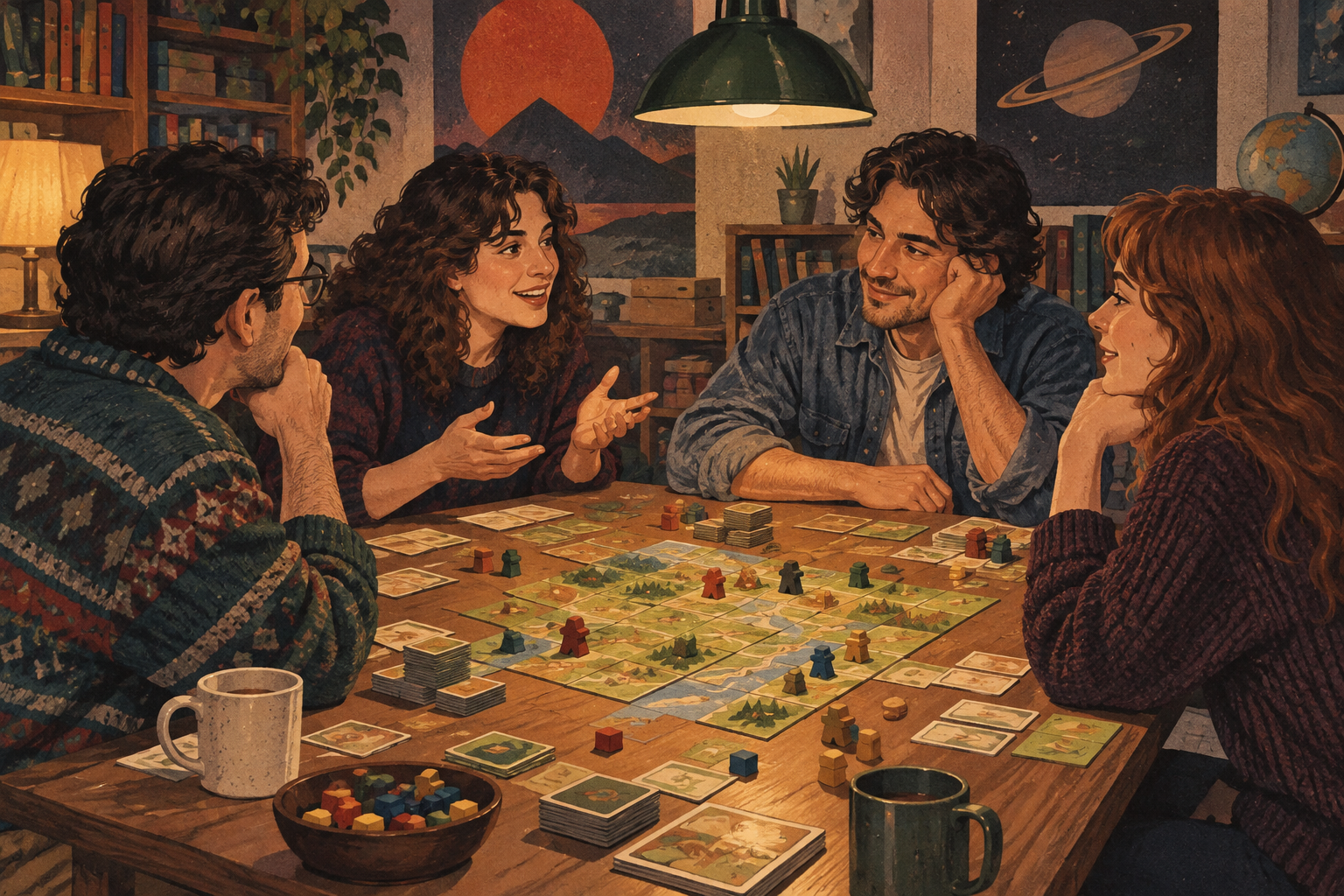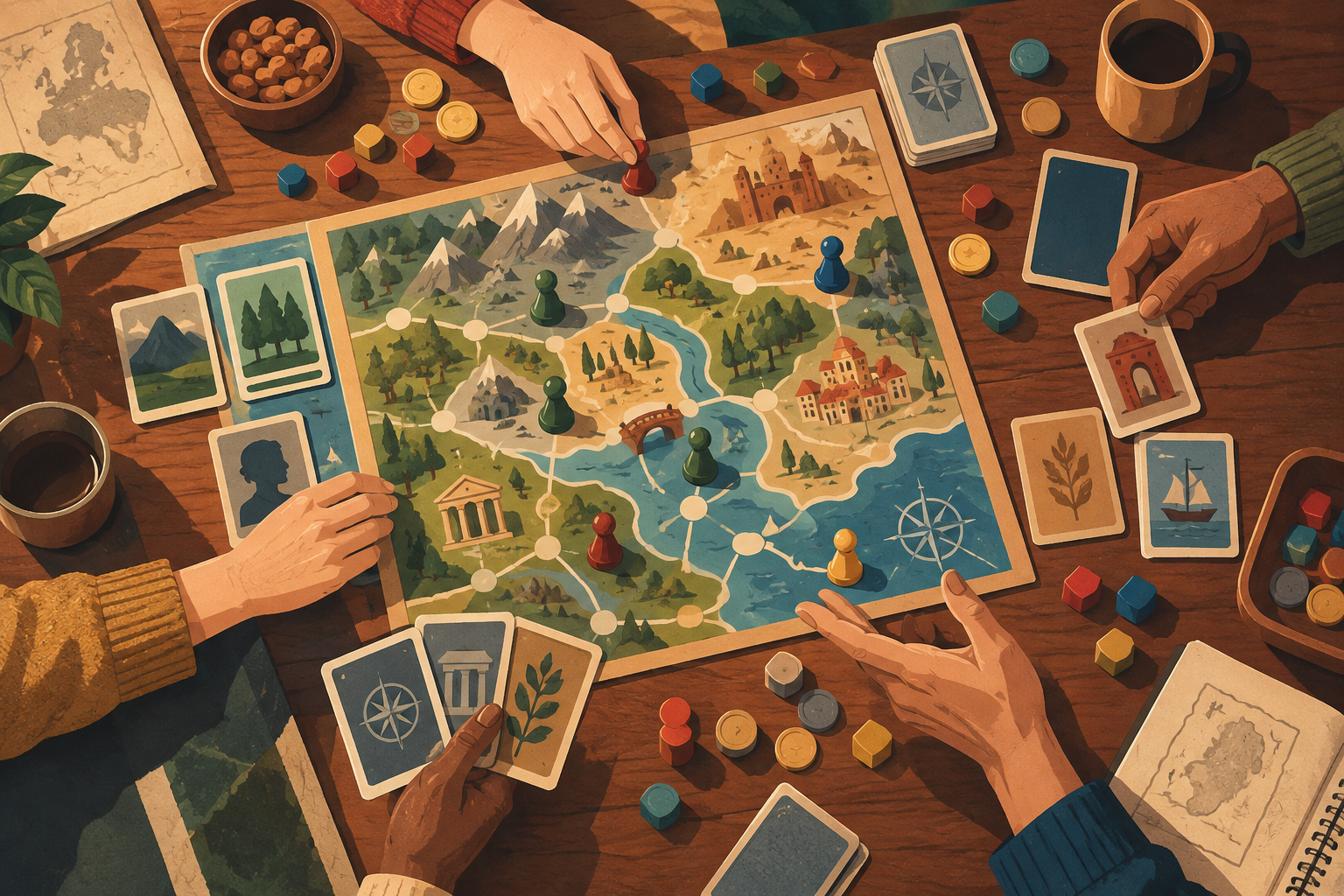
A board game does not explain the past in the way a history book does. It organizes it into permitted actions, goals and consequences: a limited representation, but one that can raise questions. Research on historical simulation games notes that a game system conditions the player’s scope for action. That observation invites us to read rules not as a neutral window, but as a constructed interpretation.
History within playable limits
In a simulation, players can make decisions, but only among the possibilities provided. Jan Gonzalo Iglesia’s chapter on historical-simulation board games addresses the relationship between a game’s context of creation and its view of the past; Xavier Rubio-Campillo’s chapter considers Spanish Civil War board games as public history and from the perspective of data science. The supplied titles and metadata do not allow us to summarize their findings, but they do show that historical games are a subject of academic study.
The editorial question is easy to ask and difficult to settle: which aspects of the past become decisions, and which remain outside the board? Theme and illustration are not enough. It also matters who gets to act, what counts as success, and which rules make an alternative possible—or unthinkable. These questions are a framework for reading, not claims about a particular game.
Teaching is not neutral representation
Alfonso Iglesias Amorín’s article in the journal Clío concerns the use of board games in teaching history. Its existence places games in an educational context, although the material supplied here does not describe its conclusions or methods. We therefore cannot claim that any particular mechanic improves learning. We can, however, recognize a useful tension: an activity may help organize events while simplifying complex processes to make them playable.
Simplification is not necessarily a flaw. It is a condition of the medium: a game needs rules that can be applied and decisions players can understand. But it is worth asking what that process leaves behind. An analysis of an educational game should distinguish between what its materials document, what its rules represent, and what players infer.
From product to cultural field
The history of board games is also connected to companies, authors, audiences and distribution. A history published by Jugamos Todos highlights a wave of creation that emerged from the late 1970s, with Germany as its centre, and discusses the development of so-called European-school games, eurogames or social games. On another page, the same site mentions Dalmau Carles Pla’s publication of games from 1970 and the continuation of its educational and television-programme-based catalogue. These are useful clues against reducing the medium to a list of famous rules.
The collective volume Encrucijadas del juego de mesa. Historia, cultura e industria describes the 1990s as a period of transformation, popularization and growing choice. Its description proposes studying mechanics, narratives, materiality and industry, among other subjects. That combination is productive: a box is at once an object, a cultural product and a set of instructions for play.
Catan as a reference, not a complete explanation
The supplied sources cite The Settlers of Catan (1995) as a well-known title from the late twentieth century. Corvus Belli presents it as a milestone and links its release to the development of eurogames. Zacatrus also lists it in an overview of games of the twenty-first century, although its available excerpt gives the date 1995. These accounts allow us to treat Catan as a recurring reference, not to credit it alone with transforming the entire industry.
A responsible history distinguishes the importance sources assign to a game from what they do not document. The supplied excerpts provide no sales figures, comparative data or first-hand accounts from players. Nor do they establish a single cause for the sector’s transformation. Caution does not make the story less interesting; it prevents a list of milestones from becoming a closed explanation.
Reading a game as a source
Board games can be studied through their rules, components, editorial text and historical context of production. The cited academic sources show that historical simulation and education are fields of analysis; popular and industry publications offer chronologies and examples, with different scopes. Reading them together helps separate documentation from interpretation.
A board does not contain the whole past. It contains a selection organized so that someone can play. That is precisely why it deserves attention: each possible choice and each limit can reveal a way of imagining history. The game ends; questions about representation, learning and memory can continue beyond it.
- Decade
- 1990s
- Region
- Global
- Level
- Enthusiast
- Entities
- Settlers of Catan
Sources and references
- Juegos aquí, antes y ahorajugamostodos.org · 2026-09-26
- (PDF) ¿Qué historia jugamos? Una aproximación al estudio de los juegos de mesa de simulación históricawww.researchgate.net · 2026-09-26
- Juegos de mesa: Evolución Históricacorvusbelli.com · 2026-09-26
- Encrucijadas del juego de mesa. Historia, cultura e industria – Shangrilashangrilaediciones.com · 2026-09-26
- ¿Qué historia jugamos? Una aproximación al estudio de los juegos de mesa de simulación históricadoi.org · 2026-09-26
- La aplicación de los juegos de mesa en la enseñanza de la Historiadoi.org · 2026-09-26
- Los juegos de mesa de la guerra civil española como historia pública: una aproximación desde la ciencia de datosdoi.org · 2026-09-26