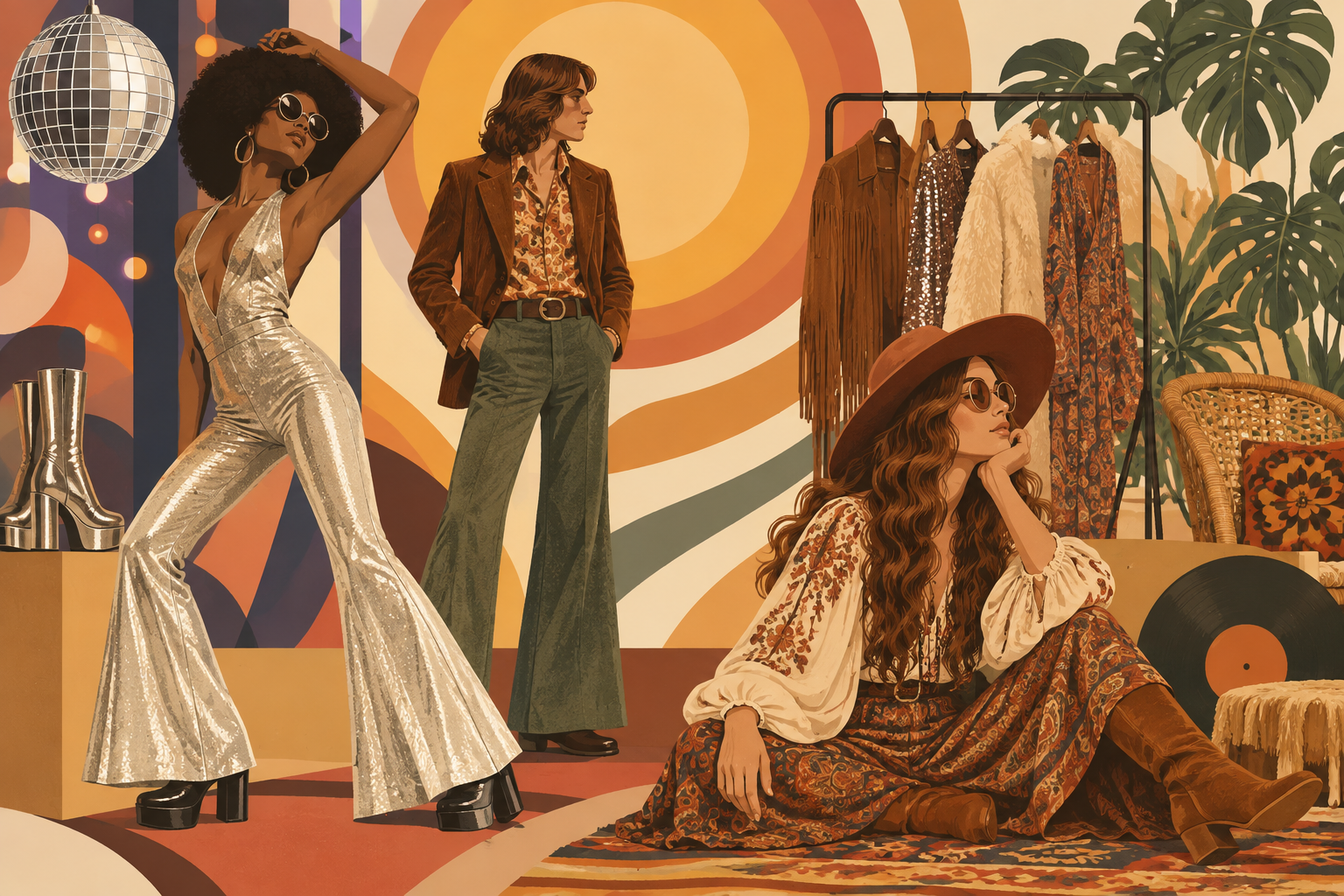
Seventies fashion is often remembered through a compact image: the dance floor, platform shoes, and synthetic fabrics. The available sources support that image, but it is not enough to describe an entire decade. The same references also speak of experimentation and diversity, and connect clothing with different musical and cultural currents. The result is not a single style, but a range of possibilities that coexisted—and that the evidence here allows us to describe only in broad terms.
The disco image and its limits
One popular overview of fashion history characterizes the 1970s as the disco era and highlights Lycra and platform shoes. This is a useful starting point because it identifies a recognizable aesthetic, but it does not show that these items were universal or that they alone defined everyday life. Turning a visible trend into a complete portrait of the decade would erase differences in context, use, and preference.
Caution matters because the supplied sources are brief summaries, not a systematic study of garments, consumers, or markets. They allow us to point to features and associations, but not to measure their reach or establish which groups adopted them most often.
Experimentation, not uniformity
The same overview places the 1970s and 1980s under the sign of experimentation and diversity, and mentions bohemian and androgynous styles. That description invites us to see the decade as a period of coexistence, rather than an orderly replacement of one fashion by another. Variety is a reasonable interpretation of the evidence; it does not mean every trend had equal visibility or importance.
In this framework, clothing can be read as a changing form of expression. Without more detailed evidence, it would be unwise to assign a fixed meaning to each silhouette, material, or accessory. What the sources do support is that experimentation is presented as a characteristic of fashion in the period.
Music and the circulation of styles
The references also link fashion with music and youth cultures. One account of fashion history notes that hip-hop culture emerged in African American and Latino communities during the 1970s and had a significant impact on urban fashion. Another summarizes that different musical movements influenced clothing in the 1970s and 1980s.
These references help prevent a history focused exclusively on disco. At the same time, they do not provide enough detail to reconstruct specific garments, internal timelines, or how each style circulated among cities and communities. The careful conclusion is narrower: music was one of the cultural contexts that the sources associate with fashion in the decade, alongside other forms of experimentation.
A decade viewed from Spain
The Community of Madrid describes an exhibition on fashion in Madrid from 1940 to 1970, featuring photographic reproductions and pieces from institutions including the Regional Archive and the Museo del Traje. Its description places the 1960s in a context of international references and youth change, but it does not provide a detailed account here of Spanish fashion after 1970. It therefore offers a methodological reminder: local history needs local, specific sources, not automatic extrapolation from general summaries.
The Museo del Traje, for its part, describes a collection of regional clothing and accessories. That reference reminds us that fashion history can also be studied through preserved objects, although the supplied material does not identify a specific 1970s piece.
What we can say
The sources allow us to present the 1970s as a decade associated with disco fashion, Lycra, platform shoes, experimentation, diversity, and the influence of musical currents, including hip-hop. They do not provide a complete chronology, quantify trends, or describe precisely how every social group or region dressed.
That limit need not weaken the story. It helps prevent a popular image from becoming a universal rule. The decade becomes more interesting when understood as plural: a period in which different aesthetics coexisted and clothing was connected with cultural change, without any single silhouette representing everyone who lived through it.
- Decade
- 1970s
- Region
- Global
- Level
- Introduction
- Entities
- Museo del Traje
Sources and references
- Historia de la moda - Wikipedia, la enciclopedia librees.wikipedia.org · 2026-09-27
- Conoce la historia de la moda y su evolución a lo largo de las décadaswww.andrespert.com · 2026-09-27
- Así fue... Exposición: En Madrid. Una historia de la moda, 1940-1970 | Comunidad de Madridwww.comunidad.madrid · 2026-09-27
- Historia de la moda: del origen a la actualidad | CEACwww.ceac.es · 2026-09-27
- Moda e indumentaria - Museo del Traje | Ministerio de Culturawww.cultura.gob.es · 2026-09-27
- Todo sobre la historia de la moda y su evoluciónaudaces.com · 2026-09-27
- 10 HITOS SOBRE LA HISTORIA DE LA MODA - Fashion Radicals Magazinewww.fashionradicals.com · 2026-09-27