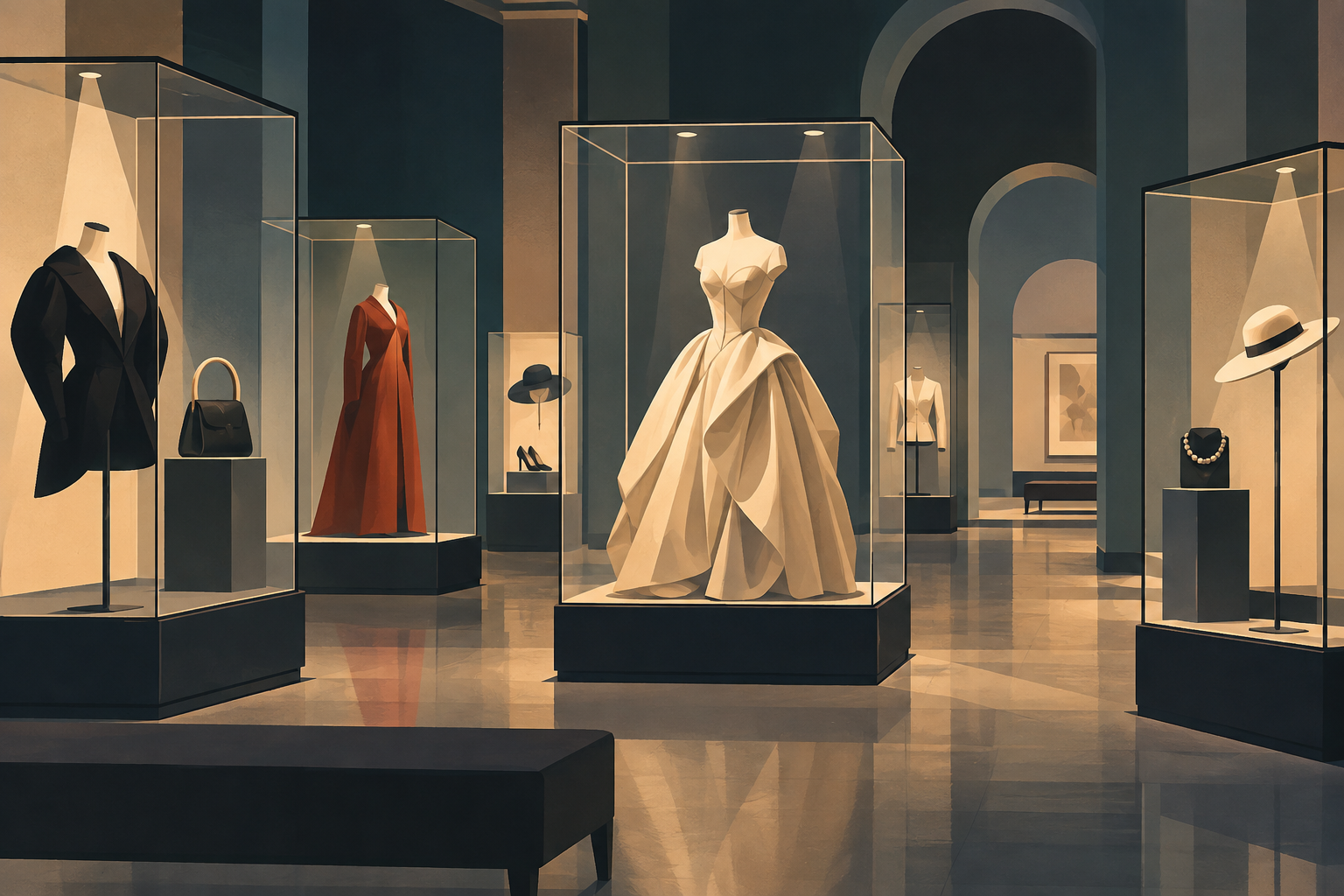
A garment in a display case seems to speak for itself: its silhouette, materials and ornament draw the eye before we read the label. Yet a fashion exhibition is not just an image. A dress was worn by a body, in a particular context and for a time; once it enters a museum, it loses some of that movement and raises new questions. Who made it? Who could wear it? What documents support an interpretation? And even before asking those questions, is the object in a condition to be displayed?
From wardrobe to cultural heritage
Fashion had to establish its place in museums. Research into the inclusion of clothing in galleries identifies Fashion: An Anthology, a group exhibition organised by Cecil Beaton in 1971, as an important step in that process. It helped present contemporary fashion as a cultural expression worthy of exhibition, rather than as an object considered too recent for a museum.
This shift does not mean that every displayed garment is automatically a work of art, or that its meaning can be reduced to a designer’s intentions. Clothing also belongs to everyday life and social history. A collection’s value may lie in its making, its materials, its association with a person or what it allows researchers to study about dress. The museum perspective opens up these possibilities, but it should explain them rather than assume there is only one reading.
One object cannot tell the whole story
Clothing carries visual and material information, but a case on its own can turn it into an image without context. Research on fashion museums stresses the need for documentation, scholarship and an educational purpose. It also identifies tensions between companies’ commercial interests and institutions’ cultural responsibilities, as well as questions about curatorial independence.
These issues help explain why a label should do more than name a garment. Where evidence allows, interpretation can connect an object with its production, use or context. Where evidence is missing, it is better to state the limit than to fill the gap with an appealing guess. Caution does not impoverish an exhibition; it separates evidence from editorial interpretation.
Conservation determines what can be seen
Conservation is not an invisible stage that ends before the public arrives. It can shape which objects are selected, how they are displayed and how long an exhibition lasts. An article on fashion in museums describes how condition influenced the narrative of Death Becomes Her, an exhibition about nineteenth-century mourning. In that case, whether dresses could be included depended on whether their condition allowed them to be shown.
Fragility can also change the form of access. The Museo del Traje says its collection comprises nearly 30,000 objects and includes works by Mariano Fortuny y Madrazo, Cristóbal Balenciaga and Pedro Rodríguez, as well as the latter’s documentary archive, covering his work from 1940 to 1978. A collection’s size and variety do not mean everything can be displayed at once. Selection, documentation and protection are part of objects’ public history.
Showing without wearing objects out
Light, contact, humidity, temperature and pests can affect collections, according to the National Museum of the American Latino’s explanation of preventive conservation. It describes periodically rotating light-sensitive objects, usually about every six months, as a care measure. Temporary removal does not end access; it may be what allows an object to be preserved and displayed again later.
An exhibition therefore has a material duration as well as a narrative one. A garment may leave its case, rest and return in a different arrangement. That change affects what visitors see and can itself become part of the story: no collection is entirely present at once. What appears is a selection that changes with conservation needs and curatorial questions.
Reproductions raise questions too
When an original is too fragile, a reproduction can offer another way to interpret it. The Culturas de Moda article describes a project that reproduced a dress associated with Anna Carolina de Melo Oliveira de Arruda Botelho, Countess of Pinhal. The source also says that digital reproductions of the dress and of the process were made. A copy does not replace the original, but it can make information visible that would otherwise remain outside the gallery.
To avoid confusion, an exhibition should clearly identify what is original and what is a reproduction. It can also explain which questions a copy helps answer and which still depend on the historical object. Technology or reconstruction alone does not guarantee rigour: their value depends on being part of research and being presented transparently.
A museum that acknowledges its limits
Fashion enters a museum when it is treated as material culture: something to look at, but also something worn, moved and preserved. From the recognition of contemporary fashion in exhibitions to today’s decisions about selection and rotation, the sources show a field shaped by productive tensions. A garment draws the eye; documentation, conservation and context prevent that gaze from stopping at the surface.
Not everything can be displayed at once, and not every object supports the same kind of story. Acknowledging these limits is a matter of rigour and care. A good exhibition does not promise that a dress tells everything. It explains what we know, what we interpret and why that object—or its reproduction—is before us today.
- Decade
- 1970s
- Region
- Global
- Level
- Enthusiast
- Entities
- Museum, Museo del Traje
Sources and references
- Moda e indumentaria - Museo del Traje | Ministerio de Culturawww.cultura.gob.es · 2026-09-27
- Los tejidos en las colecciones de los museos españoles, una ...revistas.ucm.es · 2026-09-27
- Resumen de La articulación de la moda en el espacio museístico en el cambio de milenio - Dialnetdialnet.unirioja.es · 2026-09-27
- Una historia de la moda en los museos – Culturas de Modaculturasdemoda.com · 2026-09-27
- La moda en la historia - Museo del Trajemuseodeltrajevirtual.com · 2026-09-27
- Nuevos objetos, nuevas historias | National Museum of the American Latinolatino.si.edu · 2026-09-27
- Una visión global sobre aspectos de conservación, ...www.cultura.gob.es · 2026-09-27