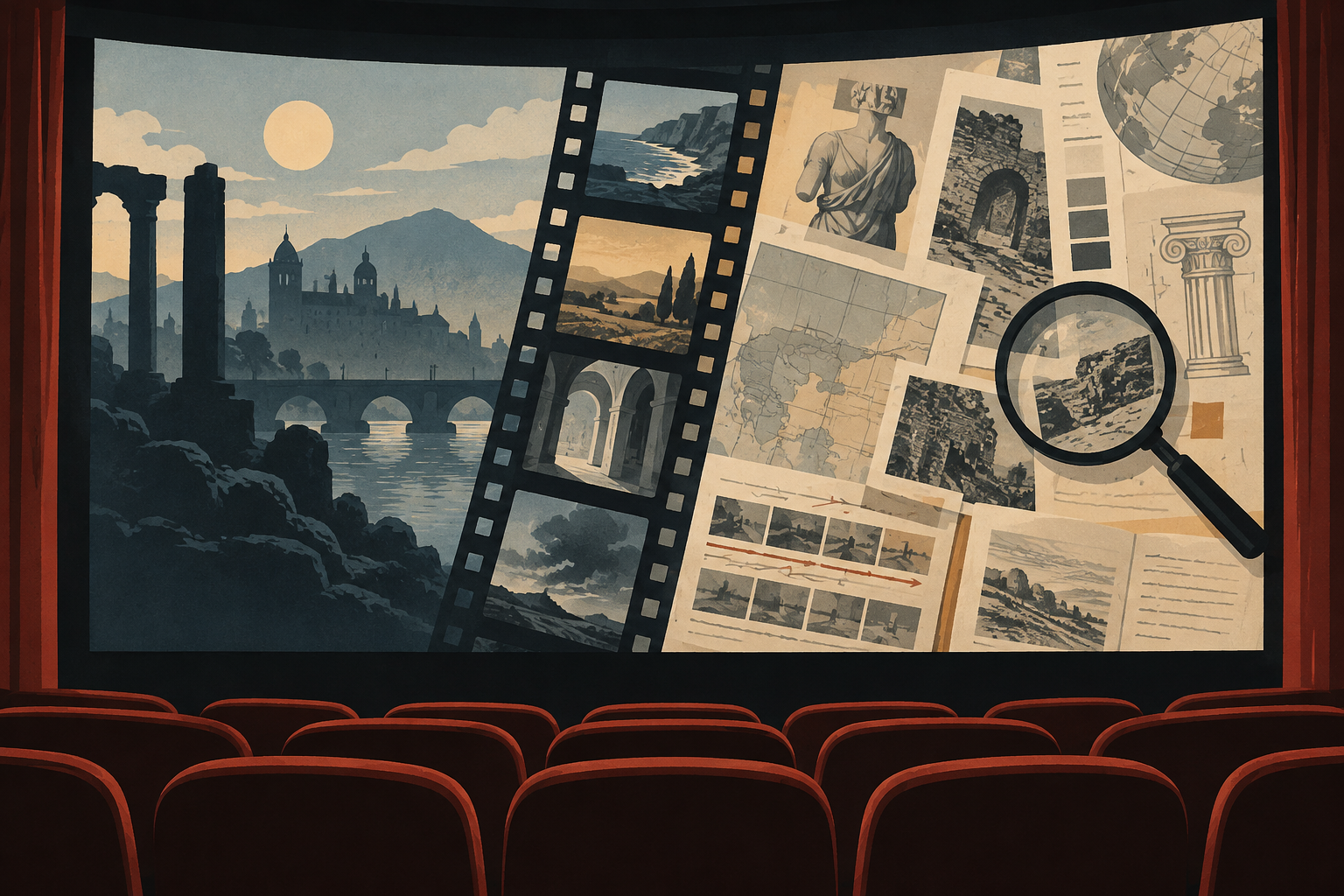
A film is a source, not a mirror
Calling a film a historical “source” does not mean treating every scene as direct proof that something happened exactly as shown. The academic work El Cine como fuente de la Historia, available through DADUN, addresses this relationship explicitly. Its title invites a useful question: what kind of knowledge can a cinematic work provide, and what are its limits? The screen preserves a representation, not an event untouched by mediation.
Historical cinema makes this distinction especially visible. The supplied entry on the genre describes it as set in a particular historical period, while allowing that its events and characters may be real or imagined. That description alone cannot establish the merits of any particular film; it does remind us that period setting and historical accuracy are not synonyms.
Representation has a context too
A film selects characters, episodes and perspectives. Those choices can be studied as part of the work and its context, rather than mistaken for a neutral record. The educational project Historia y Cine, hosted by CLIO, is explicitly devoted to the relationship between the two fields. It helps frame the task: examine how a film constructs a view of history, rather than asking it to replace other sources.
The Universidad Carlos III document 102 Grandes acontecimientos históricos contemporáneos en el cine offers one way of organising the subject, by linking events and titles. The supplied extract includes Patton (1970) and Nicholas and Alexandra (1971), among other works. Connecting a film with an event can be a starting point for research, but the extract alone does not prove that the films reproduce events accurately.
The 1970s are not an explanation by themselves
The decade appears in studies of specific national cinemas, not as a universal explanation. The academic chapter “La ‘tercera vía’ y el cine español middlebrow en la década de 1970” defines its subject as Spanish cinema in that decade. Separately, the record for Sobre Israel Rodríguez, El nuevo cine y la revolución congelada. Historia política del cine mexicano en los setenta identifies a review related to the political history of Mexican cinema. These are distinct works; their titles do not justify reducing both cinemas to a single tendency.
A chapter titled Cine y teatro, from Acercamientos al teatro actual (1970-1995), also appears in the supplied evidence. Its record confirms a thematic and chronological overlap, but does not allow us to attribute specific arguments to it without consulting the chapter. Making that limit clear is part of rigorous reading.
What to ask
When analysing a film as a source, it helps to separate questions that are often conflated: what period it depicts; which narrative choices are visible; what historical information is supported by other sources; and what is not established by either the film or the documentation consulted. The answer should depend on the available evidence, not on how realistic a scene feels.
OpenAlex also records the 2019 article Historia de la infancia en el cine colombiano, showing that the field can be organised around specific subjects and contexts. Its title identifies the object of study, but is not enough to summarise its conclusions. That distinction prevents a bibliographic record from being turned into an argument we have not verified.
Reading the screen carefully
Cinema provides material for studying how periods, events and experiences are narrated and represented. It can also be studied in relation to the historical and cultural context in which it was made. But a film does not automatically confirm the events it stages: confirmation requires comparison with suitable sources.
The strongest conclusion supported by the available evidence is also the most measured: cinema can be part of historical research when it is studied as representation and its limits are made explicit. The screen offers questions and clues; it does not remove the need to verify them.
- Decade
- 1970s
- Region
- Spain
- Level
- Enthusiast
- Entities
- No linked entities
Sources and references
- 102 Grandes acontecimientos históricos contemporáneos en el cinee-archivo.uc3m.es · 2026-09-27
- El Cine como fuente de la Historia - DADUNdadun.unav.edu · 2026-09-27
- Historia y Cineclio.rediris.es · 2026-09-27
- Capítulo cuarto. La «tercera vía» y el cine español middlebrow en la década de 1970doi.org · 2026-09-27
- Cine y teatrodoi.org · 2026-09-27
- Historia de la infancia en el cine colombianoopenalex.org · 2026-09-27