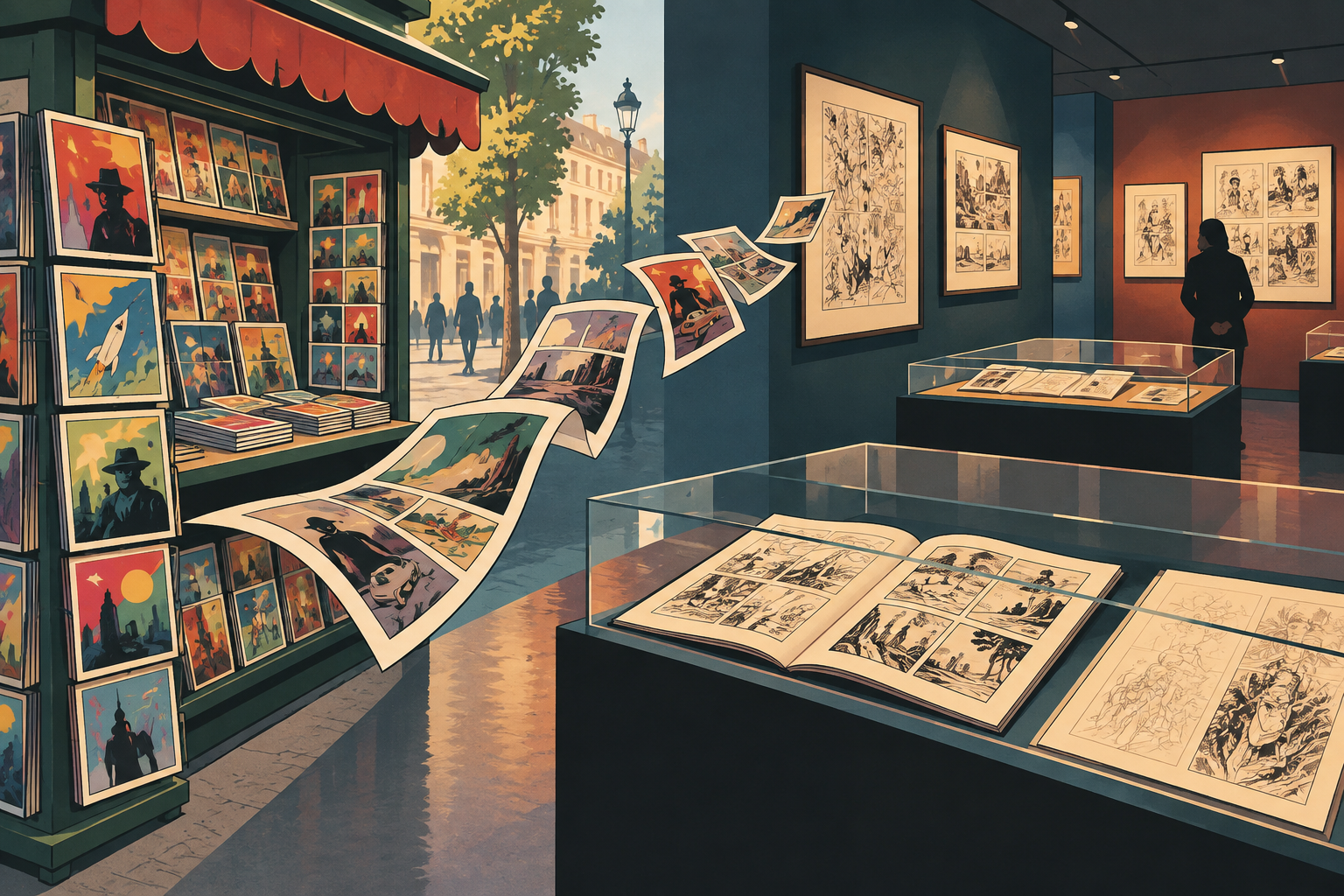
The newsstand as a starting point
For decades, the newsstand was a familiar place for comic magazines to circulate. The available sources show that this channel was not merely an abstraction: in Spain, the supply of adult comics magazines expanded strongly in the late 1970s and through the 1980s. A count reported by El Periódico de España says that thirty adult-comics titles appeared at Spanish newsstands between 1981 and 1990. In 1981, the year of the first Barcelona International Comics Fair, the same article puts the number of adult comics available at press outlets at around twenty.
These figures describe a period of expansion, but they should not be treated as a measure of total readership, sales or print runs: the source supplies no such data. They do show that the newsstand was a meeting point for varied publications and potential audiences. The magazine made comics visible as a periodical practice: a format offering works and artists over time, rather than only as separate albums.
The magazine as showcase and platform
The magazine format could also serve as a platform for artists at different stages of their careers. In El Periódico de España, Antoni Guiral, curator of an exhibition about the fair’s forty years, notes that magazines gave young artists visibility alongside established names. This is a specific observation about the editorial role of the format, not a claim that every title had the same conditions or results.
A magazine brought works together in one object, while allowing readers to approach them through artists, series or graphic choices. Rubén Varillas’s study of magazines, fanzines, mini-comics, albums and graphic novels reminds us that format is central to thinking about how comics are organized and circulated. The available bibliographic record does not provide the full article text; it is therefore useful as a reference for the focus on formats, not as evidence for detailed conclusions absent from the supplied material.
The 1980s and the Barcelona fair
The first Barcelona International Comics Fair in 1981 appears in the sources as a milestone of the period. The number of titles reported by El Periódico de España gives context to that date: the fair began when adult magazines had a notable presence at newsstands. This does not by itself prove that the event caused the boom, or that the boom depended on it. It does place the fair and the publications within the same cultural landscape.
Over time, exhibitions on comics made another kind of approach possible: not only reading published pages, but viewing original drawings, covers and mastheads as visual documents. El Correo’s report on Historietas del Tebeo. 1917–1977 describes a chronological and thematic route featuring publications and original drawings, and names characters and artists from different periods. It is an example of how an exhibition can bring dispersed materials together and propose a historical reading without replacing the experience of the publications themselves.
Exhibitions turn archives into narratives
A magazine can tell us about its time through its format, pages and circulation; an exhibition, by contrast, selects objects and establishes relationships among them. The academic study “Las exposiciones de cómics. Historia y contexto global,” published in CuCo, Cuadernos de cómic, places these displays in a broader history. The available bibliographic information and excerpts cite, among other cases, an exhibition from 1969 that travelled to the University Art Museum in Berkeley and remained there until March 1970. The material also refers to exhibitions in museums and art spaces. These examples show that the dialogue between comics and museums did not begin in Spain and cannot be reduced to a single exhibition.
For the Spanish context, a Jot Down article on comics and museums in France notes that the Louvre created its own bande dessinée collection in 2005; it also mentions Période Glaciaire and Le Ciel au-dessus du Louvre, published in 2009. Revista de Arte, meanwhile, documents a Museo Reina Sofía exhibition devoted to women authors of adult comics in Spain from 1967 to 1993. Taken together, these sources show different ways of making comics visible: through collections, historical exhibitions and displays focused on creators.
What is gained—and what is left out
A display case gives visitors time to notice details that can be overlooked in ordinary reading: linework, composition or the differences between originals and printed pages. It also provides an institutional framework in which comics can be presented as objects of study and heritage. But every exhibition makes selections. A show based on preserved originals is not a complete inventory of what was published, and the chosen route shapes the history visitors encounter.
The available evidence is stronger for some matters—exhibition dates, titles, numbers of magazines or descriptions of displays—than for others, such as audience response, the material preservation of every magazine or the commercial impact of comic fairs. It is important to distinguish documented facts from cultural interpretation: moving from newsstand to museum signals a change of context and valuation, but it does not mean popular circulation disappeared or that every comic received equal attention.
A change of place, not a closed history
The journey from newsstand to display case is not a simple story of replacement. Magazines offered a mode of publication and circulation; exhibitions create other forms of reading, selection and memory. The growth of adult titles in the 1980s, the emergence of the Barcelona fair and exhibitions featuring publications and original drawings let us follow several stages of that shift.
Perhaps the most revealing point is that comics can inhabit both spaces without being quite the same object in each. At a newsstand, a comic is a publication to browse and circulate; in an exhibition, it is also a document, a graphic artefact and part of a historical narrative. The sources support that change in framing. They do not, however, justify turning it into a universal story of progress: the archive that reaches the display case is always partial, and recognizing that limit is part of reading it well.
- Decade
- 1980s
- Region
- Spain
- Level
- Enthusiast
- Entities
- Museum
Sources and references
- (PDF) Las exposiciones de cómics. Historia y contexto globalwww.researchgate.net · 2026-09-26
- El año del cómic y los museos - Jot Down Cultural Magazinewww.jotdown.es · 2026-09-26
- Cien años de historietas | El Correowww.elcorreo.com · 2026-09-26
- Las exposiciones de cómics. Historia y contexto global | CuCo, Cuadernos de cómicerevistas.publicaciones.uah.es · 2026-09-26
- Mujeres del cómic en la España de los 70 y 80 - Revista de Arte - Logopressrevistadearte.com · 2026-09-26
- Del quiosco al museo: el viaje del cómic en los últimos 40 añoswww.epe.es · 2026-09-26


