A building, an archive and a public promise
In April 2025, Spain’s Ministry of Culture announced the creation of a Film Museum in Madrid’s former NO-DO building. The official notice describes it as a future centre for exhibiting and conserving Spanish film heritage. It also envisages a space for memory and interpretation concerning the building and NO-DO’s role in the audiovisual imagination. This matters because the building housed NO-DO from 1942 and is therefore connected to the audiovisual history of Francoism.
The announcement does not reveal the exhibition route, the objects to be displayed or an opening date. It does, however, support a useful question: what can a film museum do when its raw material is not only films, but also documents, formats, devices, publicly circulated images and the political conditions in which they were made and watched? The project’s interest lies in its potential to turn the archive into a critical experience rather than a nostalgic set.
Film as artwork and document
Writing on film heritage describes a lasting tension. Cinema may be approached as art, linked to authors, movements and styles, but it is also a set of physical materials. A film reaches the future not merely as a title: it may survive through negatives, prints, production records, photographs, posters, equipment and exhibition records. The Digibug study on film heritage and museums notes that treating cinema as art can push its materiality into the background.
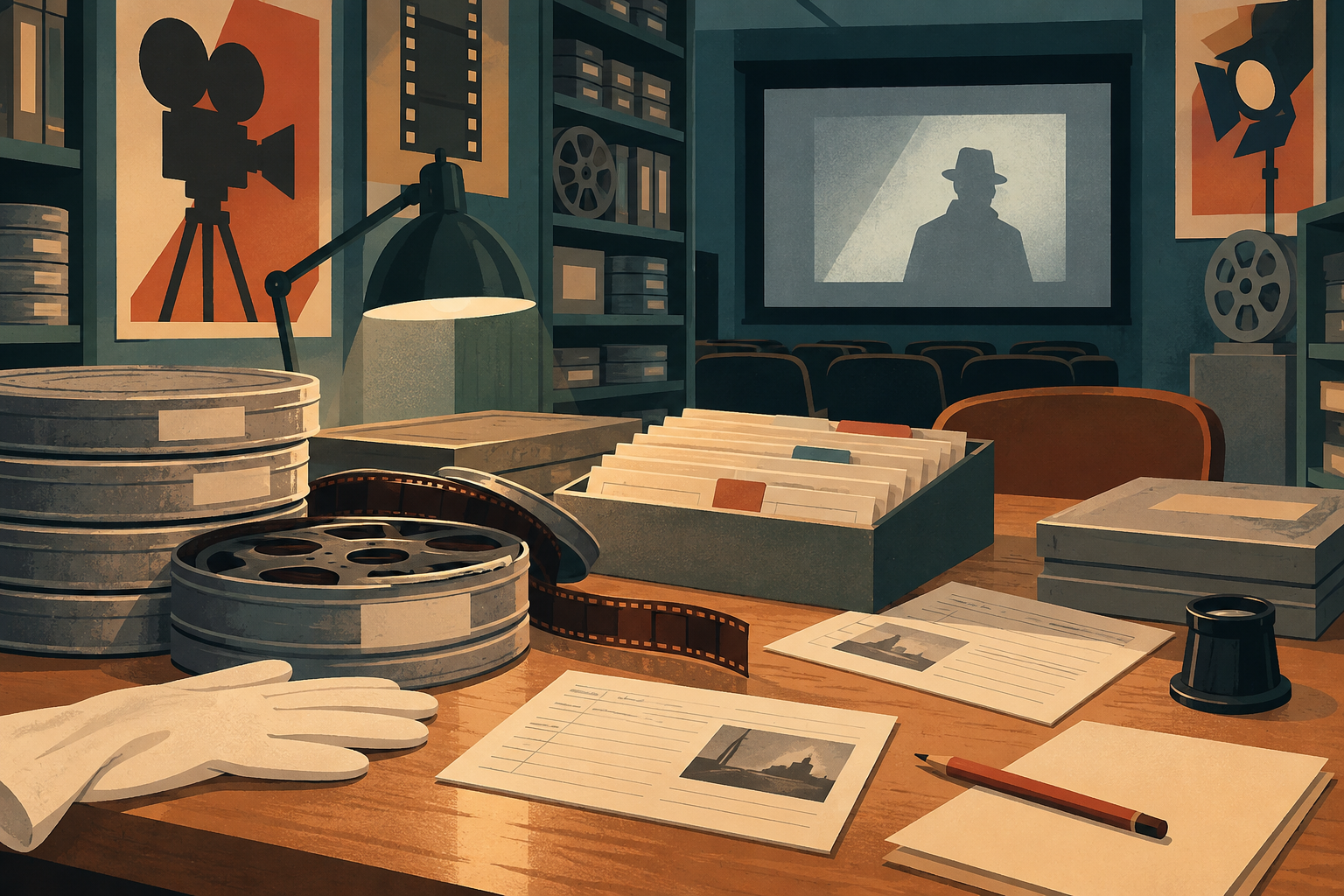
This matters because a museum does not simply present finished stories. It can show that every image has a technical and social history. A print, a negative or a digital file has particular preservation needs; a poster or projector may reveal information absent from the film itself. Research on Mexico’s Cineteca Nacional recalls that film collections with museum functions also bring together photographs, posters, projection equipment and stage infrastructure as documents for understanding technical and material processes.
The negatives: a figure with limits
The ministry states that nearly 70,000 negatives from the NO-DO archive are held at Filmoteca Española’s Conservation and Restoration Centre. It also says that the ICAA took over their administration in 2017. These are important facts, but a number alone cannot become a narrative. A negative is not a transparent window onto the past: it is an archival object whose production, selection, preservation, cataloguing and access shape what can be seen and how it can be interpreted.
That is why the announcement’s language of memory and interpretation is apt. With NO-DO, making the archive accessible also requires explaining the historical framework from which it emerged. The official statement explicitly links the space to the history of Spanish audiovisual culture under Francoism. A rigorous museum need not flatten that complexity into one reading; its task can be to make visible the mediations, public uses of images and questions that remain.
Conservation is not simply storage
Audiovisual conservation is continuous work. Filmoteca Española explains that video works and digital files exist in many forms and that its department seeks both to preserve them and to guarantee access over time. This shifts a familiar assumption: preservation is not merely keeping a copy, but maintaining the possibility of consulting it.
The institution lists digital carriers including CD, DVD, Blu-ray, hard drives, USB sticks and LTO. Their variety illustrates a central issue in audiovisual heritage: survival depends on formats, equipment, procedures and knowledge that change. Preservation studies also identify distinct risks across materials, including the flammability of some nitrate bases, acetate decomposition, colour fading and technological obsolescence. These are not reasons for alarmism, but for understanding conservation as sustained cultural infrastructure.
A museum does not replace a film archive
Museum, archive and film library overlap, but their roles are not identical. Research available through Dialnet describes film libraries as working from conservation to dissemination, with a model drawing on museums, archives and libraries. The distinction is useful: an archive organises and safeguards; a film library preserves, enables research and programmes screenings; a museum interprets for broad audiences through displays and mediation.
The future Film Museum could be most valuable if it acknowledges this institutional network rather than hiding it. An object display can invite questions: What format is it? Who made it? How did it enter a collection? What documentation accompanies its catalogue record? Under what conditions can it be consulted? Such an approach prevents the visible spectacle of exhibition from being detached from often invisible documentary work.
Access, context and public discussion
Exhibition is one form of access, not the only one. The Ministry of Culture’s “Cinema at the Museum” programme proposes discussions involving specialists in history and archaeology alongside cinema specialists before screenings. It offers a methodological clue: watching a film with context can change the questions asked of it without reducing it to historical illustration.
For the new museum, this suggests that interpretation matters as much as display cases. NO-DO images require tools for understanding their narrative forms, circulation and political setting. They also require careful distinctions between what a document shows, what it omits and what a contemporary viewer may infer. The museum would be stronger if it made those layers part of the visit.
An institution still to be defined
The announced project is an opportunity, not an exhibition that can already be assessed. It would be improper to assign it collections, routes, technologies or curatorial choices absent from available information. Nor should one assume that conservation and access will be free of tension: specialist literature stresses that preservation, conservation and restoration have different uses across institutions, materials and professional traditions.
What is currently verifiable is specific: the former NO-DO building will be rehabilitated for a Film Museum; the project includes exhibition and conservation; and it foresees a space of memory and interpretation related to the archive and to Franco-era audiovisual history. If this framework is developed through access, context and transparency about materials, the museum can do more than celebrate cinema. It can teach visitors how to read its traces.
Documentary gallery


- Decade
- Contemporary
- Region
- Spain
- Level
- Enthusiast
- Entities
- No linked entities
Sources and references
- Concepto | Estudios El Patrimonio cinematográfico en el Museodigibug.ugr.es · 2026-09-19
- Cine en el Museo - AGENDA CULTURAL - Ministerio de Culturaagendacultural.cultura.gob.es · 2026-09-19
- El nuevo Museo del Cine se ubicará en el antiguo edificio del NO-DO | Ministerio de Culturawww.cultura.gob.es · 2026-09-19
- 1 Dossiê El cine como patrimonio culturaldialnet.unirioja.es · 2026-09-19
- Acerca de los conceptos de preservación, conservación y restauración fílmica en el caso de la Cineteca Nacional de México desde los planteamientos de Paolo Cherchi Usaiwww.scielo.org.mx · 2026-09-19
- Departamento de Conservación fílmica - Filmoteca Española | Ministerio de Culturawww.cultura.gob.es · 2026-09-19