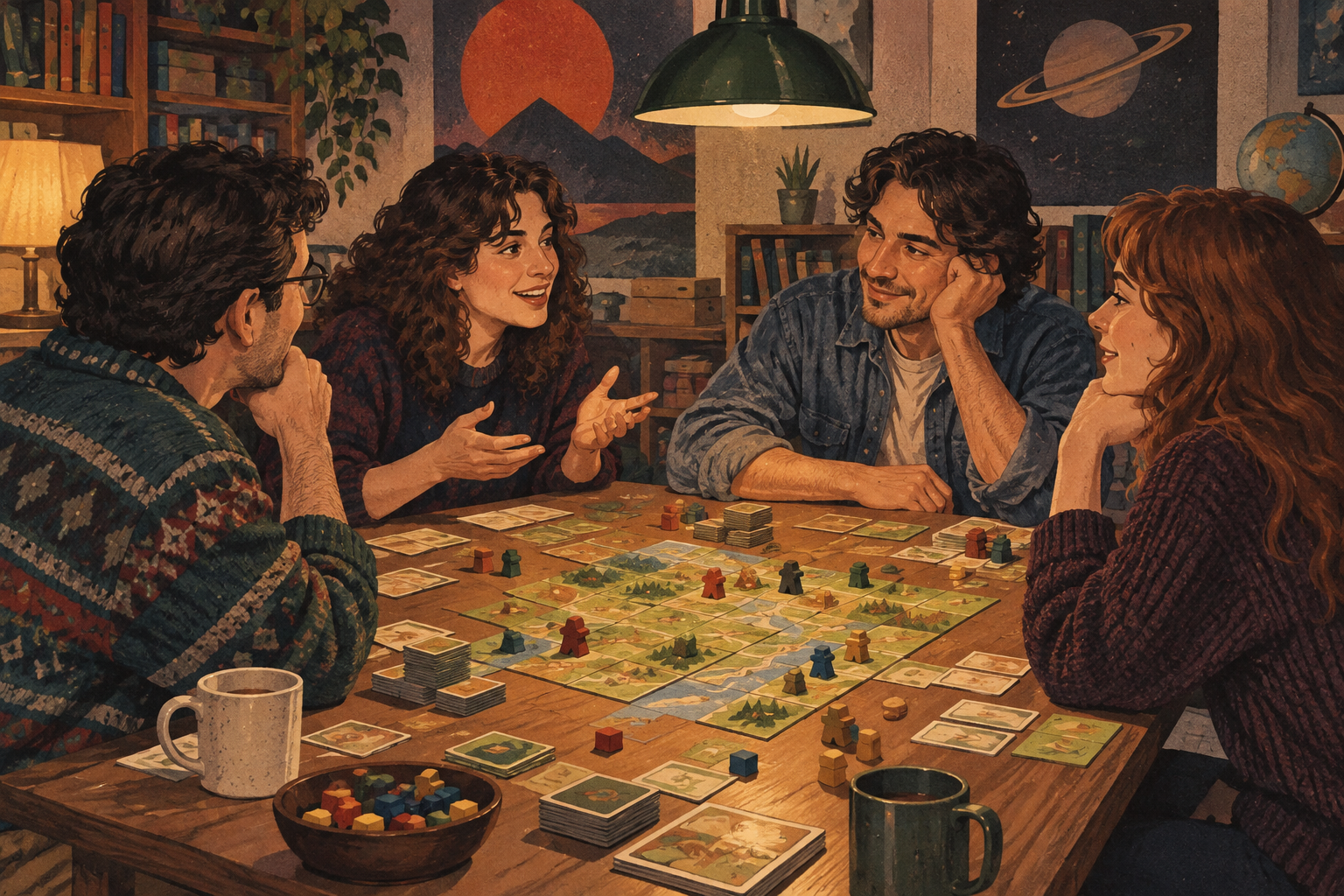
A transformation placed in the 1990s
The available sources describe the 1990s as a turning point for the board-game industry: in that decade, the range of games is said to have expanded and become more popular, alongside works often grouped under the label “Eurogames.” The named examples include Settlers of Catan, Carcassonne and Ticket to Ride. The supplied material provides no market figures and does not allow the development of each title to be measured separately. It does, however, show that this transformation has become an important question for those studying the history and culture of games.
“Transformation” should be read as the sources’ characterization, not as a complete industry chronology. The material contains no comparable data on sales, print runs or publisher numbers, so it cannot establish the scale of the change.
Analog games as objects of study
The introduction to Encrucijadas del juego de mesa. Historia, cultura e industria argues that game studies had focused predominantly on digital games, leaving so-called analog games in the background. The claim is not that board games are a recent invention: the text emphasizes their historical and cultural trajectory predating video games, as well as their distinct characteristics and terminology.
This approach broadens the questions one can ask about a game. It goes beyond asking who wins or how a rule works to consider physical objects, contexts of use, conventions and the meanings produced around play. Materiality matters because play takes place through components and in a shared space, although the sources available here do not provide a detailed analysis of particular pieces.
Industry, audiences and circulation
The book’s publisher connects expansion since the 1990s with the growing popularity of certain games and a wider range of offerings. It also points to the significance of festivals, including Internationale Spieltage in Essen, and the growth of projects funded through crowdfunding. These elements make it possible to consider how games circulate beyond the box: authors, publishers, consumers and gathering places all play a part.
A Games & Co. post offers a further point of context. It dates a board-game symposium organized by Irving Finkel at the British Museum to 1990 and says that in 1995 it became an annual gathering held in different parts of the world. This is a useful indication of spaces for exchange and study, but it is not enough on its own to reconstruct the event’s full history.
Mechanics, themes and materiality
The sources identify several possible approaches to board games: their mechanics, the narratives and metaphors they propose, the worlds they let us play in, and the contexts they seek to simulate. They also highlight physical materiality and its transformation into digital formats. This list helps avoid reducing games to entertainment alone: rules, components and themes can be examined as interconnected parts of a cultural experience.
The game Museum, documented in later reviews and retail listings, offers a contemporary example of a title that takes museum work as its theme and structures play around collections. It does not, by itself, demonstrate what changed in the 1990s, and it should not be confused with the Eurogame examples named for that decade. Its value here is narrower: it illustrates how a game can stage institutions, objects and cultural practices.
What the evidence shows—and what remains open
The material supports two main ideas: that the industry underwent a transformation from the 1990s onward, and that analog board games merit scholarly attention in their own right. It also supplies examples of games, gathering places and thematic frameworks. It does not provide a comprehensive national history, a statistical series or first-hand accounts from players and professionals. More precise explanations of causes, commercial scale or regional differences would therefore require additional sources.
The careful conclusion is that board games can be studied at once as industry products, rule systems, material objects and social practices. Recognizing this plurality does not erase their differences from video games; it makes it possible to ask what experiences and meanings arise from sharing a table, handling components and negotiating a game. The sources invite us to treat analog play not as an appendix to digital games but as a cultural field with its own history and questions.
Documentary gallery


- Decade
- 1990s
- Region
- Global
- Level
- Enthusiast
- Entities
- Museum
Sources and references
- Museum ~ Juego de mesa • Ludonauta.eswww.ludonauta.es · 2026-09-23
- textos en red - shangrila-blog: II. ENCRUCIJADAS DEL JUEGO DE MESA. HISTORIA, CULTURA E INDUSTRIA", Jan Gonzalo Iglesia (ccord.), Valencia: Shangrila, 2024.www.shangrila-blog.com · 2026-09-23
- Encrucijadas del juego de mesa. Historia, cultura e industria – Shangrilashangrilaediciones.com · 2026-09-23
- mundo lúdico – Games & Co.gamesandco.wordpress.com · 2026-09-23
- Cultura y Juegos de Mesa Analógicos | PDF | Sociedad | Ociowww.scribd.com · 2026-09-23
- Reseña: Museum | Misut Meeplemisutmeeple.com · 2026-09-23