A timeline built with caution
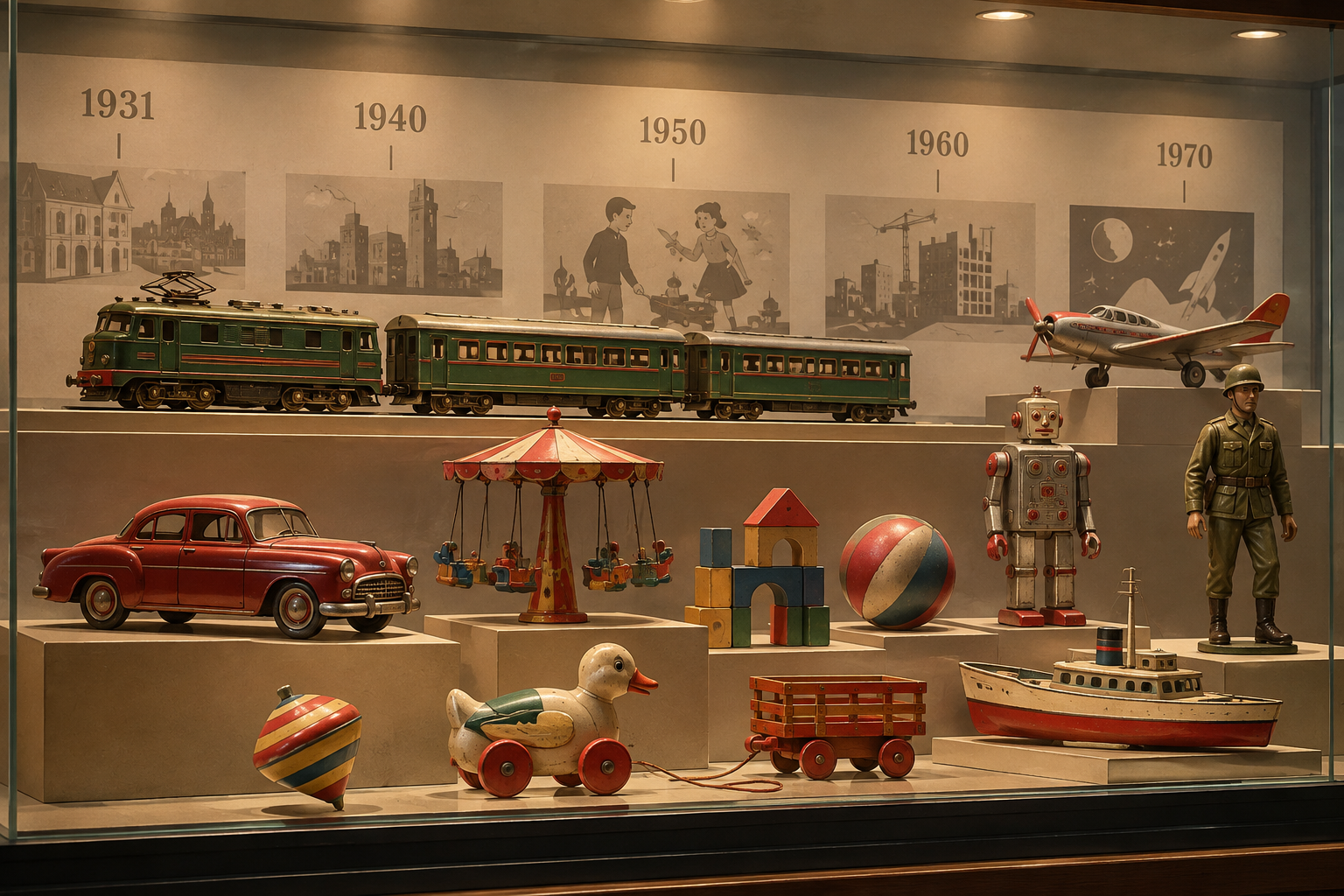
Toy timelines often offer a neat sequence of launches, brands, and fashions. The evidence available for this feature calls for a different approach: gathering only the landmarks documented by the cited sources and stating what they do not establish. The result is not intended as a complete history of Spanish toys or as a product catalogue. It is a limited timeline, useful for observing changes in technology, materials, consumption, and cultural representation between 1931 and 1975.
How we look also matters. Madrid’s Del juguete al cielo exhibition proposed connecting displayed toys with their sociological context and, at times, comparing them with photographs of the real object or means of transport. That method prevents us from treating a toy as an isolated miniature: a locomotive, doll, or action figure retains traces of industrial techniques, domestic aspirations, and ways of imagining the world.
1931: the electric train as a technical landmark
The Almassora Toy Museum places the launch of the first electric trains with current transformers, points, automatic brakes, and tunnels in 1931. The wording should be read literally: the source identifies a set of features and a year, but does not specify a maker, model, country of manufacture, or commercial reach. It would therefore be unsound to turn the information into an attribution to a particular brand.
Even so, the landmark matters. Unlike a clockwork toy, the electric train incorporated power, route, and control elements. It does not by itself show how every household played, but it records that railways could enter play through more complex technology. For collecting and documentation, the lesson is straightforward: transformer, track, points, brakes, and tunnels are not simply interchangeable extras; they belong to the historical description of a set.
The Civil War and a documented interruption
The same Almassora source states that production stopped during the Civil War and that toy factories became auxiliary industries for war material. This is a broad statement, yet the supplied evidence does not list businesses, production sites, or individual schedules. It should therefore be understood as a framework presented by the museum, not as a detailed demonstration of every factory’s history.
The private exhibition described by Los Juguetes de Olivia portrays the 1940s as a period marked by a lack of new toys because of the Second World War. That claim belongs to an exhibition narrative and should not be confused with a national measurement of output or availability. Taken together, the two sources offer a methodological warning: wartime decades require us to distinguish between what was made, sold, preserved, and remembered. An object dated to the 1940s does not prove that it was new, widespread, or affordable for most people.
From 1952: Scalextric in exhibition memory
Los Juguetes de Olivia states that Scalextric ran on electricity and had captured children’s hearts since its 1952 launch. The wording links an electric toy to a memory of desire, especially associated with Three Kings’ gift requests. The evidence does not provide a product variant, Spanish distribution details, or figures for household ownership; those matters must remain open.
What can be verified within this selection is more modest and more useful: the track toy is presented as an electrical object of desire. Comparing it with the 1931 train does not justify a linear history, but it does reveal a continuing interest in guided movement and control of a route. In a collection record, retaining the distinction between an exhibition’s cultural memory and a checked technical specification is essential.
1968: Nancy and Madelman, two separate references
Historia del Juguete identifies Nancy as Famosa’s flagship product, launched in 1968, and says it offered a more modern alternative to traditional dolls in Spain. The source also places Famosa in Alicante’s Toy Valley. It does not provide physical features of the first edition, wardrobe variants, or manufacturing data. The idea of modernity must therefore remain the source’s assessment, rather than a fixed technical category.
Madelman also appears in 1968 in reporting on an exhibition at the National Museum of Anthropology, published by laSexta. The article says the exhibition opened exactly fifty years after the 1968 launch and assembled more than 250 toys to put the figures in dialogue with their sociocultural setting. It relates their emergence to countercultural revolutions and a growing middle class demanding new products. This is a museum and historical interpretation, not sufficient proof of a particular social intention on the part of makers, designers, or buyers.
The shared year permits one limited observation: the selected sources place both the Nancy doll and the Madelman action figure in 1968. They do not demonstrate a shared audience, price, sales channel, or impact. They do show that both objects became reference points for discussing Spain’s material culture of childhood.
1975: Geyperman and the danger of simplification
Historia del Juguete dates Geyperman’s launch to 1975 and presents Geyper as a company founded in 1945 in the Toy Valley. It also calls the figure a direct competitor to G.I. The timeline can record these claims as they appear in the source, but must not extend them: there is no documentation here on commercial agreements, product equivalences, advertising, or market shares.
The datum is useful because it locates another action figure in the decade after Madelman’s launch. Competition can guide further research, but it cannot replace comparison of boxes, catalogues, instructions, distribution, or company archives. For a collector, the priority remains recording the particular object: the name appearing on it, materials, surviving accessories, signs of use, and documented provenance.
Museums, archives, and the limits of this timeline
The Valencian Toy Museum explains that much of its collection came from a donation by workers of the Payá Cooperative and was expanded by a municipal collection and donations from firms and individuals. The Polytechnic University of Valencia, meanwhile, proposes linking museum archives and a leisure-product database to offer a historical and industrial overview of the sector. Both reminders matter: a reliable timeline depends on objects, documentation, provenance, and searchable systems, not merely on repeated dates.
The academic article published in Enfances & Psy argues for examining toys in the context of each period and traces an evolution from terracotta dolls to interactive electronic toys. Its approach supports a key precaution: one toy cannot speak for an entire generation. It can help study design, imaginaries, and consumption, provided a preserved object is not turned into a universal experience.
Conclusion
Between 1931 and 1975, the available sources allow six markers: electric trains in 1931; a production interruption during the Civil War; Scalextric from 1952 in an exhibition narrative; Nancy and Madelman in 1968; and Geyperman in 1975. This timeline is intentionally incomplete. Its value lies in refusing to fill gaps with undocumented memories, prices, sales, or relationships. Looking at these toys precisely means preserving both the object and the uncertainty that still surrounds it.
- Decade
- 1960s
- Region
- Spain
- Level
- Advanced restoration
- Entities
- No linked entities
Sources and references
- Historia del Juguetehistoriadeljuguete.com · 2026-09-17
- Museo del Juguete de Almassorawww.almassora.es · 2026-09-17
- La exposición “Historia del juguete y juguetes con historia” | Los Juguetes de Olivialosjuguetesdeolivia.com · 2026-09-17
- Museo del Juguete - Memoria Viva - UPVmemoriaviva.upv.es · 2026-09-17
- «Del juguete al cielo» | Condeduque Madridwww.condeduquemadrid.es · 2026-09-17
- Historia de la cultura infantil a través de los juguetes | Cairn.infoshs.cairn.info · 2026-09-17
- Pasado, Presente y Futuro - Museo del Juguetewww.museojuguete.com · 2026-09-17
- Los míticos juguetes 'Madelman' cumplen 50 años de historiawww.lasexta.com · 2026-09-17