Dressing also leaves documents
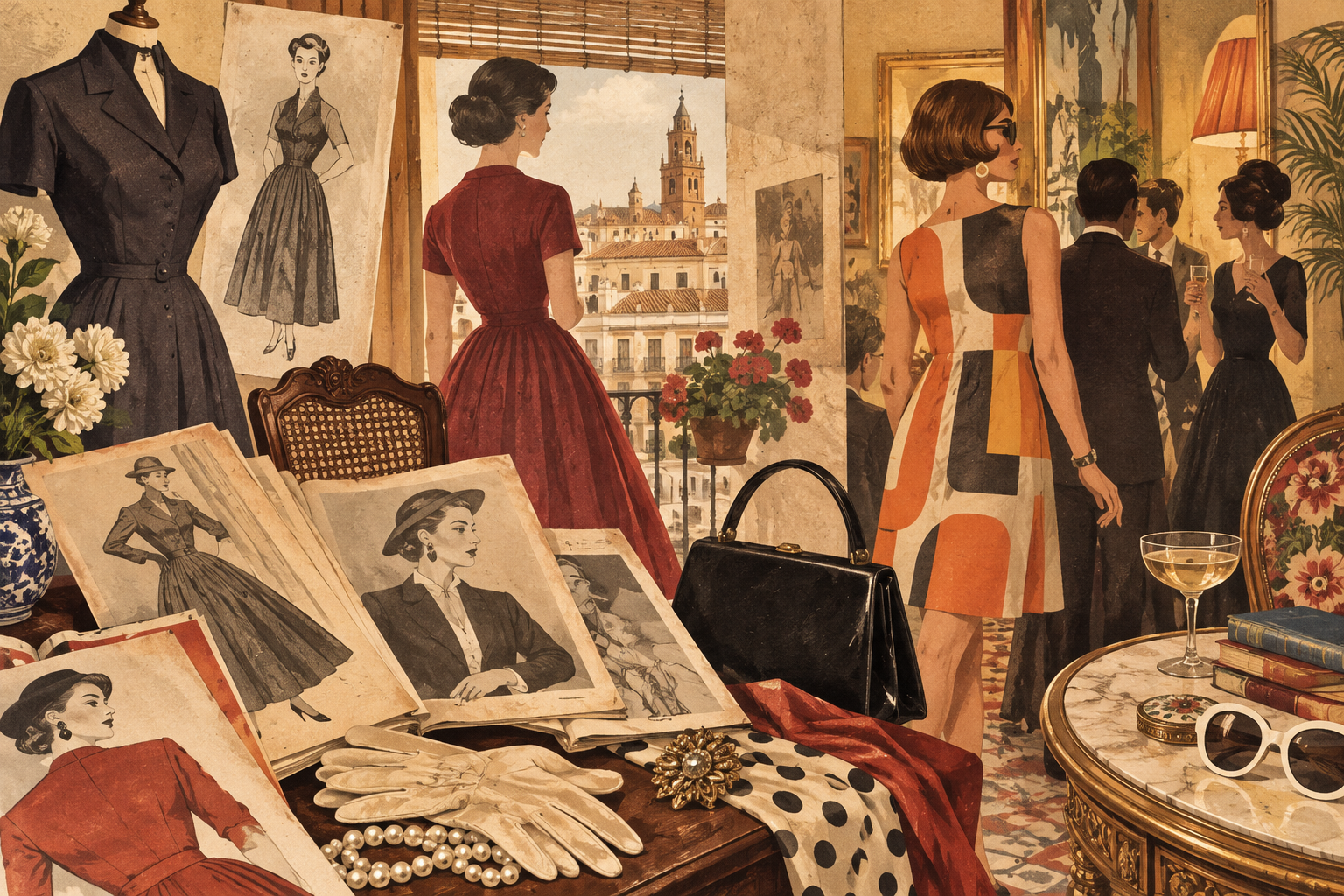
Fashion in Spain between 1940 and 1970 can be approached without reducing it to a sequence of trends or a handful of celebrated names. The exhibition En Madrid. Una historia de la moda, 1940-1970, presented by the Community of Madrid, offers a broader frame: it follows the path from the post-war period to the 1970s and places designers, models, costume designers, actresses, dressmakers, and anonymous people from Madrid within the same city. That formulation matters because it treats dress as evidence of social life.
Garments do not speak for themselves. Their fabric, cut, traces of wear, and accompanying images require context. Yet when they are studied alongside photographs, magazines, patterns, and fashion plates, they make specific questions possible: what was considered appropriate, which references circulated, which trades took part, and how an appearance could travel beyond the moment of making.
From the post-war years to the 1970s: an arc, not one aesthetic
The 1940-1970 period should not be understood as a uniform style. The institutional source frames it as a journey from post-war Spain to the 1970s; its value therefore lies in changes as well as continuities. A 1942 garment preserved by the Museo del Traje, the Manolita dress in wool crêpe embroidered with jet, is among the objects highlighted by the Community of Madrid. It shows why dated and documented objects are firmer ground than retrospective labels applied to whole decades.
The exhibition brought together 118 photographic reproductions—many previously unpublished according to the institution—and 76 objects from, among other places, the Regional Archive of the Community of Madrid and the Museo del Traje. This combination prevents history from being confined to a display case. Photographs restore body, posture, street, and occasion to clothing; objects offer material and constructional proximity that an image cannot replace.
Accessories: small objects, extensive information
Accessories are not simply decorative additions. In dress collections, they can guide the reading of a silhouette, a social gesture, or a particular use. Des-vestidos. Una moda entre dos siglos (1850-1950), a publication from Museos de Tenerife, lists hats, shoes, mantillas, fans, shawls, corsets, and shirts among the indispensable visible and hidden accessories in its survey. Although its chronology ends in 1950, it helps demonstrate that the study of dress must look beyond the outer garment.
This attention to ancillary objects has a methodological consequence: they should not be separated from function. An accessory may contribute to fastening, comfort, public presentation, or the construction of an image. Its meaning depends on its relationship with the ensemble, date, provenance, and collection record. Without that information, assigning a precise social meaning remains a hypothesis rather than a fact.
The press circulated fashion
Specialist publishing was a crucial infrastructure of visibility. The Museo del Traje and Acción Cultural Española devoted the temporary exhibition ¡Extra, moda! El nacimiento de la prensa de moda en España to the conditions that fostered fashion magazines in Spain. According to the Ministry of Culture, these included the development of luxury and textile industries, the beginning of the seasonal system, and the arrival of new fabrics and garments.
The exhibition assembled more than one hundred objects, including outfits, publications, and fashion plates. This supports an essential point: fashion did not circulate only as finished clothing. It also travelled through images, texts, patterns, and drawn models. Magazines could propose references; fashion plates translated ideas of silhouette; patterns connected an image to making. None of these media automatically describes what the whole population wore, but together they reveal mechanisms through which aspirations and visual formulas circulated.
Trades, wearers, and visual culture
Fashion gains meaning through the interaction of those who design, make, display, sell, photograph, and wear it. The Madrid exhibition description names dressmakers alongside publicly visible professionals such as designers and actresses and, importantly, alongside anonymous people. That distribution of protagonists corrects a history focused on authorship alone.
A museological reflection published by EVE Museos + Innovación states that from the 1960s onward fashion became a mass-consumption product and entered a popular visual culture in which media played an important role. This should be read as a general framework, not evidence that every Spanish experience was identical. It is useful, however, for understanding why magazines, photographs, and exhibitions matter so much for the period: they show fashion simultaneously as object, image, and bodily practice.
What collections allow us to claim
Public collections bring needed discipline to nostalgia. The Museo del Traje explains that its exhibition on the fashion press brought publications, magazines, fashion plates, patterns, garments, accessories, and other objects into dialogue in order to prompt reflection on the fashion system and its chief means of dissemination. The approach does not treat clothing as an isolated relic, but as part of an ecosystem of production and representation.
It also establishes limits. Preserved objects are not a complete portrait of every wardrobe, social group, territory, or everyday use. The institutional material cited here confirms exhibitions, objects, and curatorial approaches; it does not establish prices, commercial circulation, production quantities, or the preferences of the entire population. Those questions would require business archives, dated press, inventories, surveys, or other direct sources not provided here.
An open history
Looking at Spanish fashion from 1940 to 1970 through garments and accessories means attending to material, but also to the media that made it legible. The documented dress, photographic portrait, fashion plate, and magazine page belong to the same network. The available institutional exhibitions show that this network includes makers and wearers, trades and media, private memory and public heritage.
The period’s legacy is not one aesthetic that can be condensed into a single image. It is evidence that dressing was—and remains—a social practice able to preserve traces: in embroidery, a photograph, a pattern, and a printed page. The most rigorous reading keeps those traces attached to their dates, collections, and contexts, while clearly acknowledging everything the documents do not yet allow us to know.
- Decade
- 1960s
- Region
- Spain
- Level
- Enthusiast
- Entities
- No linked entities
Sources and references
- La moda en la historia - Museo del Trajemuseodeltrajevirtual.com · 2026-09-16
- ¡Extra, Moda! El nacimiento de la prensa de moda en España - Museo del Traje | Ministerio de Culturawww.cultura.gob.es · 2026-09-16
- Así fue... Exposición: En Madrid. Una historia de la moda, 1940-1970 | Comunidad de Madridcomunidad.madrid · 2026-09-16
- DES-VESTIDOS - Una moda entre dos siglos (1850-1950)www.museosdetenerife.org · 2026-09-16
- Moda – EVE Museos + Innovaciónevemuseografia.com · 2026-09-16