Traditional toys are not transparent records of an idealized childhood. They are material objects, used or preserved in uneven ways, and they reach museums through decisions made by families, collectors, institutions, and professionals. That chain matters: a spinning top, cup-and-ball toy, pirinola, or yo-yo may speak about play, but also about available materials, craft labour, cultural transmission, and later conservation criteria.
1930–1960: a research frame, not a closed collection
The Colombian Pedagogical Museum explicitly cites academic work on childhood, games, and toys in Colombia for 1930–1960. This span provides a careful basis for considering how play objects can be studied alongside education and school memory. It does not, however, allow every preserved toy to be treated as evidence of a universal practice, or to be assigned an exact date without documented provenance.
The value of this timeline lies in its questions. Who made the object? What material was used? Are there signs of repair, use, missing parts, or storage? Does it come from a family collection, a school archive, or a museum holding? Before telling a broad story, the object needs a record separating what can be observed from what is interpreted.
Before and within the period: craft, tradition, and context
The Colombian Pedagogical Museum describes handmade toys—also called traditional or popular toys—as objects made by craftspeople. It adds that they commonly represent and preserve the cultural traditions of communities and are characterized by colours and forms typical of a country or region. This is not enough to assign local identity automatically to any wooden item. Rather, it is a framework for investigating materials, techniques, formal repertoires, and channels of transmission.
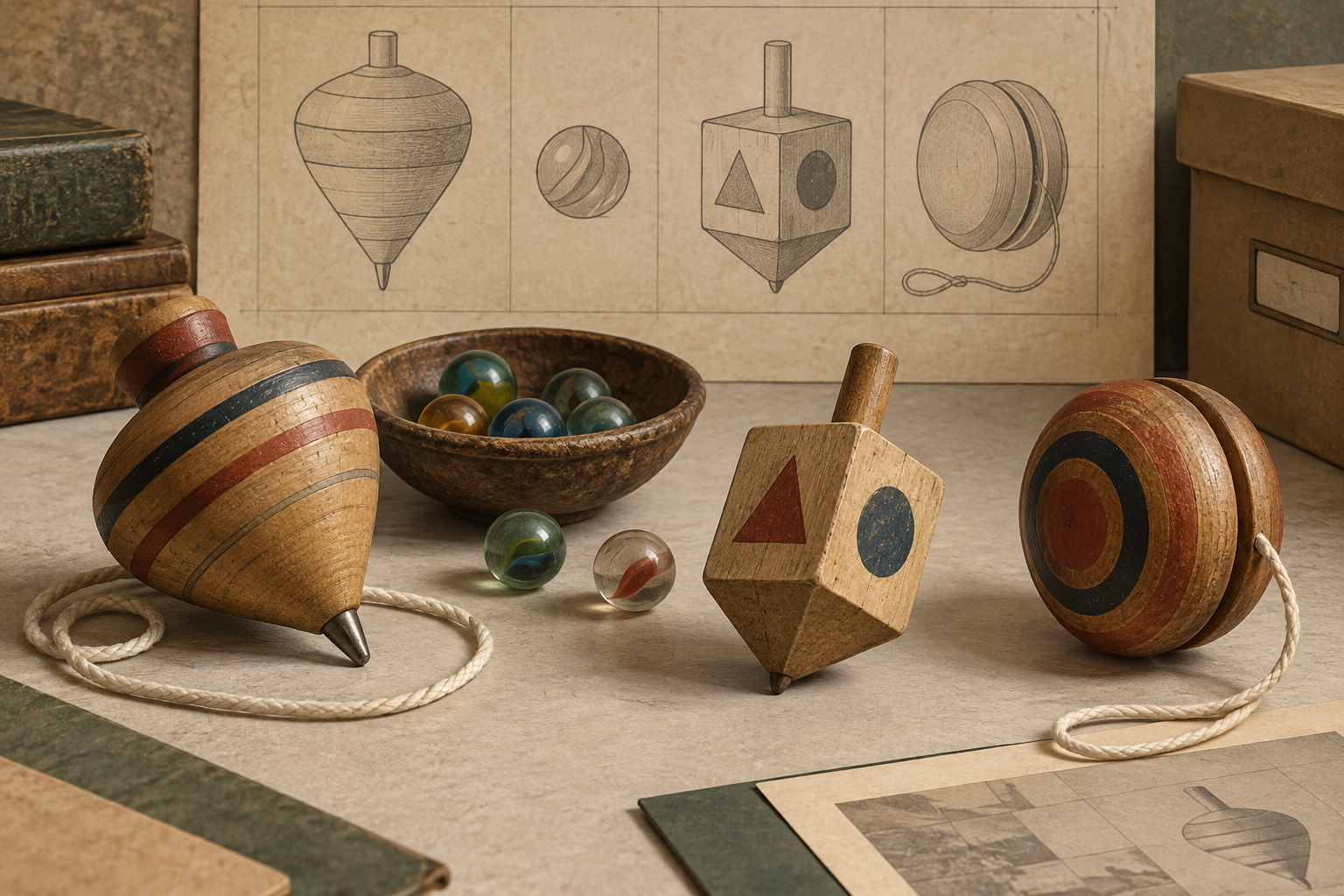
The museum identifies cup-and-ball toys, pirinolas, spinning tops, and yo-yos in its traditional collection. Naming these types helps recognize object families, but it cannot replace cataloguing. Two similarly looking tops may have different dates, woods, finishes, and histories of use. For an advanced reading, typology is a beginning; material and contextual documentation determine how far a historical claim can go.
The late 1950s: a material transition
Madrid’s exhibition Del juguete al cielo. Un siglo de historia 1880–1980 states that, in the late 1950s, plastic—easier and cheaper to produce—displaced wood and tinplate, while electrical components began to be introduced to extend toys’ capabilities. This is a significant marker because it discourages treating “the toy” as a materially stable category.
The statement is general. It cannot date the shift in a particular object or be applied without qualification to every territory. It can nevertheless contextualize a visible difference in collections: alongside handmade or mechanical objects in wood and metal, plastic and electrical components introduced other modes of production, preservation, and museum interpretation. A responsible timeline records that change without depicting it as total or instantaneous.
The toy as social learning
Spain’s Costume Museum explains that toys help children acquire skills for fitting into what is expected of them in the society where they live and for internalizing essential values of their culture. It also states that toys reflect the society and historical moment that create them, while carrying aesthetic value. This is a strong interpretive proposal, provided it is not used to infer a child’s private experience from an isolated object.
A doll, tea set, or miniature vehicle may, for example, point toward roles, aspirations, technologies, or everyday scenes. Meaning does not reside in design alone: it changes according to who gave, shared, kept, or discarded the object. The Royal Collections Gallery emphasizes that a toy is connected to a history of acquisition, recipient, gift-giving, intergenerational passage, or shared use. When known, this contextual information should be preserved with the item.
From domestic memory to the institutional archive
Preserving toys is not simply a matter of displaying them. The Colombian Pedagogical Museum connects its collection with preserving and researching school memory, disseminating educational material culture, and studying childhood; it also safeguards and exhibits documentary and bibliographic holdings. This model shows that an object gains depth when connected to photographs, catalogues, attributed testimony, inventories, and other preserved records.
An academic article available through Dialnet describes the Museu del Joguet de Catalunya as holding tens of thousands of toys alongside trading cards, comics, illustrated stories, nativity figurines, miniature theatres, and music boxes. The scope of this group shows that childhood material culture is not limited to a display case of independent objects. It also reveals a limit: a museum changes a toy when it separates it from playing and turns it into a collection item, document, and exhibit.
What a careful timeline can claim
For 1930–1960, the available evidence supports treating games and toys as useful for investigating childhood, education, craft, changing materials, and cultural heritage. It supports recognizing that institutions may preserve both objects and documentation, and that plastic took on a growing role in the late 1950s. It does not by itself reconstruct the frequency of use, price, social reach, or personal meaning of every model.
The strongest conclusion is not that a toy “contains” complete memory, but that it can trigger verifiable research. A well-catalogued object, accompanied by known provenance and presented with its uncertainties, can connect material culture and historical experience without confusing nostalgia with evidence. That is the difference between looking at old toys and using them as cultural sources.
- Decade
- 1960s
- Region
- Other regions
- Level
- Advanced restoration
- Entities
- No linked entities
Sources and references
- Anti-juguetes o la «memoria lúdica» tras un cristal: Una ...dialnet.unirioja.es · 2026-09-17
- Juguetes Reales - La Galería de las Colecciones Realeswww.galeriadelascoleccionesreales.es · 2026-09-17
- «Del juguete al cielo» | Condeduque Madridwww.condeduquemadrid.es · 2026-09-17
- Producción Artesanal – MUSEO PEDAGÓGICO COLOMBIANOmuseopedagogico.pedagogica.edu.co · 2026-09-17
- Pasado, Presente y Futuro - Museo del Juguetewww.museojuguete.com · 2026-09-17
- Juguetes - Museo del Traje | Ministerio de Culturawww.cultura.gob.es · 2026-09-17