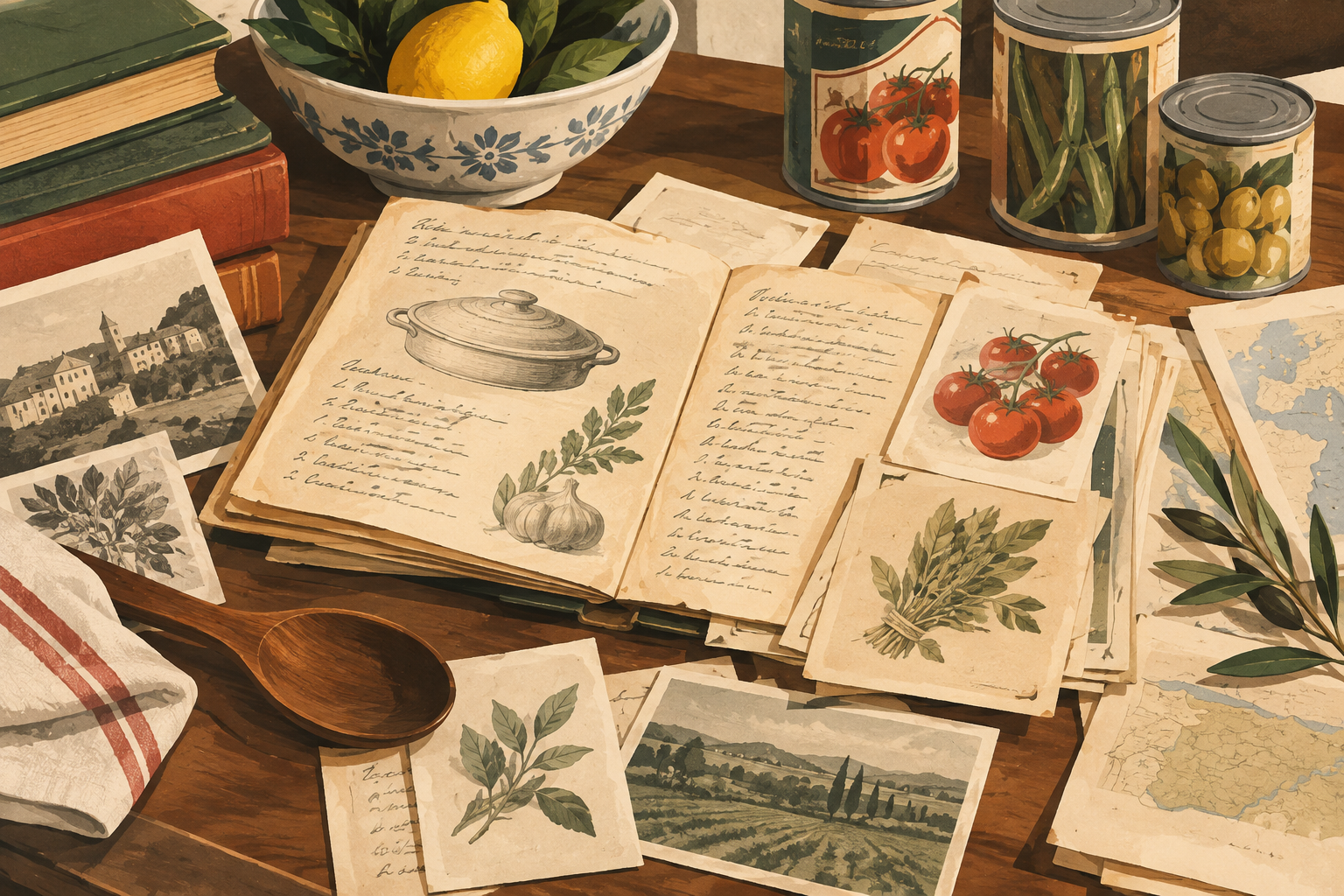
A preserved recipe is not a transparent window onto a meal from the past. It is a document produced in a particular situation: someone chose to note certain ingredients, preserve instructions or keep a notebook. Beside a label, a tin or a clipping, it can help reconstruct not only what people ate, but also what they considered worth remembering. Caution matters: an object can prompt questions; by itself, it neither represents an entire community nor proves that a recipe was prepared regularly.
The different traces left by food
Food archives and collections bring together materials that tell different kinds of stories. A household recipe book records instructions and ways of writing; a label helps us study a product’s design and message; a document may place a practice within a particular social relationship. According to its own presentation, the Museo da Conserva collection includes original tins, labels, documents and materials related to the history of the canning industry. These are not interchangeable sources: each reveals a different part of the journey from production and presentation to preparation and consumption.
This variety also appears in research on food heritage. An academic study from the Universitat Politècnica de València examines museums connected with food and frames its analysis around management, context and intangible heritage. Its approach is a reminder that food cannot be reduced to an exhibited object: the knowledge and practices that give the object meaning matter too. The diversity of institutions and collections makes it necessary to ask who selected the materials and what context accompanies each one.
A recipe book is not a complete portrait
A culinary text may preserve vocabulary, ingredients and ways of organizing work, but it does not necessarily tell us who cooked, who ate or how often a dish was made. Nor is the discovery of a recipe enough to conclude that it represented a region or an era. An archive records what was kept and survived, not a neutral sample of all everyday life.
An article about documents associated with an aristocratic household connected to Valencia offers a specific, limited example: it describes sweets and other products mentioned in a document, including fruit preserves, cacao, sugar and cascas. That record is valuable precisely when it remains attached to its context. It tells us what appears in that document and household; it cannot automatically be turned into a description of what the entire Valencian population ate.
Labels, tins and visual culture
Packaging adds another layer. A label is not simply an identification of its contents: it also preserves graphic choices and messages associated with a product. The Museo da Conserva says it keeps original tins, labels and documentation to reconstruct the history of the seafood-processing industry. The relationship between form, function and message can be studied as material culture, without mistaking a printed commercial claim for an independent description of the food.
Looking at a tin in a display case is not the same as knowing how it was used at home. Complementary sources and specific questions are needed to interpret that experience. What information does the object provide? What do associated documents add? What remains outside the frame? An exhibition or archive can bring materials closer to the public, but context prevents an object from becoming an illustration detached from the people and processes that produced it.
Memory, transmission and selection
Public-facing projects can reactivate materials that might otherwise remain in a collection. The Museo da Conserva describes a campaign centred on domestic recipe books under the idea of «comida viejuna» and invites people to reinterpret recipes connected with its collection. This does not make present-day versions exact copies of the past. Rather, it shows how an institution proposes rereading documents and how the public can engage with them.
Oral memory and local practices offer other perspectives, although they do not replace documentary evidence. A study on yaquispala addresses local practices, memory and conservation; its title and bibliographic record identify that focus, but the information available here is not enough to summarize its findings. Similarly, a publication on local food culture in Costa Rica and a study of culinary notes in Argentina point to areas of research, not permission to generalize their conclusions beyond what the sources describe.
What can be said, and what remains open
Reading recipe books, packaging and documents together helps us study food as material and social history. It also requires us to distinguish a preserved object, an institution’s interpretation and a broader historical claim. The available sources support discussion of food collections, specific documentary examples and projects that share recipes with the public; they do not provide a complete history of sweets, preserved foods or the consumption habits of a particular population.
That limitation does not make the archive less interesting. It makes it more useful: each item can be read for what it actually contains, alongside the questions it leaves unanswered. A recipe speaks of ingredients and writing; a label, of presentation and message; a collection, of choices about preservation. Read in context, together they bring us closer to food as a documented way of life—one never wholly contained in paper or in a display case.
- Decade
- Contemporary
- Region
- Spain
- Level
- Enthusiast
- Entities
- No linked entities
Sources and references
- Navidad en los archivos, historia y tradición - Xercodexercode.com · 2026-09-25
- Museos, Interpretación y Gastronomía – EVE Museos + Innovaciónevemuseografia.com · 2026-09-25
- Directora Nuria Ramón Marqués Septiembre de 2021 Gerardo Jesús García Olivaresriunet.upv.es · 2026-09-25
- Home - funpromarmuseoconserva.com · 2026-09-25
- Entre recetas, memorias y apellidos - funpromarmuseoconserva.com · 2026-09-25
- Archivowww.foodcultura.org · 2026-09-25
- Diálogos Revista Electrónica de Historia E-ISSN: 1409-469Xwww.redalyc.org · 2026-09-25
- Costumbres en común. Escritura, mujeres y saberes: apuntes culinarios. Argentina, 1880-1980openalex.org · 2026-09-25