The object does not tell its whole story
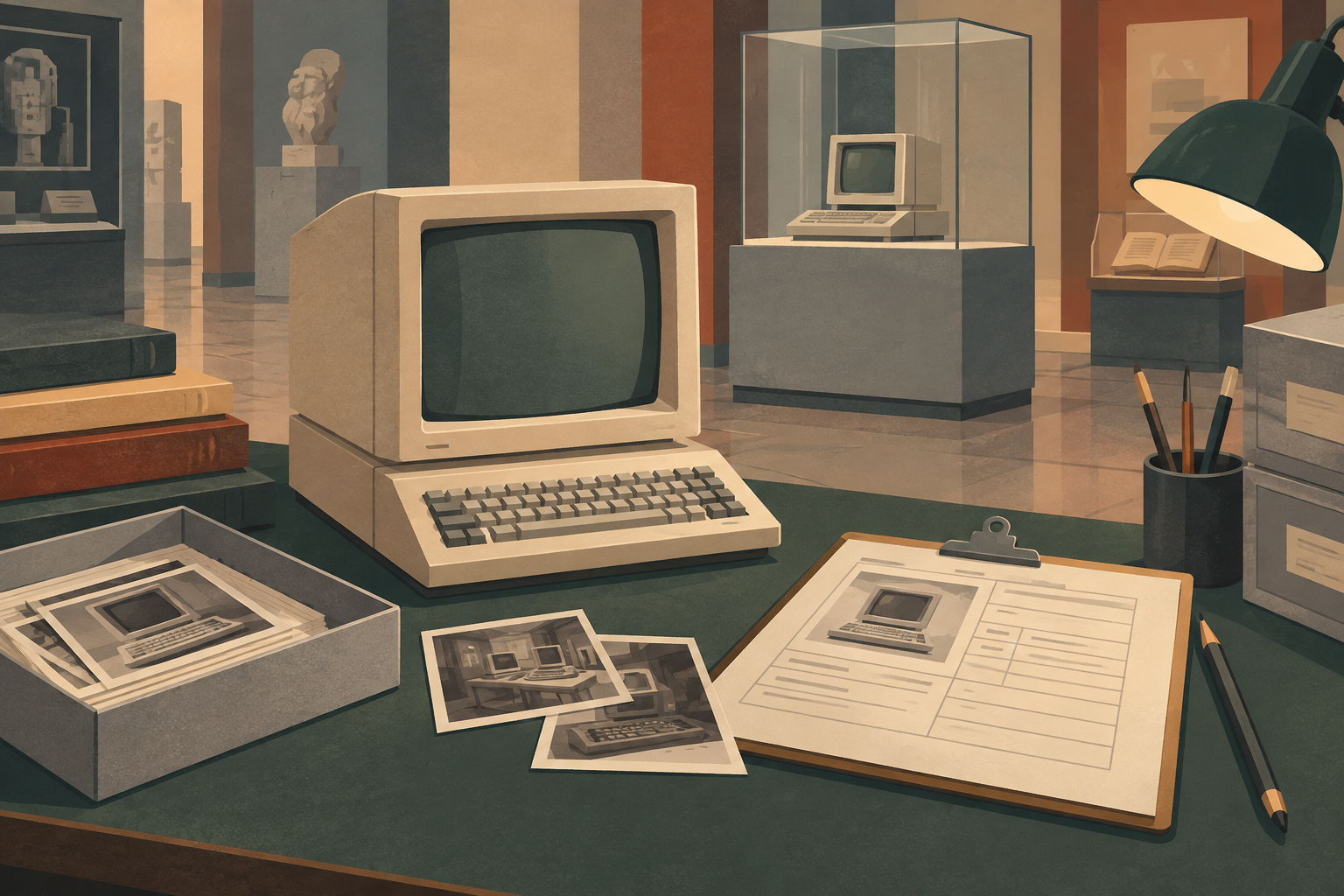
A computer on display can seem self-contained: a case, a screen, a keyboard, perhaps a storage drive. Yet its appearance alone cannot explain how it entered a collection, the condition in which it arrived, which components it retains, or how people used it. The distinction between seeing an object and knowing its trajectory matters to any museum that wants to present computers as more than curious shapes from the past.
Museum documentation can connect each object to its history and condition. Francisco Javier Zubiaur Carreño’s museology text stresses that acquisition conditions, observations about condition and the object’s history should be recorded. It also argues that keeping an object without keeping the documentation that explains how it was found can reduce a museum to a warehouse. This is not guidance written exclusively for computing; applied to a computer, however, it prompts specific questions, whose answers should be recorded only when evidence supports them.
A record is part of the collection too
A computer does not necessarily arrive with a complete history. There may be acquisition documents, institutional records, photographs or other material; there may also be gaps. The museum’s task is not to fill those gaps with a plausible story, but to distinguish what is documented from what is unknown. A clear record can state observed condition, documented provenance and uncertainty without disguising any of them.
The University of Valencia’s material on computing in museums describes management functions that include a documentary and image file for each object, along with the control of movements, loans and locations. This perspective moves preservation beyond the display case and into the everyday life of a collection: knowing where equipment is, what information accompanies it and which records need updating are also preservation work.
Navarra’s archival-management instructions make the broader point that documentation related to objects and their context should remain within the institution. For a computing collection, this principle can help prevent a machine from becoming separated from the records that support its interpretation. It does not mean that every computer has an associated archive; the useful principle is to retain and describe together materials that are demonstrably connected.
A computer as object and system
Computing equipment raises another question: what we see may be only part of what once made up its use. A computer may depend on components, storage or programs, and a stored machine does not by itself prove that it can operate again. It helps to distinguish three separate aims: keeping the physical object, preserving information connected with it, and maintaining or reconstructing an experience of use. The evidence available here does not warrant assuming that any one of these tasks guarantees the others.
The digital-preservation entry describes the challenge as keeping information usable despite changes in formats, programs, machines or systems, and identifies properties including integrity, authenticity, reliability, legibility and functionality. That is a useful framework for thinking about digital data and documents, but it is not automatically a complete protocol for preserving historic hardware. The distinction matters: a machine may survive physically while some content becomes inaccessible, or information may be preserved without the original equipment being available.
Record the work, not just the result
A report on the Museum of the History of Computing in Majadas de Tiétar describes work with computers there, including a restoration project involving an IBM System/370 and attention to its components. The report offers a particular case, not a universal standard or a guarantee that every machine can be treated in the same way. It does show that a computer can involve decisions about groups of parts, space and operating conditions, as well as visual identification.
Documentation makes those decisions understandable. Recording what was observed, what has been retained, what has been changed and what remains unverified is not a bureaucratic extra: it allows the next team to understand the object’s condition and prevents an intervention from being presented as though it were the machine’s original state. When information is insufficient, honesty means recording that limitation.
From internal archive to public account
Institutional archives can help reconstruct not just objects but also the work of the museum and the people who studied or cared for them. EVE Museos + Innovación describes organizational archives as records of an institution’s history and development, collections, exhibitions and programs, and emphasizes their preservation and public access. For computing, such records may provide context about how an institution acquired, documented or presented its equipment, provided the specific documents support that account.
Digitization does not solve the problem by itself. An article in the journal Clip de SEDIC warns of the need to arrange materials and ensure their condition before digitizing them, and to add contextual metadata that will make them retrievable later. The practical conclusion is simple: an unidentified digital photograph can reproduce, on a different medium, the same lack of context as an object without a record.
What an exhibition can claim
A good public presentation need not pretend that every computer has a complete biography. It can explain what is known, which documents support that knowledge and which questions remain open. It can also distinguish the physical equipment, its associated records, and the data or programs that someone is trying to preserve. That approach makes technology easier to understand while avoiding the transformation of a familiar appearance into an invented story.
The sources considered here do not provide a comprehensive manual for every type of machine, nor do they determine how any particular object should be treated. They support a more basic and valuable idea: a museum computer is easier to interpret when object and documentation remain connected, when known condition and history are recorded, and when facts are clearly separated from hypotheses. A display case may attract the eye; the archive gives that attention something to learn.
- Decade
- Contemporary
- Region
- Global
- Level
- Enthusiast
- Entities
- Museum
Sources and references
- Capítulo 10 - El museo como centro de investigación. La necesidad de documentar las piezas en el museo. Tendencias documentales actuales. Normalización y gestión integral del museo. - Fco Javier Zubiaur Carreñowww.zubiaurcarreno.com · 2026-09-25
- El museo la informáticawww.uv.es · 2026-09-25
- instrucciones para la gestión y organización de archivos ...www.navarra.es · 2026-09-25
- Clip de SEDIC, Revista de la Sociedad Española de Documentación eedicionsedic.es · 2026-09-25
- Archivos de Museo: Funcionamiento - EVE Museos + Innovaciónevemuseografia.com · 2026-09-25
- El Museo de Historia de la Computación, paraíso de los ordenadores de todos los tiemposwww.microsiervos.com · 2026-09-25
- Preservación digitales.wikipedia.org · 2026-09-25