Intervention Does Not Begin with a Tool
Restoration is often imagined as a visible gesture: repairing, cleaning, stabilising or making an item legible again. Yet the institutional material available on conservation in Spain describes broader work. Before, during and after any intervention, there is observation, recording and filing that can explain what was found, what was decided and where the limits of the action lay.
This dimension is especially important for historical, documentary and artistic collections. The Spanish Cultural Heritage Institute (IPCE) presents publications addressing, among other matters, the characterisation of metals and corrosion products, cleaning considerations, inhibitors and conservation in temporary exhibitions. This is not a universal recipe: the value of the approach lies precisely in connecting materials, context and procedure.
The Report as Part of the Object’s History
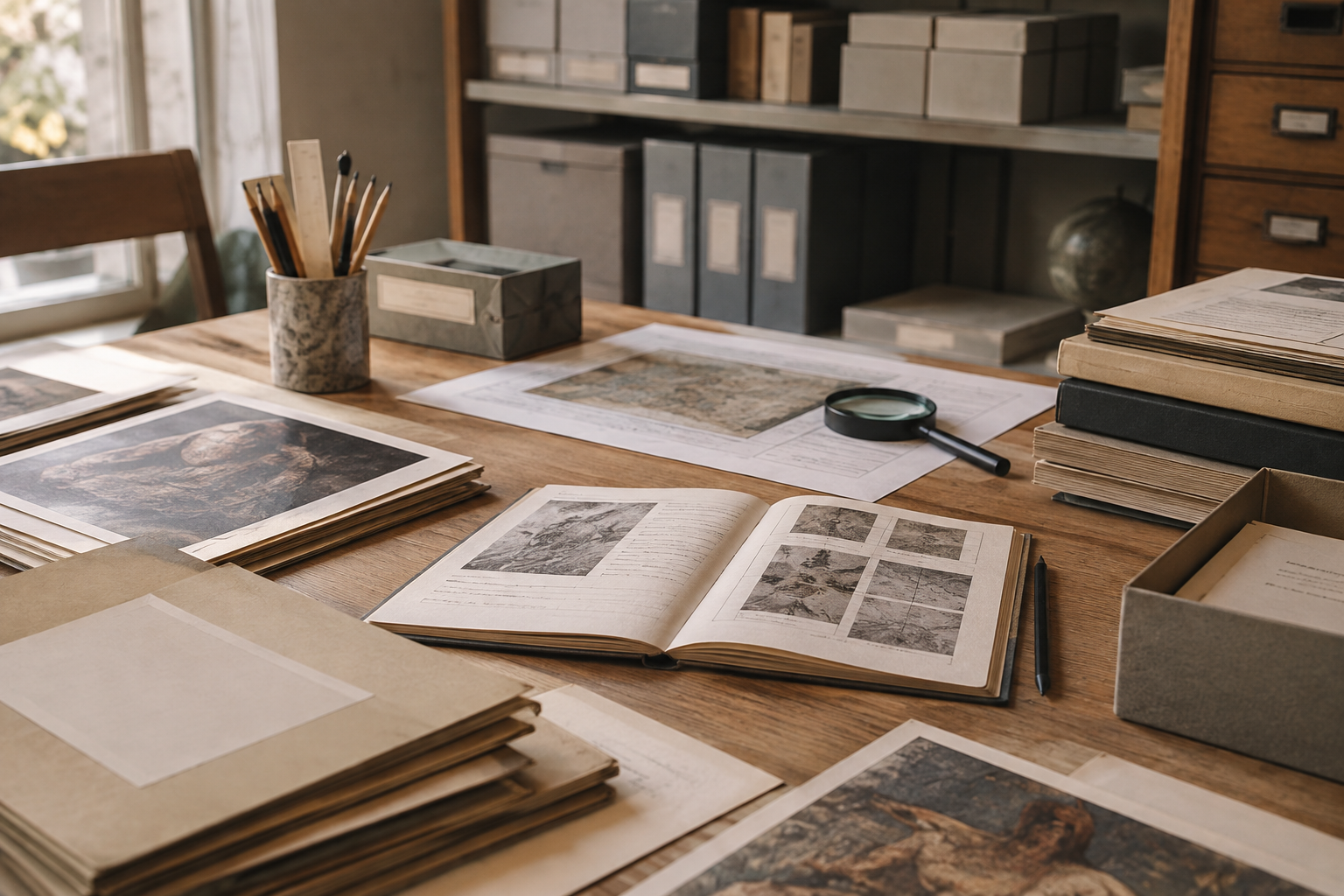
The Museo del Prado states that systematic reports began to be written for every treated work at a later stage in its history, going beyond simple lists. It also notes that these reports were organised in a dedicated archive. The point is revealing: the memory of a restoration resides not only in the restored object, but also in the documents produced around it.
A report does not replace the item, but it can reconstruct the reasoning behind a decision. It can place an intervention in time, distinguish observation from interpretation, and retain information for later researchers or caretakers. Documentation, then, is not bureaucracy added at the end; it is a condition for work to remain reviewable and understandable.
Criteria: Minimum Intervention and Reversibility
The National Museum of Natural Sciences, part of CSIC, explains that occasional restoration of severely damaged documents follows international criteria recommended by ICOM: documentation, reversibility, minimum intervention and stability of the products used. This wording matters because of what it rules out. Restoration is not framed as unrestricted transformation, but as an action constrained by material condition and by the need to preserve future options.
Reversibility and minimum intervention should not be treated as abstract promises that apply identically in every case. The source presents them as working criteria in documentary conservation. Still, they suggest a useful question for any collection: does the proposed action preserve information and room for future decisions, or erase traces that may later matter?
Preventive Conservation: Acting Before Damage
The MNCN-CSIC page also describes tasks that are not restoration of an individual work in the narrow sense: controlling photodeterioration through periodic replacement, conservation reports for loans, advice on installation and display, staff protocols, and cleaning and maintenance of stores and galleries. These are preventive measures. Their stated purpose is to extend the life of documents as far as possible, since some may deteriorate or disappear because of the inherent fragility of their supports.
IPCE likewise stresses that archives, libraries and museums should establish preventive-conservation programmes and disaster-management plans suited to their collections, resources and needs. The editorial consequence is straightforward: preservation is not only reacting to breakage. It includes creating conditions in which damage arrives later—or does not arrive at all.
The Archive as Cultural Infrastructure
Documents in the MNCN Historical Archive come from the museum’s own history and are complemented by donations, deposits and purchases. The institution safeguards, catalogues and manages them for research and scientific outreach. This description challenges a common assumption: an archive is not a passive store, but infrastructure enabling access, study and ongoing care.
Spain’s Ministry of Culture also preserves the publication Archives for the History of Restoration, collecting papers presented at a lecture series held at the National Historical Archive between October and November 1981. Without assigning conclusions not detailed in the supplied material, its existence itself confirms that archives are also a route to studying the discipline’s history.
What a Collector Can Learn
These sources concern institutions and heritage collections; they do not authorise the transfer of professional procedures without training or facilities. Their safest lesson for someone caring for objects at home is methodological: record condition before changes, retain provenance and notes, avoid impulsive irreversible decisions, and distinguish routine cleaning, preventive conservation and specialist intervention.
That caution is particularly valuable when an object retains use marks, fragile components or associated documentation. The urge to make it “like new” may be less important than retaining evidence of its material history. When scope, materials or deterioration are uncertain, professional advice is preferable to improvisation.
A Legacy That Can Be Reviewed
Restoration produces two outcomes: the object in its later state and the trail that explains how it reached that state. The Prado, MNCN-CSIC and IPCE sources, from different perspectives, place documentation, prevention and material knowledge within heritage care.
Not every household object needs an institutional file. Yet the principle remains useful: a collection is more legible when its changes can be recounted. Responsible restoration begins with looking, continues with recording, and only then decides whether intervention is appropriate.
- Decade
- Contemporary
- Region
- Spain
- Level
- Enthusiast
- Entities
- Museum
Sources and references
- Publicaciones sobre Conservación-Restauración y Gestión del Patrimonio - Instituto del Patrimonio Cultural de España | Ministerio de Culturaipce.cultura.gob.es · 2026-09-20
- Historia de la restauración en el Museo Nacional del Prado (edición digital)tiendaprado.com · 2026-09-20
- Los archivos para la historia de la Restauración - Ministerio de Culturalibreria.cultura.gob.es · 2026-09-20
- Restauración de Colecciones Documentales | Museo Nacional de Ciencias Naturaleswww.mncn.csic.es · 2026-09-20
- Restauración en el Museo del Prado. - Museo Nacional del Pradowww.museodelprado.es · 2026-09-20