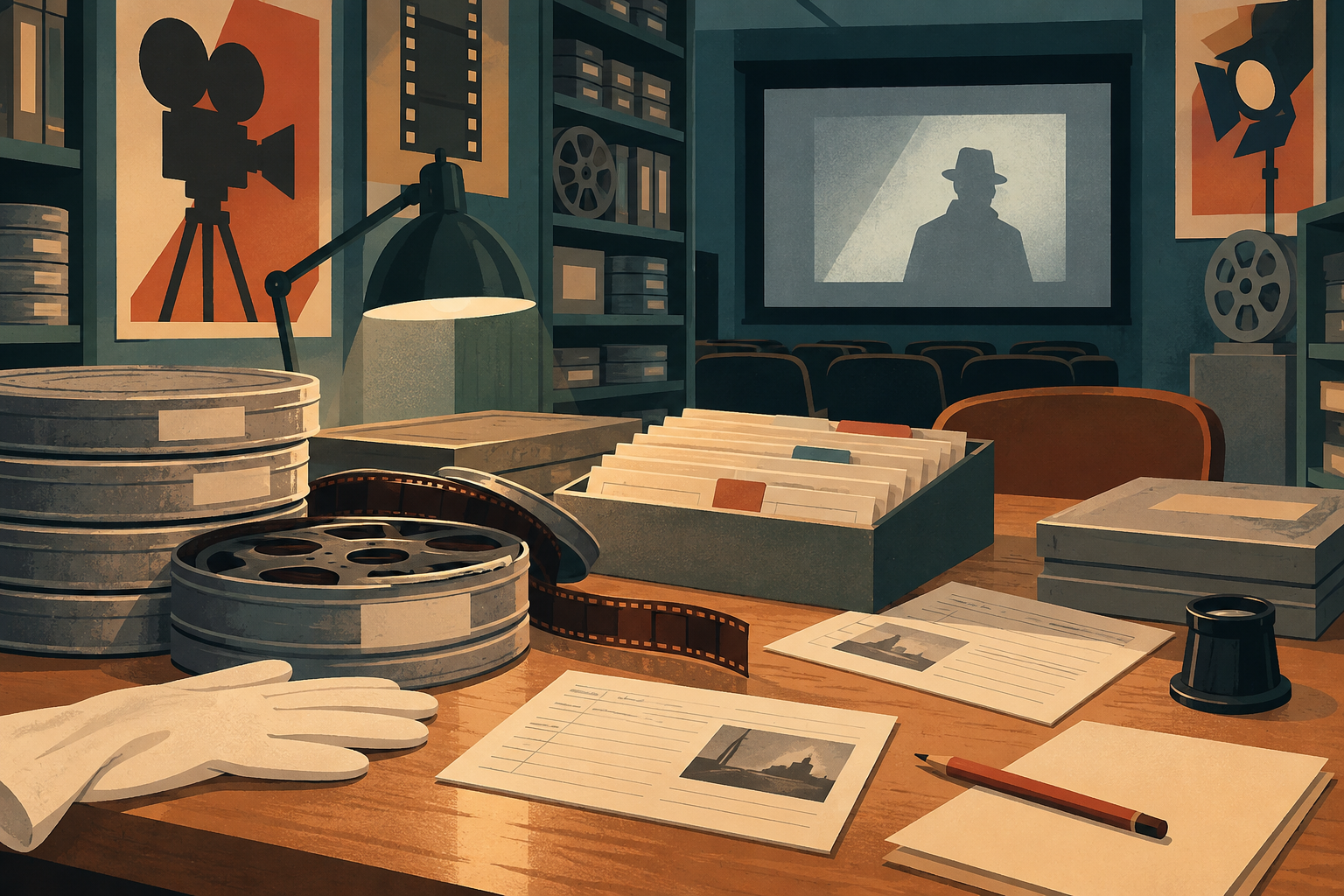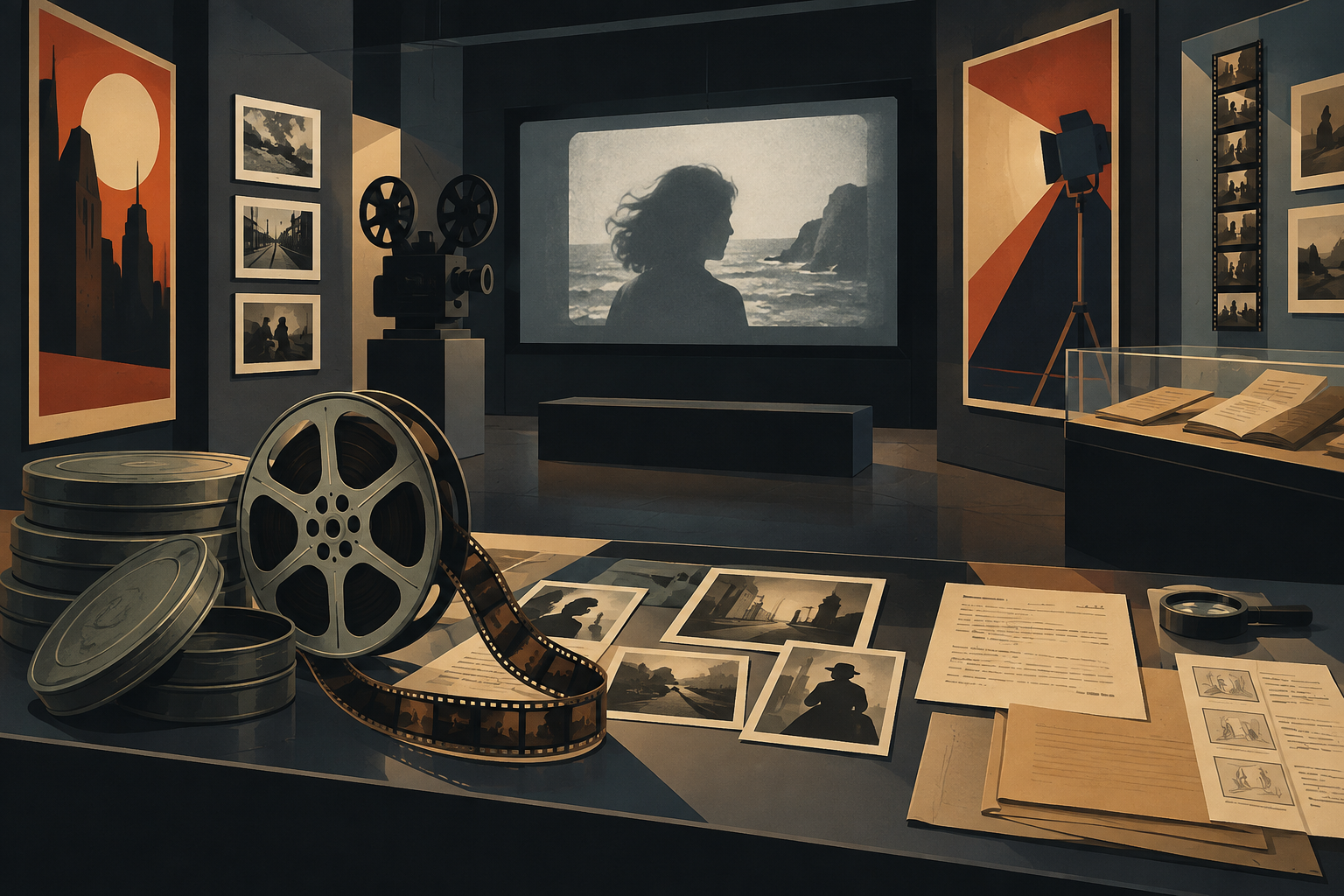
A cinema museum preserves more than images intended to return to a screen. It may also care for carriers, equipment, photographs, posters and documents connected with the production, circulation and preservation of films. This variety changes the familiar question: it is not only how to store a film, but what we mean by “the film” and which parts of its history we want to make visible. The scholarship and institutional resources consulted show that film heritage has material, artistic, historical and documentary dimensions. They do not offer a single universal definition of preservation; they do show why a film may require more than one kind of attention.
An artwork, but not only an artwork
One museological perspective described in a study of film heritage understands cinema as art and a film as human testimony, connected to authorship or a cultural moment. In this approach, materiality may recede behind the film understood as a concept or artwork. It is an important way to interpret cinema: it makes room to discuss language, creation and context, and avoids reducing a film’s value to its physical carrier.
But that perspective does not exhaust what an institution can preserve. If a film is presented only as an artwork, the objects and documents that help us study how it was produced, identified, distributed or reviewed may disappear from view. There is no need to choose between art and materiality. They are different perspectives and can coexist in an exhibition or archive. The first attends to what the film expresses; the second also asks about the material and historical conditions that made its existence and transmission possible.
The carrier is part of the history
The academic article on the Cineteca Nacional de México notes that film archives may preserve unique or especially significant copies, and that the materiality of film materials—particularly those connected with silent cinema—affects their heritage status. It also points out that photographs, posters and projection equipment can provide knowledge about the technical and material processes in cinema’s history.
The editorial consequence is concrete: a museum can tell a film’s history not only by showing its plot or a sequence, but by explaining which objects and documents survive around it. A projector is not, by itself, a complete explanation of how a work was seen; a photograph does not replace the film. Their value lies in what they can document when related to other materials and presented with sufficient information. A collection, then, is not nostalgic scenery: it can serve as evidence for research and interpretation.
Preservation, conservation and restoration are not simple synonyms
The academic sources note that the terms preservation, conservation and restoration have been discussed across different institutions, languages and practices. The study of the Cineteca Nacional emphasizes that there is no single interpretation and that meanings can vary according to the institution and processes involved. Another text, published in the Andalusian Institute of Historical Heritage’s bulletin, presents film restoration as a complex field in which archives and laboratories collaborate on duplication work.
It is therefore wise to avoid a story in which restoration simply means “fixing” a film and returning it to an obvious, unquestionable state. The available sources do not justify a universal technical recipe or the claim that every intervention has the same aim. They do support a cautious distinction: preservation, conservation and restoration are related concepts, but they are not automatically interchangeable. Explaining what each decision means and which materials support it is part of an institution’s responsibility.
The archive also preserves information
Filmoteca Española’s archive holds documents associated with the films in its care: inspection and restoration reports, main titles, end-credit rolls, records concerning rights, ownership documents, exhibition licences and censorship bulletins, among other items. The institution connects these materials with cataloguing, description and the management of loans, reproductions, restorations and digitisation.
This relationship helps explain why preserving a film is not the same as preserving only its audiovisual content. Documentation can help identify materials, reconstruct administrative histories or interpret exhibition conditions. The precise scope of any document depends on what it contains; we should not assume all documents answer the same questions or exist for every title. Even so, the existence of associated archival records offers visitors an important idea: a film belongs to an institutional and material history that may also leave written traces.
Access is part of the purpose
Filmoteca Española’s Film Conservation Department describes its mission as safeguarding audiovisual works on video and in digital formats, and ensuring access to their contents over time. In this framework, preservation is not passive storage: it is connected to the possibility of finding and consulting works again. A study of film archives also discusses the shift from conservation to dissemination and mentions the specialist library as part of these institutions’ work.
This does not mean that every work can be shown in any way, or that access and preservation are identical goals. The sources brought together here do not specify technical conditions for every item in a collection. They do show that an institution may need to serve both purposes and explain how they relate. An exhibition, a document consultation and a screening are different ways of approaching heritage; each needs context so that audiences understand what they are seeing and the limits of that experience.
A memory made of relationships
The Ministry of Culture’s announcement of a future Cinema Museum in the former NO-DO building illustrates an interpretation project combining place, archives and audiovisual memory. According to the official information, the NO-DO negatives are held at Filmoteca Española’s Conservation and Restoration Centre; the project proposes a space to preserve and share the building’s history and the role of NO-DO in the audiovisual imagination. This is a specific institutional example, not a description of a museum already open or a guarantee of how the collections will be presented.
The underlying idea extends beyond that project: film heritage is not one thing that can be summed up by a screen. It is a web of works, carriers, documents, objects and decisions about access. A museum explains cinema more fully when it makes those relationships visible and distinguishes what can be demonstrated from what is interpretation. The sources consulted support this plural view, but do not settle every debate about terminology, practice or priorities. Acknowledging that limit does not weaken history; it makes more transparent how it is constructed and passed on.
- Decade
- Contemporary
- Region
- Global
- Level
- Enthusiast
- Entities
- Archivo de Filmoteca Española, Museum
Sources and references
- Concepto | Estudios El Patrimonio cinematográfico en el Museodigibug.ugr.es · 2026-09-23
- El nuevo Museo del Cine se ubicará en el antiguo edificio del NO-DO | Ministerio de Culturawww.cultura.gob.es · 2026-09-23
- 1 Dossiê El cine como patrimonio culturaldialnet.unirioja.es · 2026-09-23
- Departamento de Conservación fílmica - Filmoteca Española | Ministerio de Culturawww.cultura.gob.es · 2026-09-23
- Investigación Restauración cinematográfica. Tierra de nadiewww.iaph.es · 2026-09-23
- Acerca de los conceptos de preservación, conservación y restauración fílmica en el caso de la Cineteca Nacional de México desde los planteamientos de Paolo Cherchi Usaiwww.scielo.org.mx · 2026-09-23