A heritage that does not fit inside a cartridge
Video-game preservation can sound like a simple task: keep a console and its games so that they continue to exist. The evidence gathered by Spanish museums and archival projects points to a broader reality. Video games have depended on machines, software, firmware, documentation, advertising, publications and audiovisual material. If one element disappears, playing may not become impossible, but an essential part of how a game was made, circulated and understood can be lost.
The Museo del Videojuego describes its purpose as preserving the history of the medium so it can be explained to people who did not know periods before PlayStation or Xbox. Its account does not separate games, consoles and computing: it presents an interconnected history of arcade machines, consoles, handhelds and computers. That breadth matters. A history reduced to famous titles leaves out the supports and practices that made the experience possible.
The object is not the only record
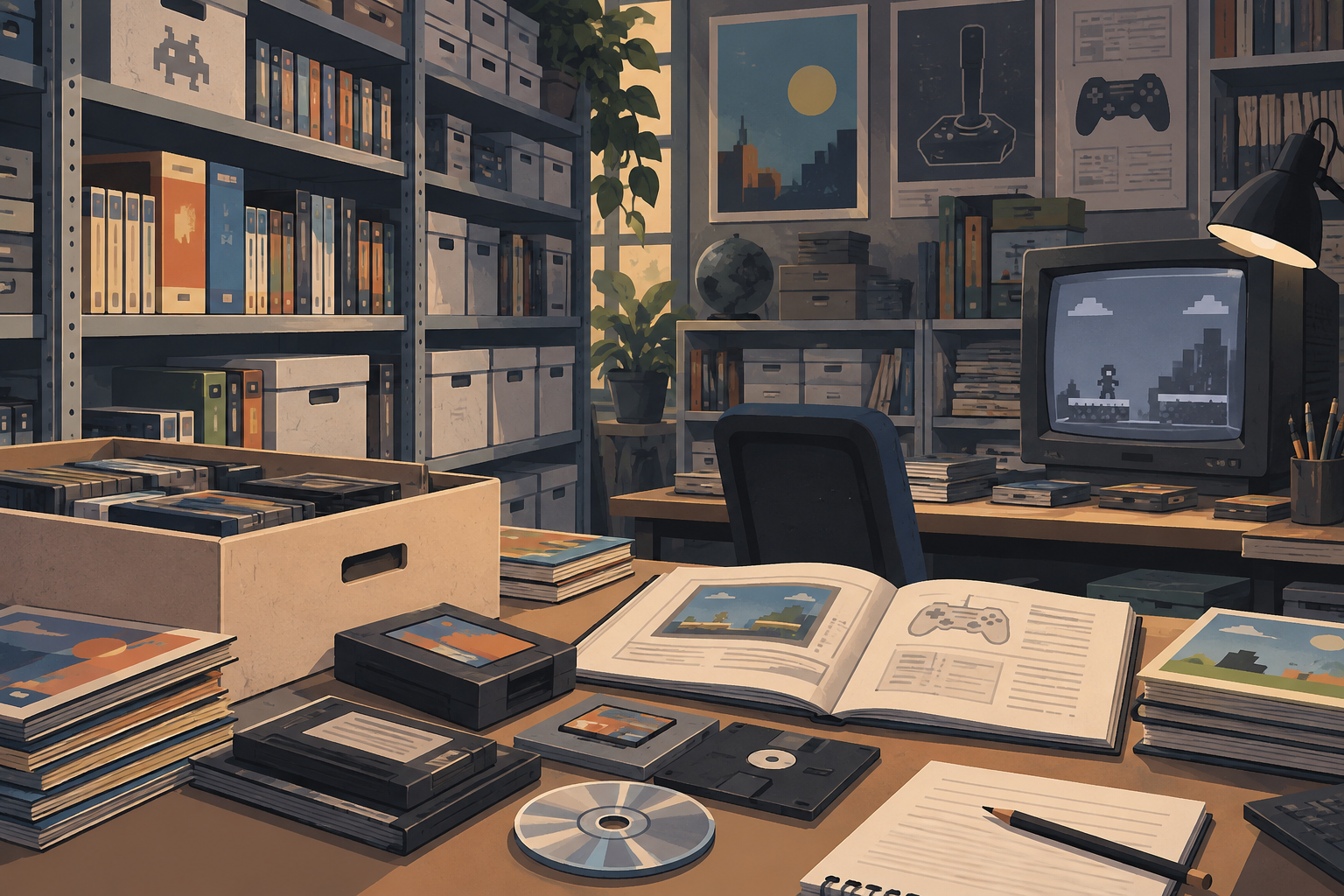
The Museo del Recreativo’s preservation fund states that it seeks to provide physical and digital means to consult, display and teach with documentation, machines, software and hardware. This approach makes clear that a museum piece need not be a single working machine. A board, manual, poster, magazine, guide or trade-show video can each supply different information.
The Museo del Videojuego’s digital library lists material often left aside by collections focused only on games: print advertising, specialist press, guides, promotional discs, demos, reports, trailers, intros and audiovisual material from events such as E3, CES and Tokyo Game Show. These are not merely decorative extras. They can help reconstruct how a product was presented, the language used by the press, the information available to audiences and the expectations surrounding a release.
Hardware, software and dependencies
Video games present a particular challenge because the work and its technical setting are closely tied together. The Museo del Videojuego notes the importance of digital electronics, associated software and hardware firmware. This is enough to challenge a common assumption: that preserving a game file automatically preserves the game as a historical experience.
That does not mean a digital copy lacks value. It can be essential for access, research and dissemination. Yet the available evidence suggests that access should not be confused with complete preservation. The medium, peripheral, interface, display, documentation and knowledge of use can all shape the interpretation of a work. Preservation therefore means documenting relationships: what worked with what, how it was distributed and in which setting it was used.
From arcade venue to archive
Arcade Vintage describes itself as an association created to preserve and share the culture of coin-operated arcades and arcade machines from the 1970s, 1980s and 1990s. Its museum lists exhibitions on video-game history, classic-game preservation, links with music, film and comics, documentation and the acquisition of new pieces. It also mentions “arcadeological” expeditions in Spain and Europe.
That language suggests that preserving arcades is not only about recovering cabinets or circuit boards. The arcade was a collective place, with social rules, sounds, physical layouts and forms of encounter that do not fit entirely into a technical record. A machine may be the starting point, but documentation and interpretation help explain its cultural life. In this sense, the museum does not merely keep objects: it organizes a narrative that makes connections among objects, places and practices visible.
Selecting is also interpreting
Canino’s article notes that no full consensus exists on preservation strategies and that every decision to save or exhibit a game is filtered through an understanding of the medium and its experiences. This is a useful warning. No archive can keep everything, and decisions about what to catalogue first, digitize or display shape future memory.
This limit does not diminish the work of museums and collectors; it makes that work more responsible when the limit is stated openly. Preservation needs criteria, clear descriptions and awareness of its gaps. It also needs a distinction between claims documented by preserved material and later interpretation. Nostalgic accounts may offer an entry point, but they do not replace documentation.
Preserving in order to consult and teach
Conservation is not only about preventing disappearance. The Museo del Recreativo stresses consultation, display and teaching; Arcade Vintage emphasizes interaction, creativity and outreach; the Museo del Videojuego makes library and catalogue material available. These practices make heritage usable: a source for research, learning, comparison and debate.
Discussion of video games in libraries, archives and museums also recalls that archives matter to long-term conservation. At the same time, games can become vehicles for cultural communication: Ana Ordás’s text cites NUBLA, an educational project linked to the Thyssen-Bornemisza Museum, as an example joining narrative, art and interaction. This does not prove that all cultural games work alike, but it does show that institutions can approach games both as objects to preserve and as a language for bringing content closer to audiences.
A layered memory
Video-game preservation cannot be reduced to accumulating boxes or retaining an executable copy. It requires attention to objects, programs, documents and contexts; making them available for consultation where possible; and recognizing the technical, legal and material limits of each project. The museums and archives cited here point in a clear direction: preservation gathers evidence so the medium’s past can be studied and explained, not simply remembered.
The task will remain incomplete because games change and every collection selects. That is precisely why archives that also retain magazines, guides, advertisements, videos, hardware and documentation matter. In those layers lies a substantial part of video-game culture: not only what people played, but how, where, with which objects and through which narratives playing was understood.
- Decade
- Contemporary
- Region
- Spain
- Level
- Enthusiast
- Entities
- Salón recreativo, PlayStation, Museum
Sources and references
- Objetivo del Museo del Videojuego | Museo del Videojuegowww.museodelvideojuego.com · 2026-09-20
- Videojuegos para bibliotecas, archivos y museos – Ana Ordásanaordas.com · 2026-09-20
- Misión – Museo Arcade Vintagemuseoarcadevintage.com · 2026-09-20
- "Everything not saved will be lost": de museos, archivos y preservación de videojuegos - Caninowww.caninomag.es · 2026-09-20
- Fondo de Preservación | Museo del Recreativomuseodelrecreativo.es · 2026-09-20
- Descargas | Museo del Videojuegowww.museodelvideojuego.com · 2026-09-20