A medium that leaves many traces
When video-game conservation is discussed, the subject is often reduced to a technical question: if the program runs, has it been preserved? The available evidence calls for a more careful answer. Museo del Recreativo describes its preservation collection as physical and digital means for consulting, displaying and teaching documentation, machines, software and hardware. Museo del Videojuego likewise describes an archive of game and console data, images, magazines and videos. A runnable game is therefore important, but it is not the only trace through which a game can be understood.
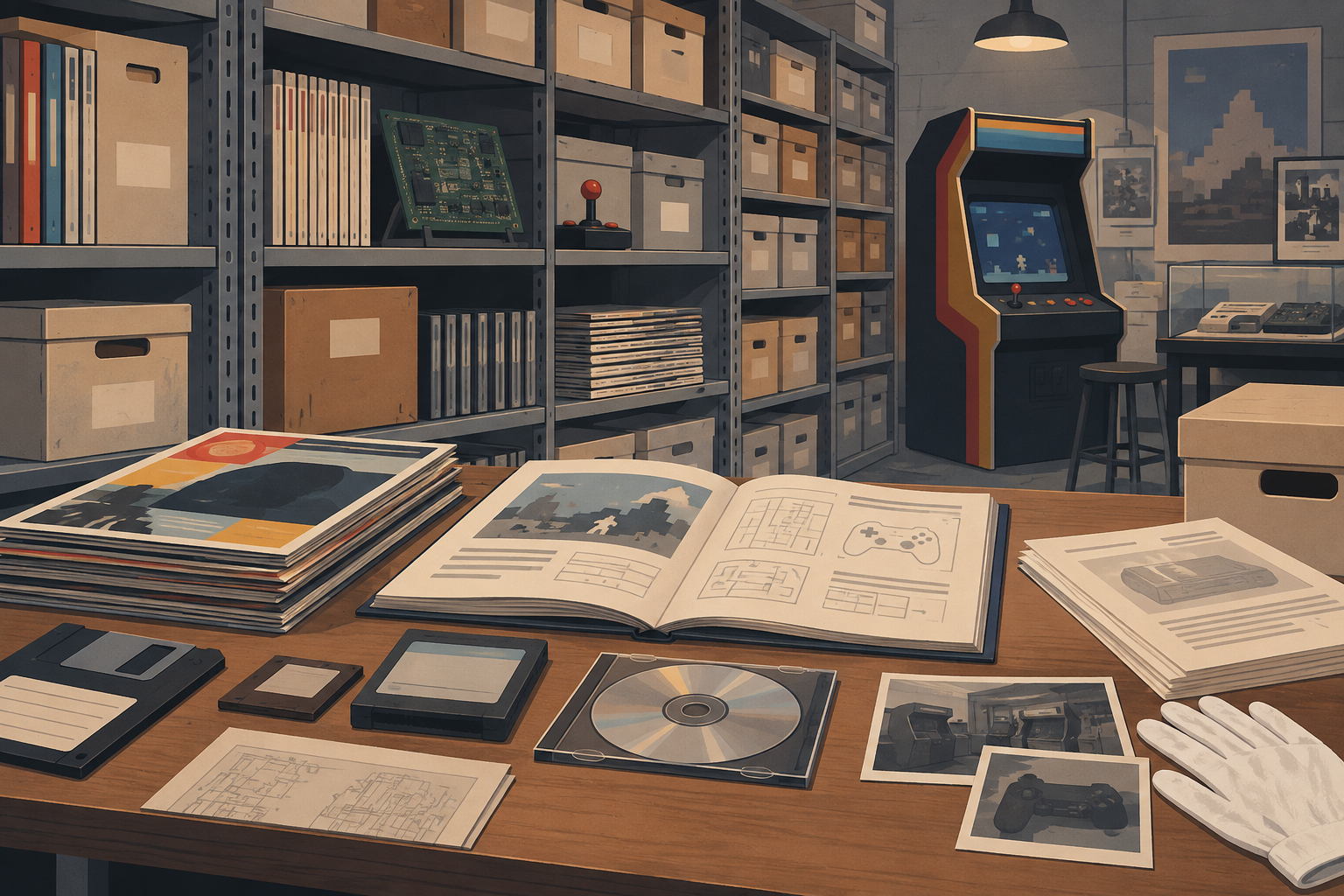
This is not merely a collector’s distinction. A title may survive as a digital file while losing the materials that explained how it reached players, how it was installed, what its advertising promised or which device it used. Manuals, boxes, guides, advertisements, promotional discs, specialist magazines and recordings from trade events can preserve information absent from the software itself.
The object extends beyond its medium
Material preservation includes arcade machines, consoles, computers, peripherals and physical formats as well as software. Museo Arcade Vintage lists classic-game preservation, documentation, acquisitions and arcade-machine restoration among its activities. This indicates a basic fact: for many games, the historical experience is connected to a particular system and its components.
The evidence does not, however, establish a universal method for reproducing every original experience. Conserving a machine can support study of its design and use; digital consultation can widen access to documents; and a modern recreation can be useful for playing or research. These are related aims, not identical ones. Treating them as equivalent would conceal the curatorial, technical and legal choices each institution faces.
Archiving editorial and audiovisual context
Museo del Videojuego’s digital library lists official guides, walkthroughs, printed advertising, commercials, specialist press, reports, documentaries, trailers, intros, promotional CDs and DVDs, demos, utilities and magazine-disc content. It also includes audiovisual material from events such as E3, CES and Tokyo Game Show.
Such material makes it possible to view video games as cultural and industrial products. A magazine can record a work’s reception at a given moment; a demo can reflect a distribution strategy; a promotional tape can retain the visual language used to address audiences. None replaces the game, but together they explain its circulation and environment.
Museums: conserving and enabling access
The Spanish initiatives in the evidence connect conservation, exhibition and public engagement. Arcade Vintage describes itself as a cultural association devoted to conserving and sharing the culture of arcades and arcade machines from the 1970s, 1980s and 1990s. Museo del Videojuego frames its catalogue and library as work to preserve the history of games and computing. Museo del Recreativo stresses that holdings should be available for consultation, display and teaching.
Access matters, but it does not mean every item can be released without restrictions. Canino notes both the challenges of preservation and the lack of full consensus on strategy. It also identifies further difficulties created by digitisation, constant updates and service-dependent games. The existence of an archive therefore does not automatically mean that its holdings are available for every use or that every layer of a work can be recovered.
Video games in cultural institutions
Rita Aloy Ricart’s 2023 study in Boletín de Arte-UMA presents video games as cultural objects and notes growing participation by cultural spaces in preserving interactive leisure. This moves the issue beyond technological nostalgia. Preserving games also involves choices about which histories, play practices and links with other arts become visible.
Arcade Vintage explicitly mentions connections between games, music, cinema and comics. Writing about games for libraries, archives and museums, Ana Ordás notes archives’ role in long-term conservation and presents NUBLA as an educational project linked to Museo Thyssen-Bornemisza. These are different cases: one focuses on video-game heritage, the other uses a game to communicate art heritage. Together they show that the museum-game relationship can move in more than one direction.
Limits of what can be verified
The available sources describe missions, collections and debates, not a complete inventory of methods, storage conditions or rights for every object. Nor do they support treating all digitisation as total preservation. Copying a program, restoring an arcade cabinet, scanning a magazine and cataloguing an advertisement answer different needs.
Institutional statements should also be distinguished from editorial interpretation. It is verifiable that these organisations say they preserve, document, restore or disseminate game-related materials. Supported by those descriptions and the cited academic debate, it is reasonable to argue that material and editorial context is essential to a fuller history of the medium. The relative importance of each element, however, depends on the research question, available resources and applicable legal framework.
Conclusion
The most useful curiosity about preservation is not a single rare object but the breadth of the task. A video game leaves software, machines, media, images, texts, advertising, recordings and traces of play spaces; those traces do not all survive in the same way. The museums and archives cited here work with precisely that plurality.
For visitors, researchers and collectors, the lesson is straightforward: a playable work is valuable, yet it cannot alone tell its full history. Preserving video games also means preserving the evidence that places them within a culture, a technology and a specific route to their public.
- Decade
- Contemporary
- Region
- Spain
- Level
- Advanced restoration
- Entities
- No linked entities
Sources and references
- Objetivo del Museo del Videojuego | Museo del Videojuegowww.museodelvideojuego.com · 2026-09-17
- Misión – Museo Arcade Vintagemuseoarcadevintage.com · 2026-09-17
- (PDF) Museos y videojuegos. La renovación de los espacios culturales hegemónicos.www.researchgate.net · 2026-09-17
- Videojuegos para bibliotecas, archivos y museos – Ana Ordásanaordas.com · 2026-09-17
- "Everything not saved will be lost": de museos, archivos y preservación de videojuegos - Caninowww.caninomag.es · 2026-09-17
- Fondo de Preservación | Museo del Recreativomuseodelrecreativo.es · 2026-09-17
- Descargas | Museo del Videojuegowww.museodelvideojuego.com · 2026-09-17