A heritage that does not fit inside a cartridge
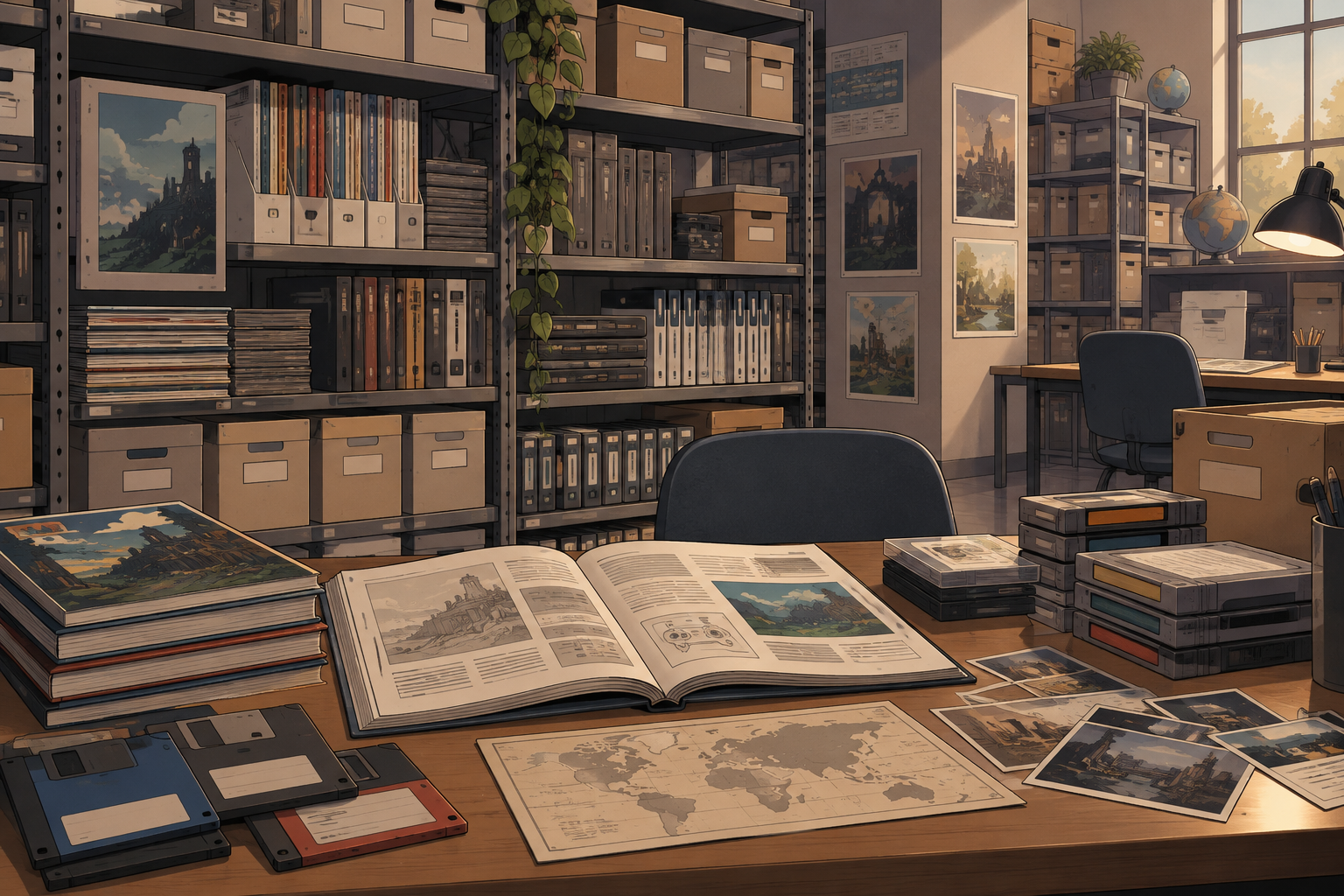
When video-game preservation is discussed, the first thought is often of a runnable game. That image is incomplete. Spanish conservation projects themselves describe holdings that include machines, hardware, software and documentation; other archives incorporate magazines, advertising, guides, videos, promotional discs and material from industry events. A video game reaches the present as a network of objects and records, not as an isolated file.
This distinction matters because it changes the basic question. It is not only whether a program can run, but what makes it understandable: the format through which it circulated, the way it was introduced to audiences, the equipment it required and the traces of its reception. Preservation is not the same as freezing nostalgia. It means creating conditions to consult, display and teach a heritage with varied material forms and contexts.
The machine tells part of the story too
Museo del Recreativo defines its work as preserving, restoring, conserving and making visible everything connected to play and associated technologies. Its approach includes both physical and digital means for consulting materials. The scope is meaningful: a board, an arcade cabinet, a peripheral or a storage format are not mere accessories when they help explain how people played and which technical limits shaped the experience.
Museo del Videojuego likewise distinguishes intersecting but different historical paths: arcade machines, consoles, handhelds and computers. This view prevents the medium from being reduced to one line of domestic products. Each setting produces distinct preservation issues and, above all, distinct accounts of use. An arcade machine points to a shared space; a computer can belong to work and leisure practices; a home console places play in another area of everyday life.
There is no need to turn those differences into a hierarchy. Heritage work becomes richer when it keeps both their connections and their specific features visible. A museum may bring them together under video-game history without erasing the spaces, technologies and habits that distinguish them.
Documentation preserves relationships
Catalogues and digital libraries are a visible part of this work. Museo del Videojuego reports collecting data, images, magazines and videos, while its library organizes publications, advertisements, guides, audiovisual material and content included on promotional media. Such material helps us read video games as cultural products: it records commercial languages, the mediation of specialist press and forms of learning that do not always remain inside the program.
An official guide or a magazine does not replace a game, but neither is it disposable extra material. It may explain what information players received, how mechanics were described or what expectations surrounded a release. Likewise, technical documentation can matter for understanding the hardware and software that made an experience possible.
Access also requires editorial judgment. Collecting material does not automatically create knowledge. Describing it, connecting it and making clear what is known about each item allow an archive to be useful to different audiences. Museo del Recreativo’s stated aim to “show and teach” points directly to this dimension of access.
Exhibiting is also interpretation
Academic research on museums and video games notes that cultural institutions actively participate in preserving interactive leisure. That participation is not neutral. Choosing what to retain, what to exhibit and which narrative accompanies an item is an interpretation of the medium. Cultural criticism has likewise observed that decisions to keep and display games are shaped by preservers’ ideas of video games and by the context in which they work.
This does not discredit museums; it defines their responsibility. A transparent exhibition can present a game as a work, a technology, a consumer object, a social practice or a crossing point between all of these. It can also acknowledge that no display exhausts its object. Interaction is particularly important: a game is understood differently through its box than through its play system, and differently again when placed in an arcade setting.
Arcade Vintage defines its mission around arcade culture from the 1970s, 1980s and 1990s, combining preservation, documentation, exhibitions and arcade-machine restoration. Its example shows that preservation can also preserve a particular cultural setting, not merely titles detached from where they were used.
Access, outreach and limits
Preservation does not end once an item is stored. Museums and archives need to make it consultable without mistaking access for simplification. Outreach can connect video games with music, film, comics, literature, illustration or computing—relationships explicitly present in the programs of the institutions cited here. That openness broadens the medium’s cultural context and gives non-specialist audiences ways in.
Verifiable limits should also be acknowledged. The available material describes aims, collections and lines of work, but it does not by itself solve every technical, legal or access issue affecting each individual game. Specialist journalism stresses that there is no final consensus on preservation strategies and that digitization, constant updates and service-dependent games pose additional challenges. This calls for caution: not every act of conservation guarantees identical future forms of experience.
Preserving so we can ask again
The cultural value of video games does not depend on every component surviving in the same way. It depends partly on institutions, associations and archives retaining enough evidence to ask questions again: how games were played, on which machines, in what places, through which publications and within which narratives.
The Spanish projects considered here share a practical idea: preservation means recovering, documenting, caring for and sharing. Their lesson is not that one formula exists, but that a video game never arrives at an archive alone. It comes with formats, images, texts, technologies and communities of use. Attending to that whole is what makes the history of the medium more than a list of recovered titles.
- Decade
- Contemporary
- Region
- Spain
- Level
- Enthusiast
- Entities
- No linked entities
Sources and references
- Objetivo del Museo del Videojuego | Museo del Videojuegowww.museodelvideojuego.com · 2026-09-18
- Misión – Museo Arcade Vintagemuseoarcadevintage.com · 2026-09-18
- (PDF) Museos y videojuegos. La renovación de los espacios culturales hegemónicos.www.researchgate.net · 2026-09-18
- "Everything not saved will be lost": de museos, archivos y preservación de videojuegos - Caninowww.caninomag.es · 2026-09-18
- Fondo de Preservación | Museo del Recreativomuseodelrecreativo.es · 2026-09-18
- Descargas | Museo del Videojuegowww.museodelvideojuego.com · 2026-09-18