Video games as a documentary whole
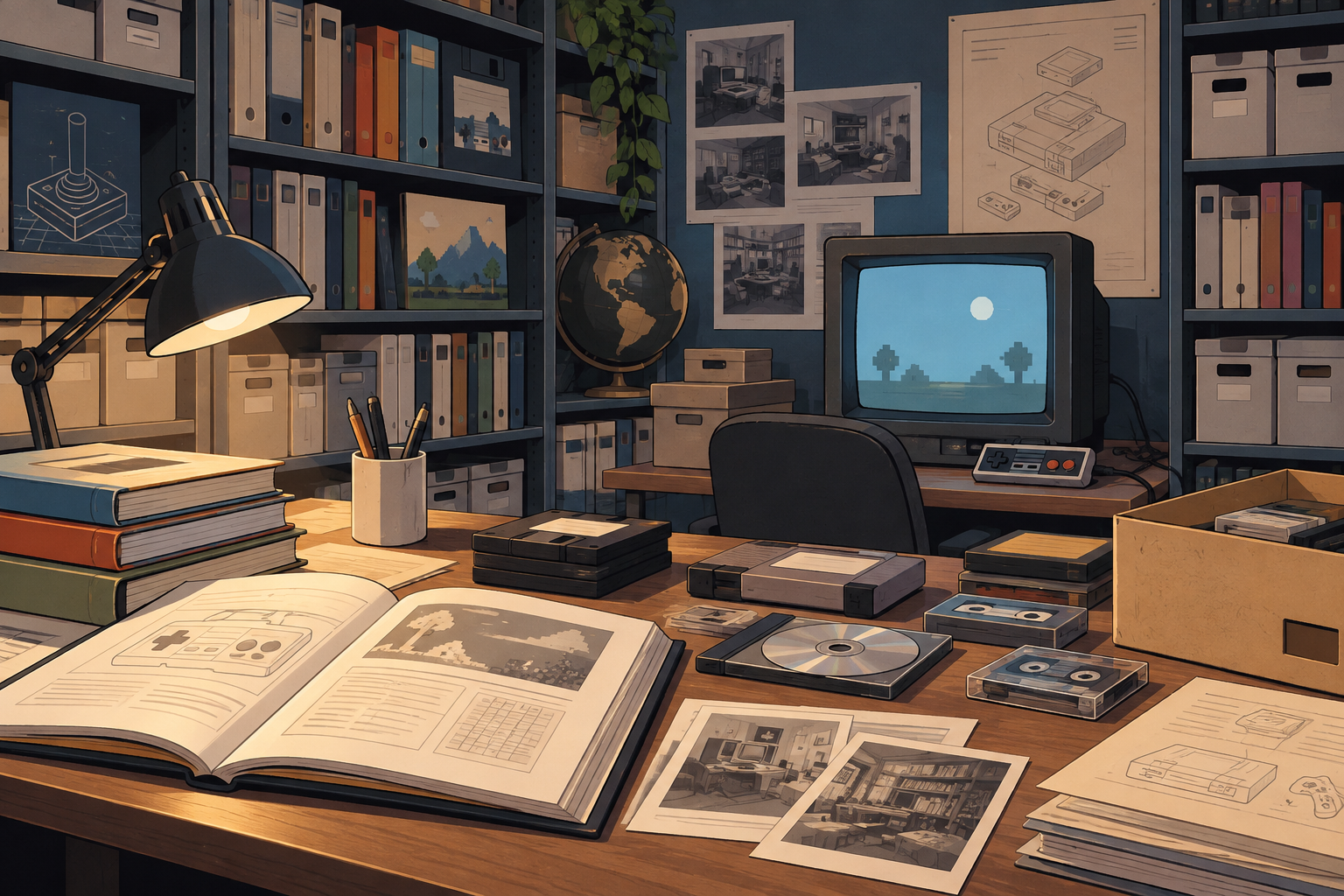
When video-game preservation is discussed, the immediate image is usually a cartridge, disc, console or a game running on a screen. It is useful, but incomplete. Museo del Videojuego describes work that gathers data on games and consoles, images, magazines and videos; its library also lists specialist press, printed advertising, guides, trade-show audiovisual material, demos and promotional discs. This scope matters because an isolated game says little about how it was presented, sold, learned or circulated.
The issue is not limited to nostalgia. Museo del Recreativo describes making documentation, machines, software and hardware available for consultation, display and teaching as part of its preservation collection. In other words, preserving a video game may mean preserving an object, but also the elements that place it within a technology and a culture.
There is no single history to keep
The available sources portray a medium made up of distinct trajectories. Museo del Videojuego mentions arcade machines, consoles, handheld devices and computers, stressing the interaction between digital electronics, software and firmware. This plurality prevents reducing the medium’s history to a sequence of home machines or a catalogue of famous titles.
Canino notes that every decision to retain and exhibit games is filtered through the preserver’s idea of the medium, its experiences and its context. This is not an abstract objection: selecting which machines remain playable, which magazines are digitised or which events are documented shapes the stories that will later be accessible. Preservation is therefore both a material and an editorial practice.
The problem of cultural evanescence
The challenge grows when a game relies on technical layers that change or disappear. Canino uses the expression “cultural evanescence” and points to issues linked to digitisation, constant updates, games as a service and digital stores. Its account provides no single solution, and that lack of consensus is meaningful: methods suitable for an arcade machine, a game on physical media or a work dependent on servers need not be the same.
It is worth avoiding a hasty conclusion: digitising does not necessarily preserve the whole experience. A digital archive may retain access to certain materials, while the physical object, instructions, advertising and technical configuration provide other kinds of evidence. Conversely, retaining a machine without recording its software, documents and provenance leaves gaps for later interpretation.
Collecting, cataloguing and making material available
The cited initiatives emphasise access. Museo del Videojuego states that its database contains more than 21,000 video-game entries and 800 consoles, while its library presents documents and audiovisual material as digitally preserved historical heritage. These are figures declared by the institution itself, rather than independently measured ones, but they illustrate a clear priority: cataloguing makes material findable, comparable and contextualised.
Museo del Recreativo expresses a similar priority in referring to physical and digital means to consult, display and teach from its materials. The difference between accumulation and archiving is clear here. A collection may be valuable for the objects it brings together; an archive adds descriptions, relationships and conditions of access that enable research and communication.
The museum is not only a display case
Video games have also entered museums as tools for interpreting heritage. Ana Ordás presents NUBLA as an educational project linked to the Museo Thyssen-Bornemisza, with a narrative moving through artworks and puzzles. Yellow Jacket, meanwhile, argues that a cultural video game should begin with the story, audience and experience to be built, rather than technology alone.
These approaches do not replace conserving video games as cultural objects; they show another possible relationship between games and museums. A game can help mediate heritage content, and a museum can preserve evidence of how games were designed, distributed and experienced. Both directions require explaining aims and limits to the public.
Limits of what can be verified, and conclusion
The gathered evidence comes partly from institutions describing their own missions and partly from popular and reflective articles. It supports the existence of cataloguing, preservation, restoration and cultural-mediation efforts, as well as debate over their criteria. It does not establish a universal method or measure the comparative effectiveness of each archive.
The most robust lesson is straightforward: a video game is neither only code nor only a box. Its memory may be distributed across hardware, software, firmware, manuals, magazines, advertising, audiovisual records and curatorial decisions. Preserving that network does not ensure that the past remains untouched, but it offers future audiences more material with which to read, discuss and play it in context.
- Decade
- Contemporary
- Region
- Global
- Level
- Enthusiast
- Entities
- Museum
Sources and references
- Objetivo del Museo del Videojuego | Museo del Videojuegowww.museodelvideojuego.com · 2026-09-22
- Videojuegos para bibliotecas, archivos y museos – Ana Ordásanaordas.com · 2026-09-22
- "Everything not saved will be lost": de museos, archivos y preservación de videojuegos - Caninowww.caninomag.es · 2026-09-22
- Videojuegos para museos: una nueva forma de acercar el patrimonio culturalwww.yellowjacketvideogames.com · 2026-09-22
- Descargas | Museo del Videojuegowww.museodelvideojuego.com · 2026-09-22