A decade that changed the frame
The 1990s hold a distinctive place in accounts of board games. Not because one title alone explains everything that happened, but because several sources describe a transformation of both the industry and the hobby during that period. Publisher Shangrila places the industry’s greatest transformation in that decade, linking it to the popularisation of board games and a broader offer. Jugamos Todos, meanwhile, places a new creative wave from the late 1970s onward, with its epicentre in Germany and labels such as European school, eurogames, social games, or designer games.
These statements are not identical, yet they can be read together. One allows us to discuss expansion and visibility in the 1990s; the other reminds us that creative processes did not suddenly begin in 1990. The decade is therefore best understood without the image of an absolute break. It is more useful to see it as a time when already active currents met a larger offer, wider circulation, and a vocabulary through which they could be recognised.
Europe as a reference, not a closed label
The term eurogame is useful, but it should not become an automatic explanation. Jugamos Todos lists several labels for the same constellation of games: European, social, and designer games. That plurality shows a disputed field rather than a fixed category. Corvus Belli describes European-style games through simple rules, an emphasis on strategy, and indirect interaction. This is a helpful way to approach the phenomenon, provided it is treated as a tendency rather than a rule for every game published in Europe.
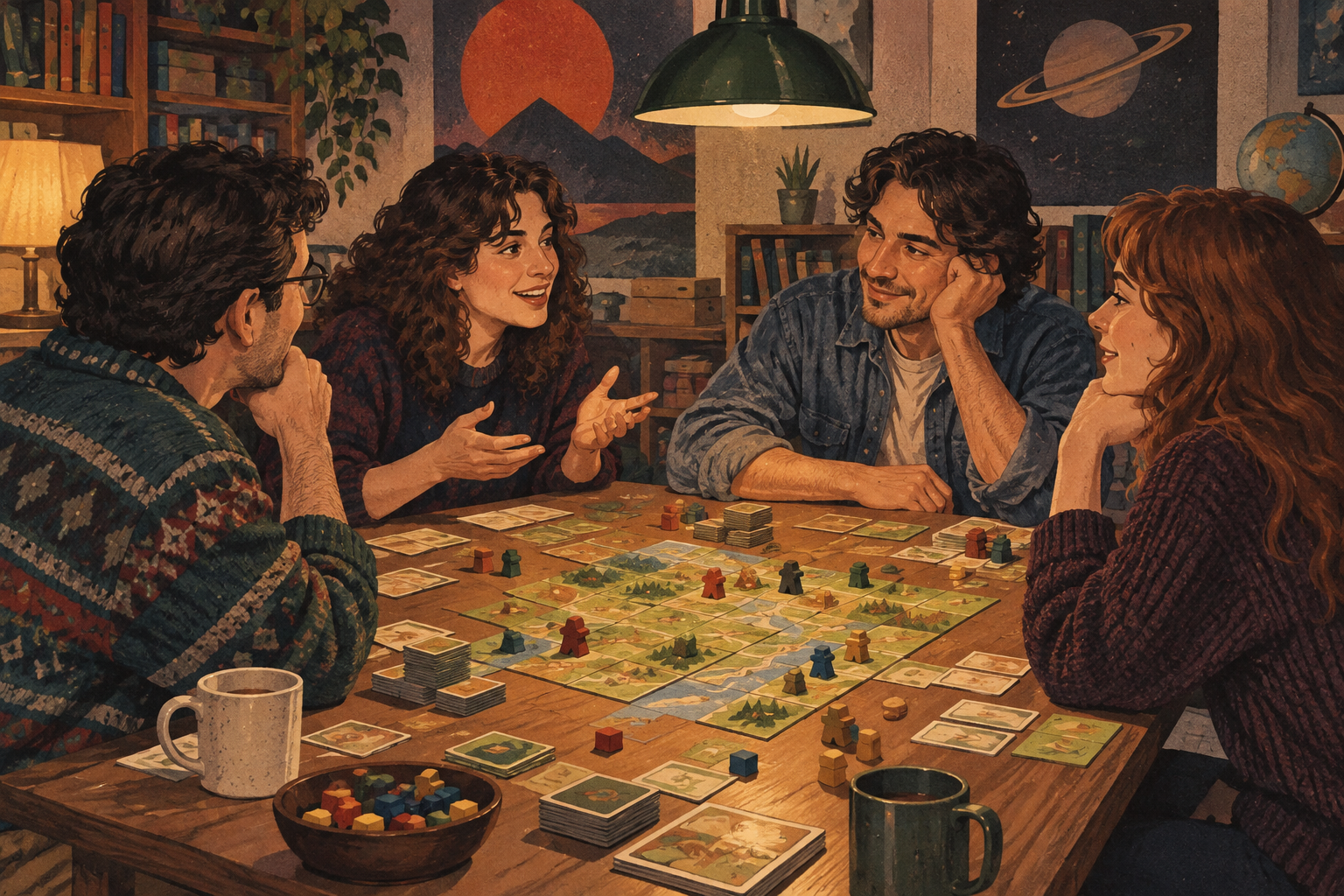
The historical value of this perspective is that it shifts attention. Rather than looking only at a box or a list of titles, it invites us to consider the relationship between rules, decisions, and shared experience. When a game encourages particular forms of negotiation, competition, or planning, it proposes a specific way for players to gather around a table. Contemporary research on historical simulation board games stresses that games construct and reinforce views of the past from their contexts of creation; more broadly, that warning helps us regard any design as a cultural object, not merely entertainment.
Catan as a case study
The Settlers of Catan, dated 1995 by Zacatrus, is the most visible example in the evidence gathered here. Corvus Belli presents it as a release designed by Klaus Teuber and as a fundamental landmark for the industry. That claim supports using the game as a case study, not as a synonym for the entire decade or proof of a linear history.
Its place in this account stems above all from the way different sources use it to mark change. When a work repeatedly appears as a landmark, it becomes an entry point for studying the period: the expectations surrounding games, the kinds of proposals gaining attention, and the language used by publishers, players, and commentators. The available evidence allows us to state that Catan was released in 1995 and that the cited source considers it an industrial landmark. It does not allow us to establish precise sales, territorial reach, a complete sequence of editions, or to credit it alone with worldwide transformations. Those questions need further documentation.
Caution does not lessen its interest. On the contrary, it prevents retrospective fame from turning the game into a legend without context. Catan works best when placed beside the expansion of the offer described for the 1990s and the European creative tradition that the sources locate in the prior decade.
From box to cultural ecosystem
A broader offer does not merely mean counting products. It means that board games can be considered through more lenses: as design objects, social practices, an industry, narrative supports, and subjects of study. Shangrila presents its volume on history, culture, and industry as a reflection moving from origins to the present industry, from narratives and metaphors to mechanics, and from physical materiality to digital formats. That breadth matters when revisiting the 1990s without reducing them to nostalgia.
It also requires us to separate fact from editorial interpretation. The documented fact is that a cultural source identifies the decade as a period of profound transformation and a wider offer. A reasonable interpretation is that this expansion encouraged new conversations about what a board game could be and whom it could be designed for. There is no need to present that interpretation as statistical certainty. It is enough to acknowledge that today’s language around eurogames, designer creation, or the material culture of games has a history of debate.
The available bibliography itself reveals another limit: many popular accounts simplify chronologies, categories, and authorship. A responsible history should therefore contrast advertising, commercial discourse, and retrospective summaries with specialised research whenever specific data are required. This article does not seek to settle that debate; it shows why the 1990s deserve close attention.
What is verifiable, and what remains open
Four points can be sustained from the available evidence: a new creative wave with a German epicentre has been identified from the late 1970s; the 1990s are described as a period of especially intense expansion of the offer and popularisation; The Settlers of Catan is dated 1995; and one source considers it an industrial landmark. Everything else requires more caution.
These sources do not allow us to infer a growth figure, a universal ranking of importance, or a single causal relationship between one game and the sector’s international evolution. Nor should eurogame be used as a rigid border. Names change according to their users, while games circulate across markets, languages, publishers, and communities. The history of the tabletop is also the history of those circulations.
Conclusion: seeing the decade without making it a myth
The 1990s do not need to be treated as a miraculous origin in order to be significant. The gathered documentation presents them as a period of expansion and transformation connected to an earlier European creative wave. Within that frame, Catan is a solid, documented reference, but not a total explanation.
The best way to revisit the decade is to use its games as material documents: read their rules, observe how they organise interaction, and ask what ideas of leisure, strategy, and sociability they put into play. The board then ceases to be a simple surface for matches and becomes a historical map: incomplete, debatable, and far more interesting when explored carefully.
Documentary gallery


- Decade
- 1990s
- Region
- Europe
- Level
- Enthusiast
- Entities
- No linked entities
Sources and references
- Evolución de los juegos de mesazacatrus.es · 2026-09-21
- Historia de los Juegos de Mesawww.jugamostodos.org · 2026-09-21
- (PDF) ¿Qué historia jugamos? Una aproximación al estudio de los juegos de mesa de simulación históricawww.researchgate.net · 2026-09-21
- Encrucijadas del juego de mesa. Historia, cultura e industria – Shangrilashangrilaediciones.com · 2026-09-21
- Juegos de mesa: Evolución Históricacorvusbelli.com · 2026-09-21