Everyday life as a historical question
Everyday life often seems too familiar to require research. Eating, working, travelling, shopping, caring, studying, and living together are so close to us that they can appear universal and unchanging. Yet the sources gathered for this dossier point in the opposite direction: everyday life changes over time, is shaped by social contexts, and offers a valid way of understanding history.
That premise has an editorial consequence. A story about daily life should not merely collect anecdotes, evocative objects, or personal memories. It should ask who did what, under which conditions, according to which rules, with which resources, and in what environment. The history of routines is not a lesser version of political, economic, or cultural history. It can show how those processes were experienced at domestic, workplace, neighbourhood, and institutional scales.
Private sources are useful, but insufficient
Memoirs, correspondence, travel accounts, autobiographies, and family archives can bring us closer to intimacy and to the specific uses of a period. The Project MUSE introduction warns, however, that such testimonies are scarce and cannot be considered fully reliable on their own. They need to be compared with other evidence and placed within a historical framework.
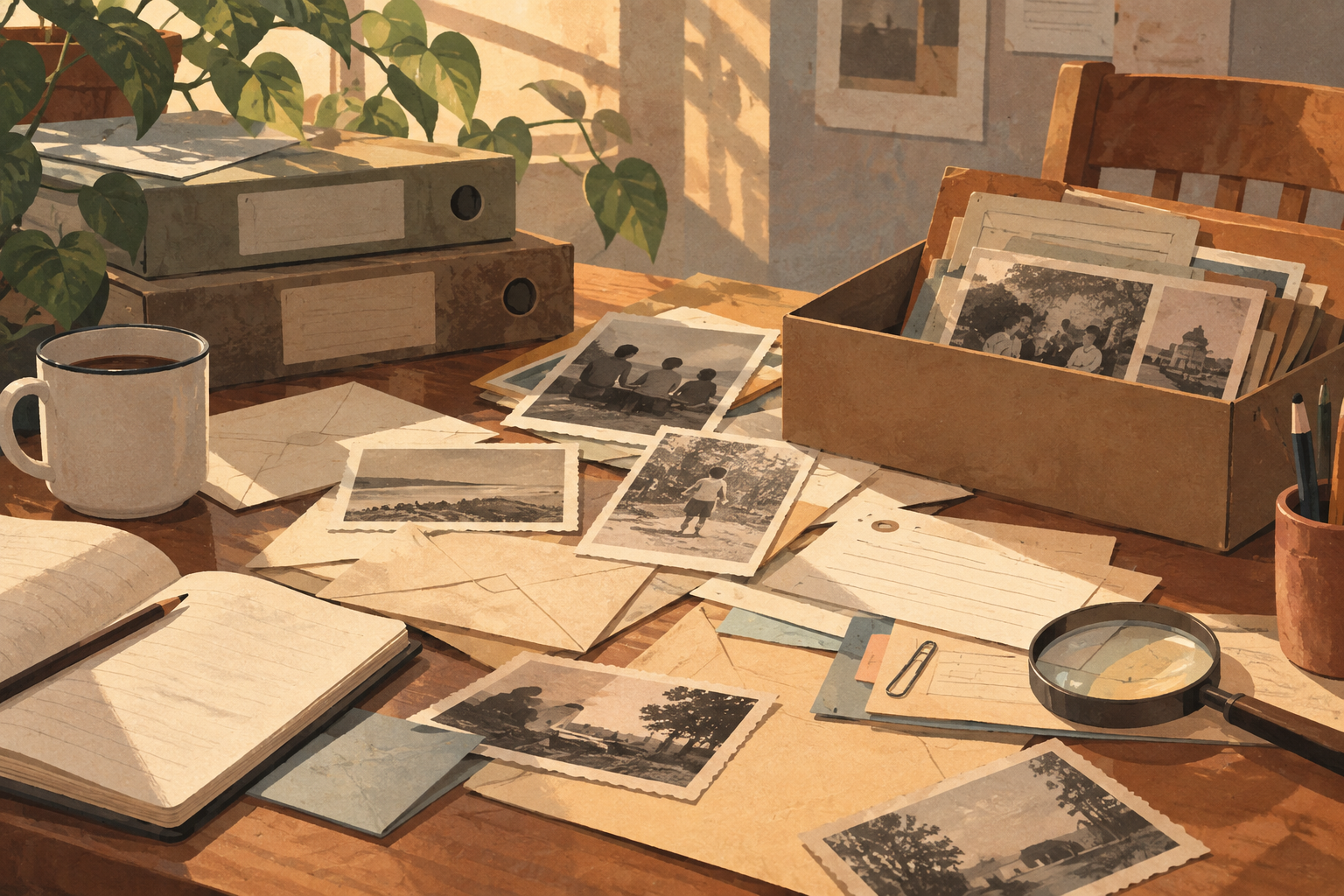
This limit matters in retrospective publishing. A family photograph can show that a family posed in a place, kept an object, or adopted a particular appearance. It cannot automatically prove that the practice was widespread, that it represented an entire city, or that it meant the same thing to everyone. Likewise, a memory may be sincere without functioning as general evidence.
Caution does not weaken a narrative; it makes it more exact. Instead of writing “this was how life was,” it is better to say “this source shows,” “this archive suggests,” “this appears in this context,” or “this testimony alone cannot establish how widespread the experience was.”
Unexpected archives also record routines
One of the most productive contributions of everyday-life history is its expansion of the documentary field. Project MUSE notes that areas seemingly distant from routine life—trade, industry, defence, administration, and justice—may yield relevant information. Import statistics can prompt questions about products valued in particular periods; factory and workshop rules can illuminate internal norms; and government or court records can contain information about foreign residents, local events, and civil or criminal disputes.
That does not make administrative documents transparent. A regulation primarily reflects a rule or institutional ambition, not necessarily a practice that was followed. A court file commonly records conflict, not the complete normality of a community. Read carefully and compared with one another, however, such records can help reconstruct living conditions rarely described by a single intimate source.
For editorial research, the method can remain straightforward: identify a specific routine, locate documents that approach it from different angles, and separate observation from inference. If the subject is consumption, advertising alone is not enough; circulation, availability, regulation, or use must also be considered when evidence exists. If the subject is work, an image of a workshop should be read alongside schedules, rules, testimony, or local data where available.
Context, scale, and difference
The Project MUSE material stresses that contexts are essential for supporting hypotheses and explaining local and regional situations. Industrial districts, working-class neighbourhoods, farming settlements, labour bodies, and religious corporations are not interchangeable settings. The same practice may carry different meanings according to territory, social position, gender, age, occupation, or family network.
This prevents “everyday life” from becoming a single image. Redalyc describes it as a sphere open to change and modification through social context. Daily life is not a fixed backdrop behind major events; it is a social reality constructed and lived by situated individuals.
Strong stories therefore define their scale. It is better to investigate a community, workplace, domestic practice, or identifiable documentary set than to claim how an immense population lived for decades. Territorial and temporal precision does not reduce a story’s interest. It lets readers distinguish evidence, interpretation, and open questions.
Avoiding anecdote and nostalgia
The first shortcut is to use a striking case as proof of a general tendency. The second is to turn the past into a sentimental scene, as if every earlier routine had been simpler, more authentic, or more communal. Neither approach is research.
Nostalgia selects. It tends to preserve pleasant objects, recognisable gestures, and bright memories while leaving out inequality, restriction, invisible work, conflict, and unequal access. A historical approach need not eliminate emotion, but it should question it. What is missing from the image? Who does not appear in the archive? What material conditions made the custom possible? Which voices are mediated by the institution that produced the document?
The National Library of Spain’s educational material presents the evolution of everyday life as a way to understand changing forms of coexistence and communication. This is useful because it moves attention from an isolated object toward relationships and transformations. A routine matters not only because it feels familiar, but because it can reveal changing rules, resources, bonds, and expectations.
A method for writing what can be verified
A sound piece on everyday life can begin with a specific question, not with a promise to recover “an era.” It should then introduce the available sources, explain what they can and cannot establish, place them in a local context, and connect them to a practice. Its conclusion can return to the initial question and identify what remains uncertain.
This structure also protects readers from excessive claims. Everyday-life history needs imagination to formulate questions, but not permission to invent scenes, dates, prices, collective habits, or private experiences. When evidence is missing, that absence should remain visible as an explicit limit.
Conclusion
Researching everyday life means looking beyond major events without abandoning rigour. Personal testimony is valuable but needs comparison; institutional archives may seem remote yet contain traces of concrete practices; and context turns scattered documents into a responsible interpretation. Routine is not history’s motionless background. It is one of the places where social change becomes visible, debatable, and researchable.
- Decade
- Contemporary
- Region
- Global
- Level
- Introduction
- Entities
- No linked entities
Sources and references
- Project MUSE - Introducción a la historia de la vida cotidianamuse.jhu.edu · 2026-09-21
- La vida cotidiana como espacio de construcción socialwww.redalyc.org · 2026-09-21
- Introducción a la historia de la vida cotidiana on JSTORwww.jstor.org · 2026-09-21
- MOMENTO 2. La evolución de la vida cotidiana: investigación y cronología | La vida cotidianabnescolar.bne.es · 2026-09-21
- Hablando de historia. Lo cotidiano, las costumbres, la culturawww.redalyc.org · 2026-09-21