A visual source, not a neutral capsule
A period advertising piece can be useful for studying design, but it should not be treated as a transparent photograph of the past. A poster, magazine advertisement, package or display was made to direct attention to an offer, a brand or a consumer behaviour. That purpose shapes every decision: headline size, image choice, product space and the medium in which it circulated.
The Museo de la Historia de la Publicidad describes its field through advertisements, magazines, packaging, posters, photographs and other period materials. It also arranges its approach by formats—print, radio, television, outdoor, digital and branded content. This variety offers a methodological warning: advertising is not a single kind of object. Each medium raises different questions about production, reading, preservation and access.
Read form before drawing conclusions
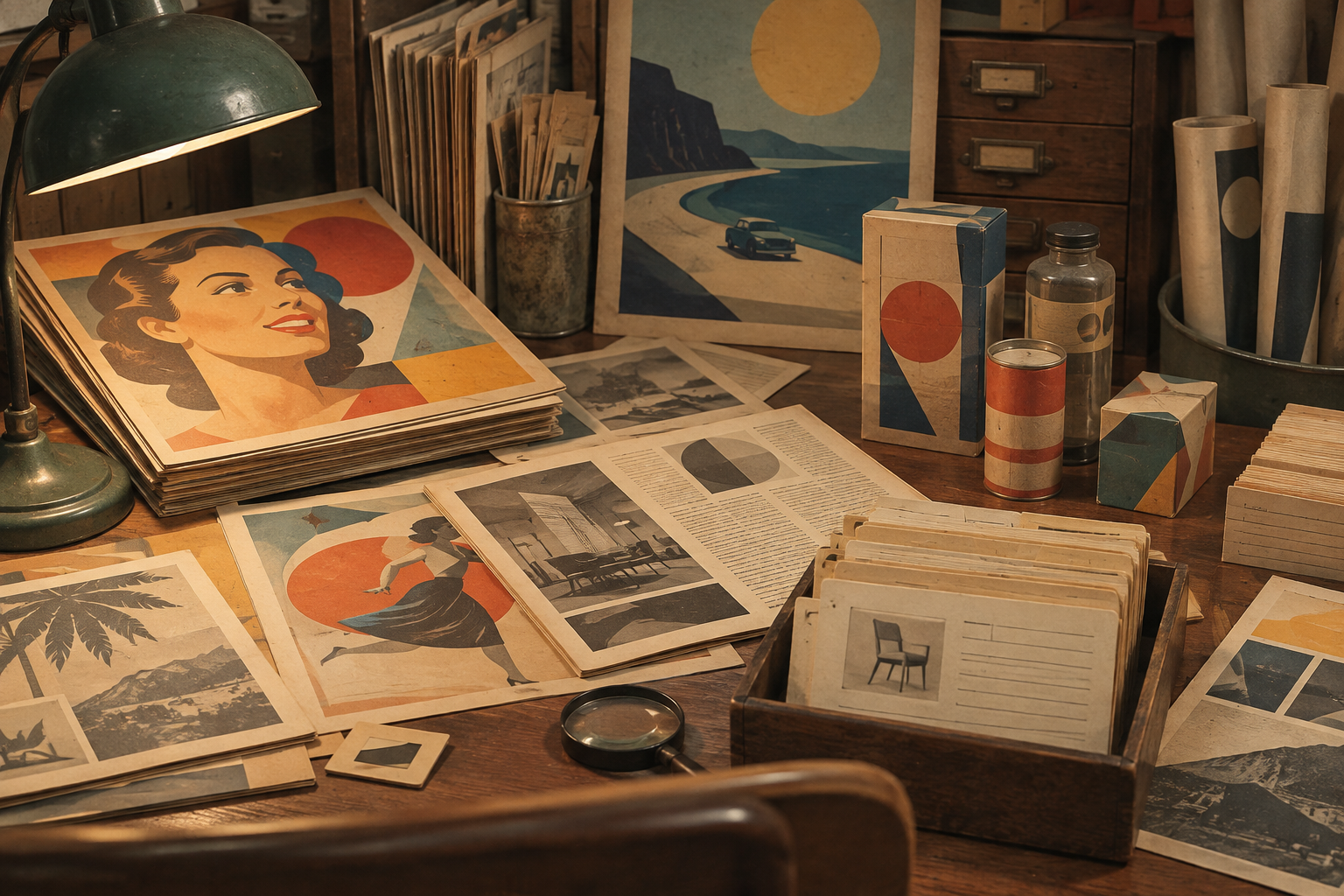
The first level of reading is to describe what is present. Identify the support, format, composition, relationship between text and image, palette, typography, illustration or photography, logo, depicted package and possible signs of circulation, such as a magazine masthead. There is no need to assign an intention that the piece itself cannot demonstrate.
Visual information can reveal design priorities. A large headline structures hierarchy; a grid, or its absence, indicates reading order; repeated colours or forms may connect the advertisement to an identity system. Fotonostra places advertising design in a history of media extending from posters and press to radio, television, the internet and mobile devices. A change of medium therefore changes both the piece and the way it is viewed.
Support, circulation and experience
The same campaign is not experienced in the same way on a billboard and in a magazine. Outdoor media face brief, distant reading; a printed page allows proximity, sequence and coexistence with other content; packaging accompanies an object at purchase or use. Support is not a minor technical detail: it takes part in meaning.
The Museo de la Historia de la Publicidad website names jingles, commercials, posters, packaging, displays and memorabilia as parts of immersive experiences. That list helps prevent a history limited to posters. A careful collection should record whether it holds an isolated item, a complete publication, three-dimensional packaging or audiovisual documentation, since each preserves different fragments of the original communication.
Archive and cataloguing: preserving context too
An advertisement becomes more valuable when its provenance and consultation data survive. Information supplied by Hispanidad about the Museo de la Historia de la Publicidad states that received material is catalogued and added to the Centro de Documentación Publicitaria website. This process turns accumulations of graphic objects into comparable, retrievable materials.
Cataloguing is not merely assigning a title. It can clearly distinguish what is visible from what is known: physical description, support, condition, inscription, documented provenance and source of identification. When a detail is missing—authorship, exact date, print run, agency or reach—it should be recorded as unknown rather than supplied through stylistic resemblance. This caution matters particularly in advertising, where reissues, adaptations and clippings can change the surviving object.
Museums, collections and ways of looking
Advertising can enter a collection because of graphic, industrial, social or emotional interest. Reason Why describes institutions and collections containing packaging, displays, advertising posters and other pieces connected to graphic arts and design. It suggests a wider view: an advertising archive is not limited to flat originals and may include objects that connect graphics, product and commercial space.
Museum display is not neutral either. The University of Barcelona text on cultural marketing mentions route design, rest areas, basic and supplementary content, and opportunities to deepen knowledge of an artwork or collection as factors in visitor perception. Applied to advertising, this invites questions about what is shown beside what, what information accompanies an item and what omissions selection produces.
What one piece cannot prove alone
An advertisement may document a visual proposal, but it does not automatically prove that a campaign succeeded, represented an entire society or was interpreted identically by every audience. It may include stereotypes, aspirations or promises that should be analysed as persuasive resources, not as reliable descriptions of reality.
La Boost Studio notes that period advertising can work as a visual chronicle of values, expectations and roles, and recommends research through archives, exhibition catalogues and specialised sources. The most rigorous wording is conditional: such items can raise questions about the values they mobilise, provided they are checked against contextual documentation and do not prompt automatic generalisation.
Conclusion
Studying historical advertising through design requires attention to materiality and purpose. An item offers evidence about visual hierarchies, reproduction technologies, supports and communication strategies; it does not alone provide a complete history of its time. Describing first, cataloguing context, comparing formats and declaring gaps turns nostalgic interest into research practice. The advertisement then becomes more than a visual memory: it becomes a document whose reading must be as precise as its composition.
- Decade
- Contemporary
- Region
- Spain
- Level
- Introduction
- Entities
- No linked entities
Sources and references
- Museo de la Historia de la Publicidad — Descubriendo la huella de la Publicidadmuseohistoriapublicidad.org · 2026-09-19
- Centro de Documentación Publicitariawww.lahistoriadelapublicidad.com · 2026-09-19
- La Guía Completa de la Publicidad Vintage: Historia, Tipos y Coleccionismolaboostudio.com · 2026-09-19
- Los museos de Publicidad que hay que visitarwww.reasonwhy.es · 2026-09-19
- Museo de la Historia de la Publicidad, referente de un sector que está buscando su pasado - Hispanidadwww.hispanidad.com · 2026-09-19
- Evolución y aplicación del marketing cultural en los museosbid.ub.edu · 2026-09-19
- Diseño publicitariowww.fotonostra.com · 2026-09-19