An exhibition begins before the display case
A museum does not communicate only through the objects placed in a gallery. It also communicates through what lets visitors find, name, connect and remember them: typefaces, colours, labels, maps, leaflets, catalogues, screens, advertisements and outreach material. Museum graphic design is therefore a visible layer of mediation. A study of several public museums in Valencia states this plainly: graphic design is part of museum facilities and creates a visual context that also affects promotion and advertising. This matters to retro culture, with its interest in print, packaging, magazines and audiovisual media: graphics do not arrive after history; they help make history readable.
This observation calls for caution. An appealing design does not automatically become complete documentation, and a contemporary panel cannot reproduce an object’s original meaning without mediation. It does, however, support a useful idea: an exhibition is a documentary and visual construction. Its ordering decisions make some relationships visible and place others in the background.
Design organises a reading
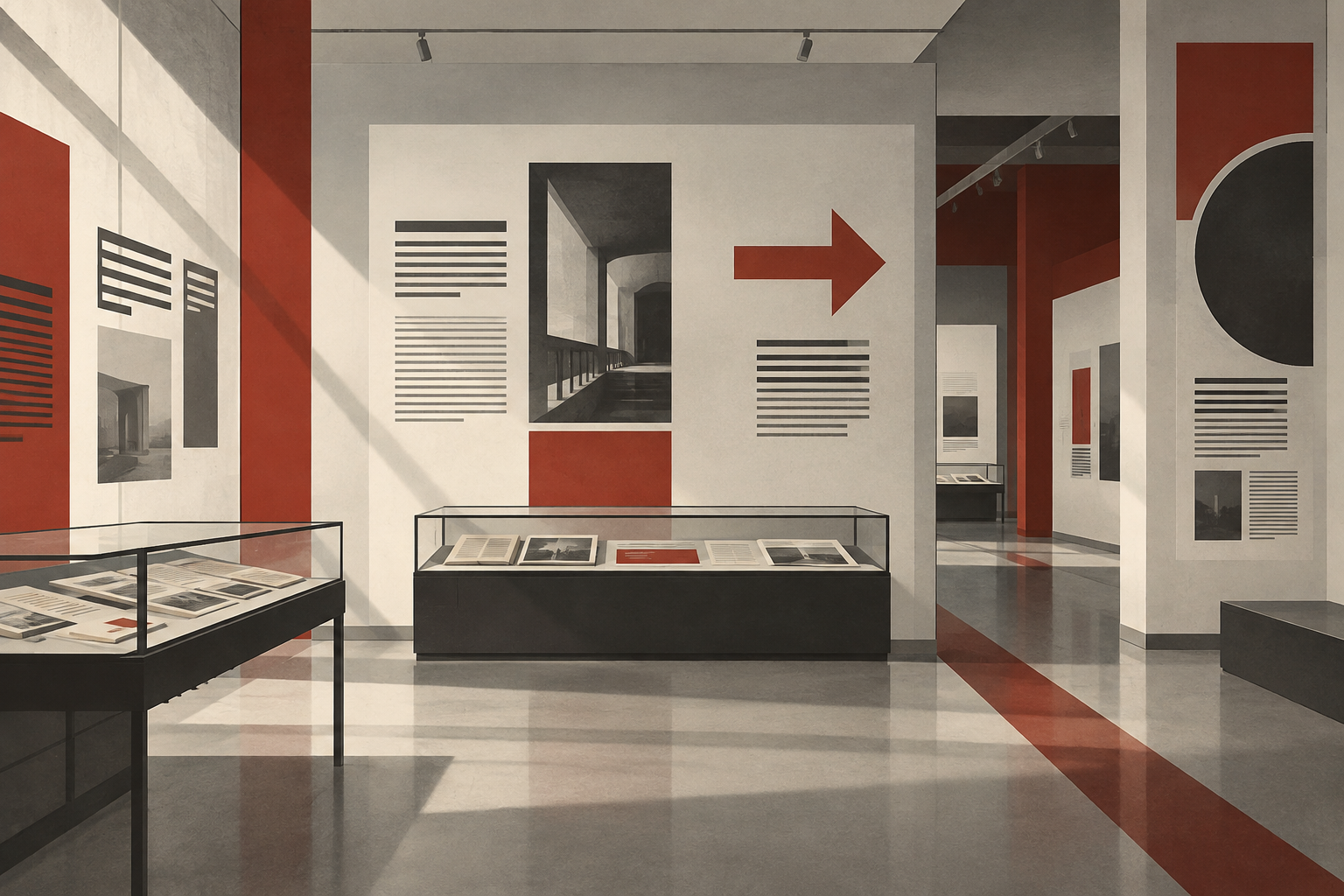
Museography does not arrange objects solely for conservation or classification. A discussion of exhibition design and semiotics argues that the arrangement of artefacts also seeks to convey narratives and establish relationships among displayed elements. In that sense, space mediates between past, present and future. This is not an abstract property of walls. It appears in practical choices: separating chronology from thematic comparison, placing an image beside an object, or making a label the only available explanatory voice.
Graphic design intensifies this mediation. Typographic hierarchy can separate title, context and technical information; a grid can make several items read as a group; colour coding can guide a route. These are ordinary tools, but they have interpretive consequences. When a gallery introduction foregrounds an advertising message before its provenance, visitors may remember the commercial promise before the material conditions of circulation. In the reverse order, an advertisement can become evidence for examining an era rather than merely nostalgic decoration.
Neutrality is therefore not the right expectation. Design can be clear, useful and rigorous, but it does not vanish. It selects scale, sequence and emphasis. Recognising this does not discredit an exhibition; it helps visitors read it more closely.
Advertising: object, document and narrative
The Museum of Advertising History presents itself as a route through decades and formats including print, radio, television, outdoor media, digital media and popular culture. It also declares an interest in preserving advertising heritage and sharing its cultural impact. This breadth matters because it reminds us that advertising does not exist only as a framed poster. It can appear in a radio spot, a masthead, packaging, a screen, an outdoor piece or a digital format.
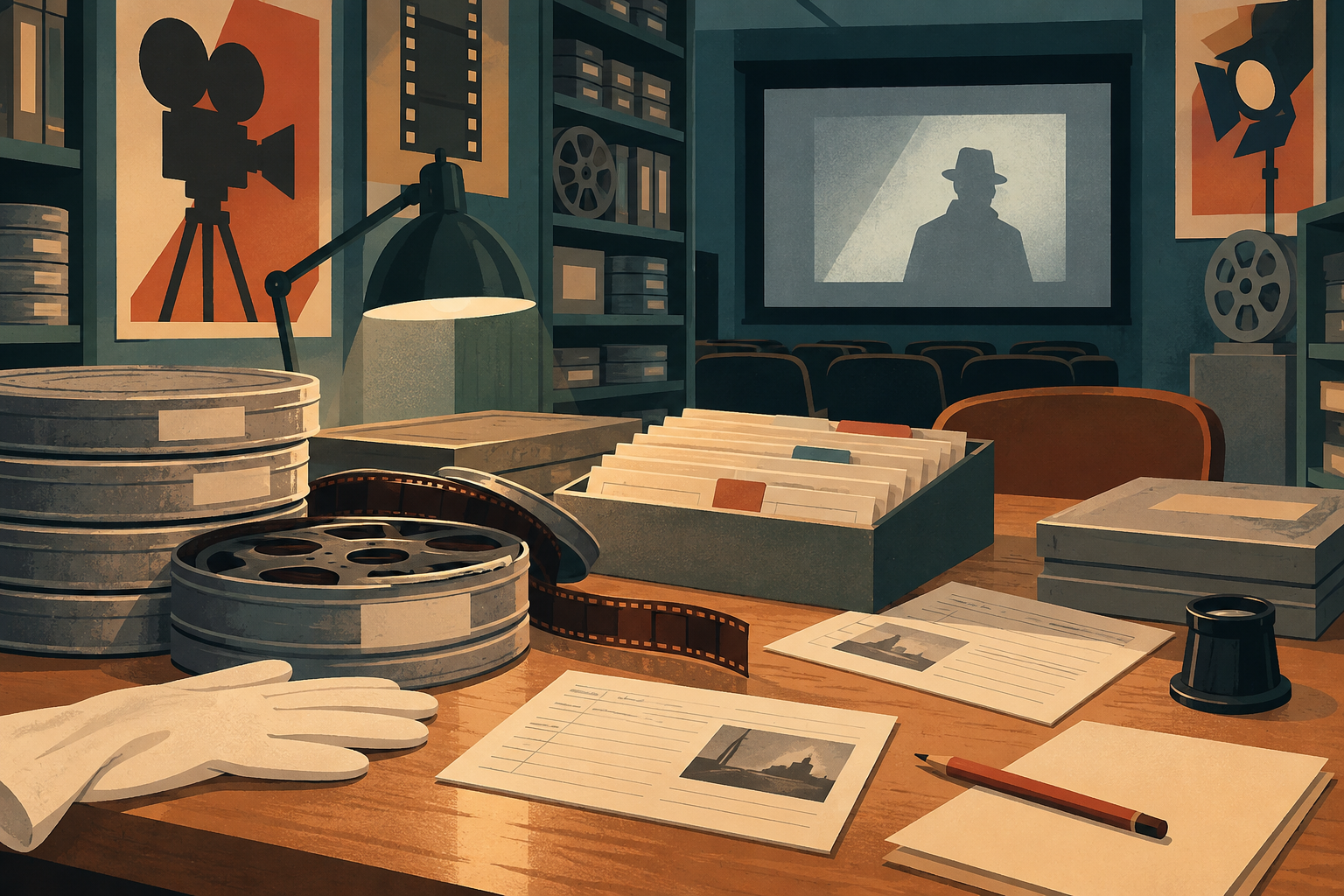
Documenting such material requires more than retaining an isolated image when context can be recovered. Archive-management guidance for museums in Navarra identifies essential elements: identifying produced document types, having a classification scheme or series catalogue, using a metadata scheme that records production context, and maintaining an appraisal and preservation schedule. Applied to a campaign or exhibition graphic, this approach asks what exactly has been preserved: an original, a reproduction, an installation photograph, a printer’s proof, a handout or a digital file?
The answer shapes meaning. A cropped image may retain visual imagery while losing size, reverse side, support, date, circulation and links to other materials. Advertising’s cultural value does not require turning every advert into an autonomous artwork. It depends largely on making its communicative function and its documentable conditions of use intelligible.
Archives preserve relationships, not only items
Recommendations on museum archives stress that they document an institution’s history and development, collections, exhibitions and programmes. They also recommend acquisition policies, descriptive tools and basic conservation measures, including archival-quality containers. This shifts the focus: an exhibition leaves more than displayed objects. It leaves decisions, records, invitations, working notes, installation photographs, mounting designs and communication material.
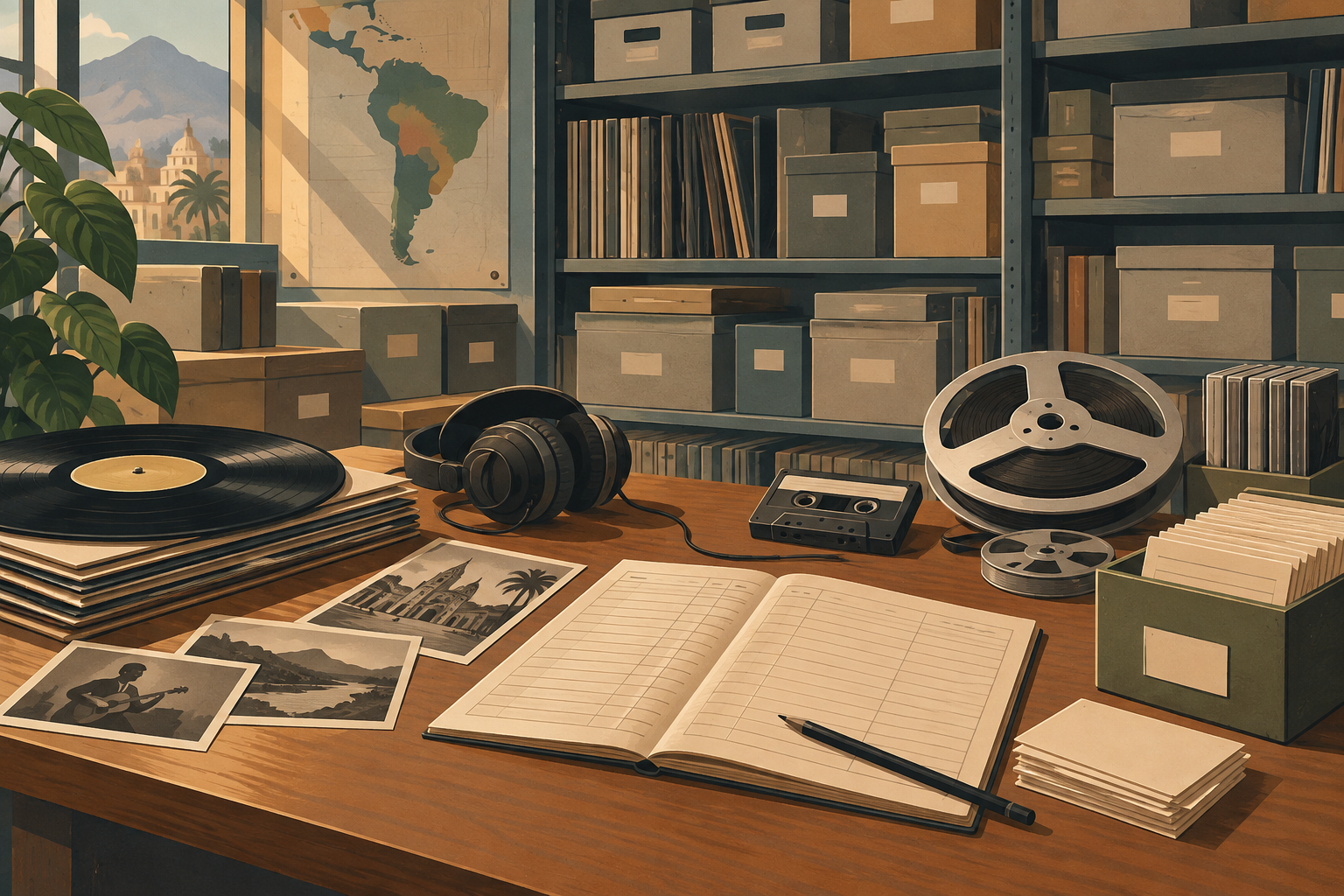
Associated documentation may be inseparable from an object’s context. The Navarra guidance explicitly refers to object documentation as context accompanying collections. Francisco Javier Zubiaur Carreño likewise notes that digitising images can complement catalogue records and support dissemination, while also observing that media such as radio and television may themselves be documents worth preserving according to intrinsic value or artistic status.
The lesson is not that everything must be retained without selection. Appraisal schedules exist precisely to make explicit decisions. What matters is that selection should not reduce memory to a striking image. Researching design and advertising requires, when available, links among an item, its description, provenance, documented date or period, support and conservation condition.
From visual impact to public knowledge
The Valencia study proposes that a visit can become a process of learning about the communicative possibilities of space, and that museums educate visitors’ gaze through constant stimuli. This helps avoid two familiar extremes. The first treats graphics as a superficial addition that can be removed from content without consequence. The second mistakes an intense visual experience for sufficient explanation.
A well-designed gallery can help attention, offer orientation and make heterogeneous material comparable. Its cultural effectiveness, however, depends on the quality of context it provides. A concise label can be appropriate when it indicates what is known and unknown; a timeline can orient visitors when it does not claim precision absent from the documentation; a reproduction can be useful when identified as such. By contrast, nostalgia without verifiable provenance can easily turn objects into scenery for generic memories.
Accessibility belongs to the same issue. The SEDIC text on archives in state museums points to the need to increase conservation, preservation and accessibility of documentary heritage. Providing access does not merely mean placing images online. It requires understandable descriptions, consistent metadata and criteria that let different audiences understand what they are seeing and why information has been connected to an item.
Limits of verification and a conclusion
The available sources support saying that graphic design participates in museum communication and promotion, that archives sustain the institutional and contextual memory of collections, and that documentary preservation requires classification, metadata and appraisal. They do not, by themselves, reconstruct the specific history of a campaign, assign authorship to unidentified pieces or establish the reception of a particular audience.
That limit does not weaken analysis; it gives it a method. Faced with a label, leaflet or advertisement, the most useful question is not only “Do I like it?” but “What documented relationship does it propose among image, object, institution and public?” Design and advertising can become cultural heritage when preserved and interpreted as situated forms of communication. In a museum, graphics are not the silence surrounding the collection: they are one of the voices that organises its conversation with the present.
- Decade
- Contemporary
- Region
- Global
- Level
- Enthusiast
- Entities
- Museum
Sources and references
- Museo de la Historia de la Publicidad — Descubriendo la huella de la Publicidadmuseohistoriapublicidad.org · 2026-09-20
- Clip de SEDIC, Revista de la Sociedad Española de Documentación eedicionsedic.es · 2026-09-20
- Diseño Museográfico y Semiótica – EVE Museos + Innovaciónevemuseografia.com · 2026-09-20
- instrucciones para la gestión y organización de archivos ...www.navarra.es · 2026-09-20
- Diseño gráfico del museo como estímulo creativo en educación patrimonial | i2 Investigación e Innovación en Arquitectura y Territorioi2.ua.es · 2026-09-20
- Archivos de Museo: Funcionamiento - EVE Museos + Innovaciónevemuseografia.com · 2026-09-20
- Capítulo 10 - El museo como centro de investigación. La necesidad de documentar las piezas en el museo. Tendencias documentales actuales. Normalización y gestión integral del museo. - Fco Javier Zubiaur Carreñowww.zubiaurcarreno.com · 2026-09-20