A decorative object does not end at its surface
A lamp, a textile, a dinner service or a piece of furniture may seem self-contained when viewed in a gallery. Museum conservation, however, begins from a broader reality: the integrity of a collection includes its physical condition and the historical-artistic information it conveys. Spain’s National Museum of Decorative Arts places both material preservation and associated information at the centre of its work.
That perspective changes how decoration is discussed. These are not simply attractive, old or stylistically representative objects. Their interpretation depends on accumulated data: what they are made of, what changes they have undergone, how they reached an institution, what is known about their history, and which documents, photographs or objects are connected to them. Without that framework, the object remains, but a crucial part of its meaning is weakened.
Conservation makes a future possible
Preventive conservation is described in museum literature as a systematic process of maintenance and improvement, rather than a spontaneous response to damage. Its horizon is necessarily long: it works for visitors who have not yet been born. This is particularly relevant to decorative arts, where very different materials, sizes and vulnerabilities coexist.
Conservation does not mean promising permanence or returning every object to an assumed original state. The definition published by the Castilla-La Mancha cultural portal stresses the assessment, establishment and implementation of measures intended to stabilise and slow the deterioration of cultural property. It is a cautious formulation: it speaks of delaying processes, not erasing them, and requires informed decisions rather than interventions driven by appearance.
Museum holdings have their own material and cultural histories: structure, composition, age, cultural affiliation, and histories before and after acquisition. One solution therefore cannot automatically suit every piece. Preventive conservation must attend to the diversity of a collection and to the conditions in which it is stored, studied, moved or displayed.
Storage also expresses values
Museum storage is often absent from public images of decoration, yet it is essential to an object’s continuity. The National Museum of Decorative Arts explains that it seeks to optimise storage spaces and improve both conservation conditions and accessibility. The link between access and preservation is not incidental.
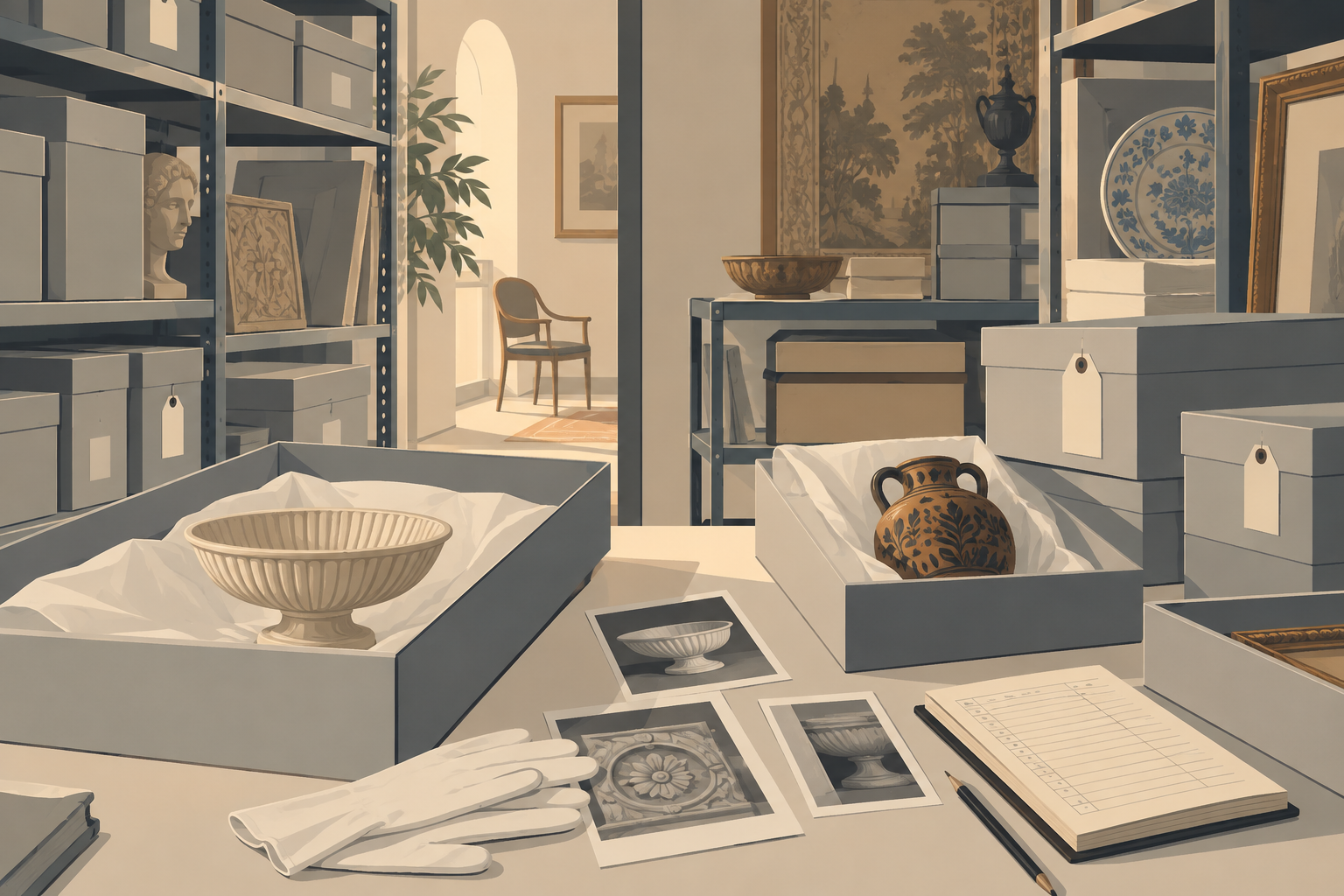
Location and support are part of a care policy. Large or heavy pieces should be placed in low areas that do not require ladders; small, fragile pieces may need special supports, trays or boxes that allow safer movement. These are not isolated logistical details: more predictable handling reduces risk while making collections easier to consult.
In this setting, accessibility does not merely mean displaying more. It means that staff can find and handle an item without imposing unnecessary strain on it. Decoration that is preserved but inaccessible for study, or accessible only through unsafe practices, loses part of its capacity to produce knowledge.
Documentation is not an accessory
Museum documentation has an active role. Archival-management guidance cited by the Government of Navarre states that documentation belonging to objects is inseparable context and should remain within the institution. In the museum literature gathered by Francisco Javier Zubiaur Carreño, a catalogue may contain information on condition, treatments, biography, bibliography and other incidents relating to an item.
This has practical consequences. A condition photograph, technical description, examination report or note on an alteration is not peripheral paperwork. Such records allow comparisons over time, support decisions and reconstruct what was known about an object at a given date. The National Museum of Decorative Arts notes that its condition reports are accompanied by photographs and, where possible, alteration maps; it also stresses the need for ongoing review and documentation.
Documentation of the museum’s external environment serves another purpose: it helps explain the context from which cultural property comes and contributes to heritage protection. In decoration, where an object may have belonged to an interior, a domestic ensemble, a shop or a collection, that contextual network can be as revealing as the isolated object.
Between an object and cultural history
Decoration gains cultural value not only through formal qualities. The Castilla-La Mancha cultural portal links the conservation of movable goods and decorative elements to social recognition of heritage: goods regarded as significant for historical, artistic, archaeological, technical or cultural reasons. That plurality prevents decorative heritage from being reduced to a hierarchy of luxury or authorship.
A museum does not preserve only what matches a fixed idea of a masterpiece. It preserves material and documentary evidence that can support research, exhibition, public communication and education. Zubiaur describes the museum as a documentary institution that both emits and receives information; from that standpoint, the decorative object enters a network of knowledge instead of becoming a mere image.
Interpretation must nevertheless retain its limits. Records may be incomplete; an attribution or provenance may need revision; and missing documentation does not permit a history to be filled in with assumptions. Good interpretation distinguishes what has been observed, what has been recorded and what has been inferred.
Caring for decoration means preserving relationships
The main lesson is straightforward, though demanding: protecting an item from visible damage is not enough. The relationships that make it intelligible must also be sustained. Storage space, location systems, photographs, reports, use data, bibliography and contextual documentation form a whole.
For readers approaching decoration from outside the museum, this offers a less ornamental and more exact perspective. A conserved object is not simply a material survivor. Its future interpretation depends on present decisions: how it is stored, how it is moved, what is recorded and which uncertainties are made explicit. Conservation is therefore not the silent reverse side of display. It is the condition that allows decorative objects to continue telling stories without forcing them to say more than the evidence supports.
- Decade
- Contemporary
- Region
- Spain
- Level
- Enthusiast
- Entities
- Museum
Sources and references
- Conservación - Museo Nacional de Artes Decorativas | Ministerio de Culturawww.cultura.gob.es · 2026-09-21
- Museum Internacional No 201 (Vol LI, n° 1, 1999) Conservación preventivawww.ibermuseos.org · 2026-09-21
- instrucciones para la gestión y organización de archivos ...www.navarra.es · 2026-09-21
- LA CONSERVACION PREVENTIVA EN LOS MUSEOS Teoría y prácticawww.museosdetenerife.org · 2026-09-21
- Estudio y documentación - Museo Nacional de Artes Decorativas | Ministerio de Culturawww.cultura.gob.es · 2026-09-21
- Capítulo 10 - El museo como centro de investigación. La necesidad de documentar las piezas en el museo. Tendencias documentales actuales. Normalización y gestión integral del museo. - Fco Javier Zubiaur Carreñowww.zubiaurcarreno.com · 2026-09-21
- La importancia de la conservación y restauración del patrimonio cultural. ¿Qué es la restauración? | Portal de Cultura de Castilla-La Manchacultura.castillalamancha.es · 2026-09-21