A computer in a museum may initially look like an administrative device: a screen for inventories, loans or searches. Yet the supplied texts on museum documentation describe a broader role. An information system structures records, links graphic archives to catalogue entries and helps locate objects; it does not decide what an object means, nor can it restore a context that was never recorded. That distinction matters when material technological culture is discussed. Preserving an object while losing its documentary history narrows what later researchers, curators and visitors can investigate, explain and pass on.
The object and its accompanying information
Documentation is not a decorative addition to an object. Francisco Javier Zubiaur Carreño argues that preserving a museum piece is fully justified only when documentation recording the circumstances of its discovery and its history is also preserved; otherwise, a museum risks becoming a storehouse of objects. This is a principle for reading collections, not an automatic formula. A record can include identification, available provenance, observations and conservation condition, but it should also show clearly which information is documented and which is not.
For a historical computer, that caution prevents speculation from becoming biography. A machine may be physically identifiable while its use, owners, modifications or relationship to a particular place remain unknown. The record should allow those uncertainties to remain visible. The value of a database lies not in erasing gaps, but in making known information recoverable and ordered, including the limits of what is known.
What computing contributes to management
The University of Valencia lists tasks that museum information systems can support: documentary files on collection objects, graphic archives, movement management, loans, acquisitions and restoration. The list shows why computers became part of museum workflows. A collection is not only a group of still objects. It involves photographs, reports, chronologies, locations, arrivals, departures and professional decisions that need to be related.
The same source notes that database-management systems cover structured and documentary information to differing degrees. The qualification matters. Possessing a database does not prove that all documentation is complete or that every description has equal quality. It does provide an infrastructure for bringing together and consulting information that might otherwise remain scattered across files, images and working records.
From graphic archive to verifiable account
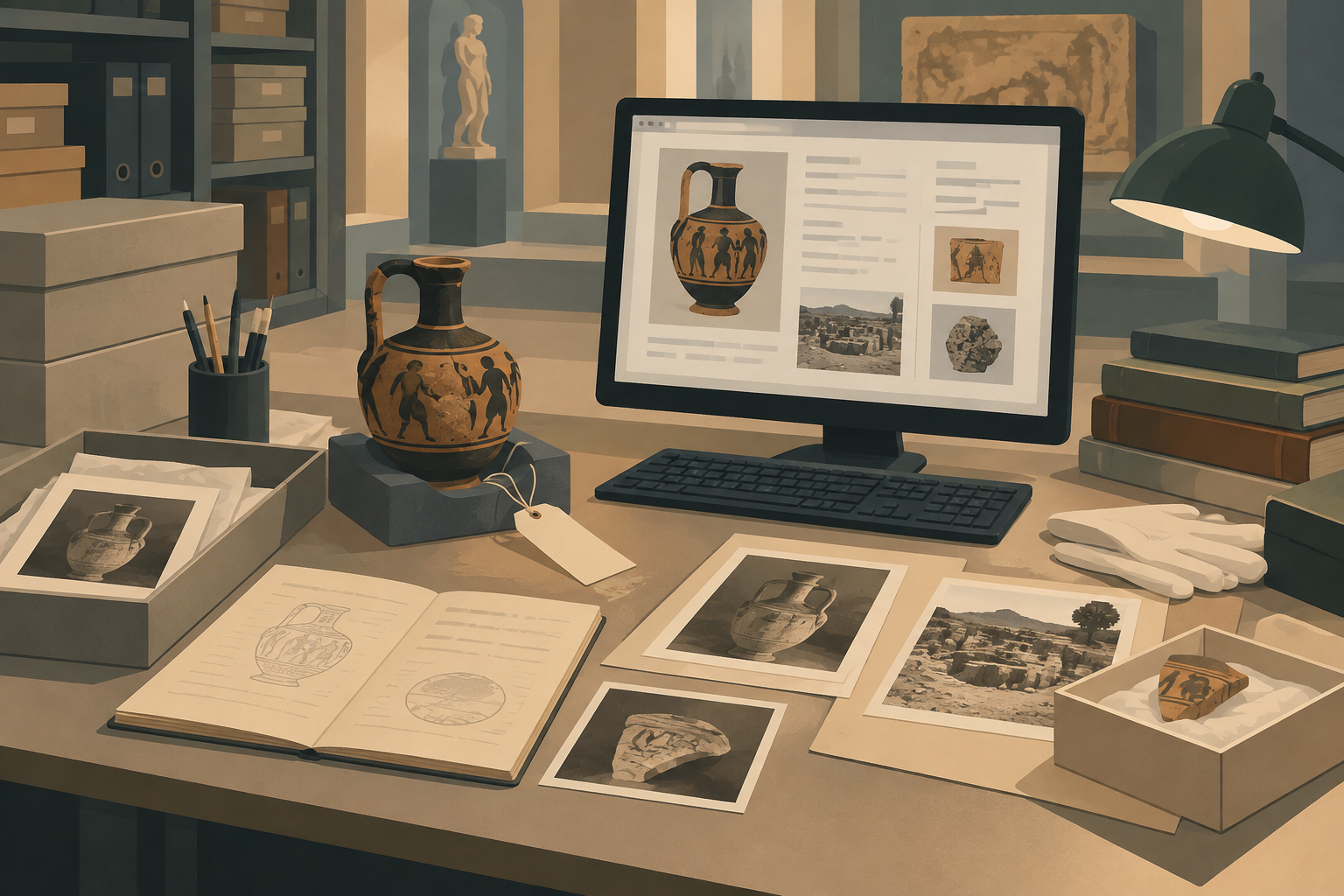
Museum-held images — photographs, slides, negatives, video or sound, in the University of Valencia’s list — can greatly broaden understanding of a collection. But an isolated image does not interpret itself. Its value grows when it remains connected to a known date, available authorship or provenance, the object shown, and conditions of creation or accession. A computer can associate and retrieve these fields; documentary work determines which association can actually be supported.
The National Archaeological Museum describes its historical archive as reflecting the people who shaped the institution, the history of its collections, and its intellectual and cultural activities. This shifts the focus. An archive concerns not only the object but also the institution that received, studied, displayed or managed it. In a collection of computers, a technical record does not exhaust a group’s cultural history. Institutional records may explain why an object entered the museum and what role it later played there.
Conservation, organisation and access
Texts from EVE Museos + Innovación stress that organisational archives document a museum’s development, collections, exhibitions and programmes, as well as contributions by people and groups connected with the institution. They describe such archives as fundamental and irreplaceable, linking their value to active conservation, updating, organisation, preservation and public access. The issue is not a choice between conserving objects and conserving papers, photographs and electronic records: they belong to the same documentary responsibility.
This also limits a simplified view of digitisation. A digitised document may be more accessible, but prior arrangement, conservation condition and contextual metadata remain decisive. SEDIC’s journal warns that a digitisation plan requires earlier ordering, materials in suitable condition and metadata allowing digital images to be located afterwards. Digitising does not automatically mean documenting; it can be a valuable phase within a process requiring description and control.
The computer as a public mediator
Computing does not operate only behind an office door. The University of Valencia describes interactive kiosks in museum galleries as public-facing computers that can complement a visit with information on works, storage areas, closed exhibitions or institutional history. This turns the documentary system into a cultural interface: part of the organised information can become a route for visitors’ exploration.
Making information public still requires selection and context. A screen can multiply access, but it cannot replace responsible interpretation. Records should distinguish confirmed information, attributions, gaps and the vocabularies used. Easy searching should not transform a catalogue entry into an absolute statement. Access design should preserve traceability between object, document and description.
Conclusion: preserving relationships
The lesson of these sources is not that a museum must adopt a particular program, nor that a computer can independently solve heritage challenges. It is both simpler and more demanding: conservation depends on documentation that is organised, contextualised and maintained over time. The computer can reveal a network of records, images, reports and movements; it can also assist management and access. But that network exists because professionals describe, arrange, review and preserve its links.
For the study of computers as heritage, this conclusion is especially useful. Physical equipment retains material presence; archives explain what it was, how it arrived, what is known of its trajectory and which questions remain open. A museum does not keep machines alone. It keeps relationships among objects, people, images, documents and institutions. The computer is a powerful tool for preventing their loss, provided that the archive remains the centre of verifiable memory.
- Decade
- Contemporary
- Region
- Spain
- Level
- Enthusiast
- Entities
- No linked entities
Sources and references
- Capítulo 10 - El museo como centro de investigación. La necesidad de documentar las piezas en el museo. Tendencias documentales actuales. Normalización y gestión integral del museo. - Fco Javier Zubiaur Carreñowww.zubiaurcarreno.com · 2026-09-18
- El museo la informáticawww.uv.es · 2026-09-18
- Introducción a la Gestión de Archivos en Museos – EVE Museos + Innovaciónevemuseografia.com · 2026-09-18
- Clip de SEDIC, Revista de la Sociedad Española de Documentación eedicionsedic.es · 2026-09-18
- Archivos de Museo: Funcionamiento - EVE Museos + Innovaciónevemuseografia.com · 2026-09-18
- Archivo histórico - | Ministerio de Culturawww.man.es · 2026-09-18