Two roles that coexist
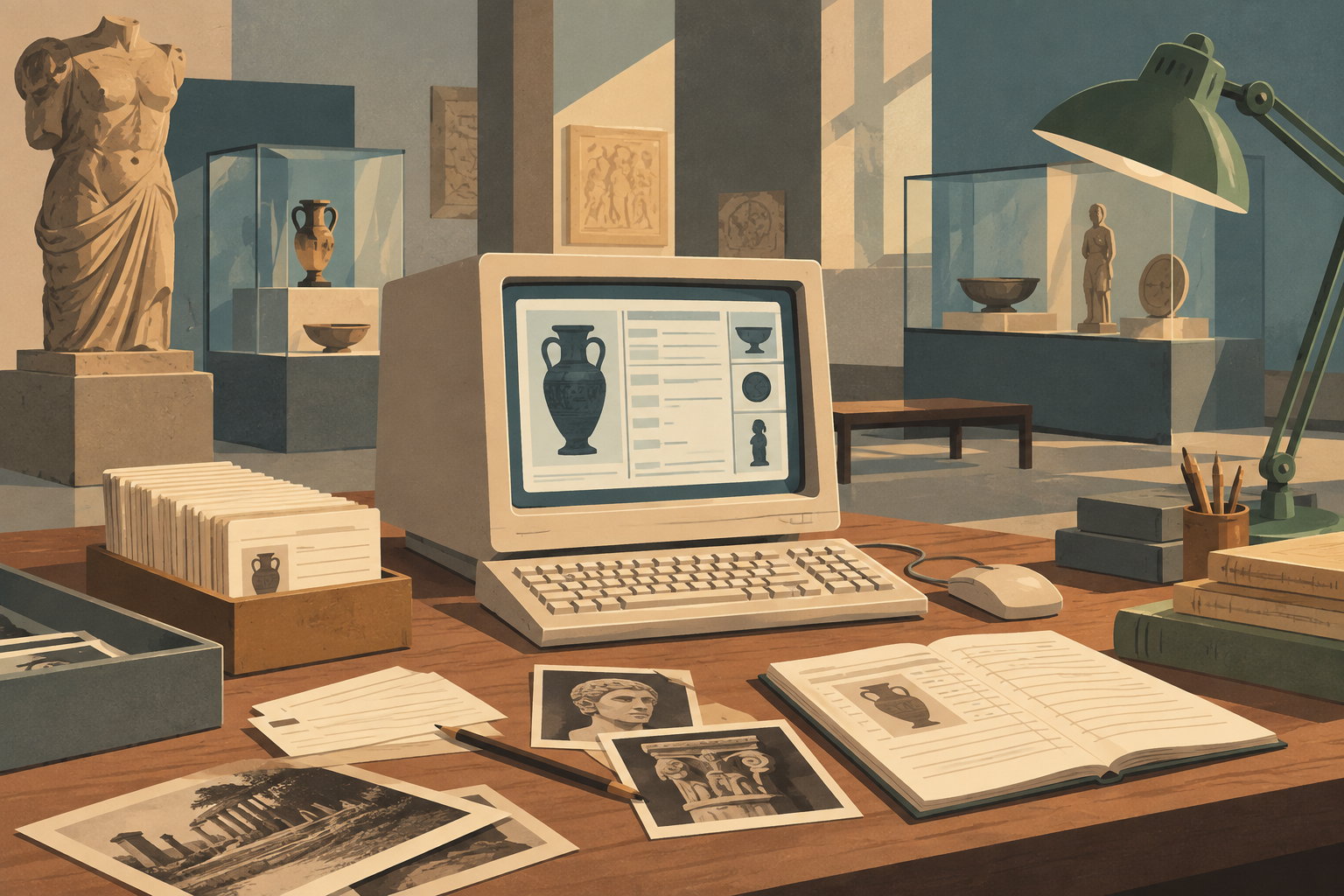
In a museum, a computer can occupy two different positions. It can be a tool for organising information about objects and, in some cases, an object that is itself collected and studied. The distinction matters: a machine used to record a collection does not automatically become a collection item, and identifying a computer as a museum object does not, by itself, establish its provenance or use.
Francisco Javier Zubiaur Carreño’s museology chapter argues that documentation for an object should include, among other details, its condition, acquisition circumstances and history. It also mentions processing this information with specialised programs. Here, computing is a means of work; the aim remains making each object and its context intelligible.
Documentation means more than entering data
The University of Valencia describes museum documentation tasks that include maintaining textual and image archives, managing a collection, and recording loans, movements, locations, acquisitions and restoration. It also notes that database management systems can meet some of these needs. The important point is the whole: a written record, an image and information about an object’s movements can complement one another, but they are not interchangeable.
Navarra’s instructions for archive management and organisation stress that documents relating to objects form part of their context and should remain linked to them. Within this framework, digitising or entering information into a computer is not, by itself, the preservation of that context. The editorial point is straightforward: a computer record is useful when it helps locate and connect information, and when the museum remains clear about what each item of information documents and where it comes from.
When the computer is the object
A computer can also move from being a tool to being an object of study. A Microsiervos report on the Museum of Computing History in Majadas de Tiétar describes a collection of computers and work undertaken there on an IBM System/370. The report mentions components and terminals associated with the system, and discusses practical difficulties the museum anticipated in operating it, including its electricity consumption.
That case invites a question rather than a universal prescription: what information needs to accompany a machine for an exhibition to explain more than its appearance? Museum documentation offers a starting point: the object’s history, acquisition circumstances, condition and context. For a computer, a physical description may be only part of the story; documentation may also clarify the role it played within a larger system. The sources available here do not provide a complete technical protocol for doing so.
Archives, access and limits
Documentation is not merely an internal tool. An article in SEDIC’s Clip journal addresses museums’ digital presence and, in the supplied excerpt, warns that a digitisation plan needs prior organisation, suitable preservation conditions and contextual metadata that makes images retrievable. The Historical Archive of the National Archaeological Museum, meanwhile, presents documentation as testimony to the institution’s life, its collections and its activities.
These examples help challenge a simplistic assumption: transferring documents to digital form does not automatically guarantee their organisation, preservation or accessibility. Nor do they establish which particular system any museum uses to manage historical computers. The sources offer principles and limited examples, not a comparative study of software, formats, access policies or digital-preservation practices.
A memory made of relationships
The practical implication is that a museum computer can be understood both as a management tool and as an object whose interpretation depends on reliable documentation. In the first role, it helps organise records and support tasks; in the second, it requires the preservation of information that situates it within a history and a collection.
It is not enough to keep a machine or create an isolated digital record. Documentation gains value when it maintains understandable links between the object, its images, its known history, and its conservation and management records. This conclusion draws on the cited sources; it is not an exhaustive technical standard and does not attribute specific practices to every museum. A computer can be a gateway to a collection’s memory, but that gateway only works when the information behind it is well documented.
- Decade
- Contemporary
- Region
- Spain
- Level
- Enthusiast
- Entities
- Museum
Sources and references
- Capítulo 10 - El museo como centro de investigación. La necesidad de documentar las piezas en el museo. Tendencias documentales actuales. Normalización y gestión integral del museo. - Fco Javier Zubiaur Carreñowww.zubiaurcarreno.com · 2026-09-24
- El museo la informáticawww.uv.es · 2026-09-24
- instrucciones para la gestión y organización de archivos ...www.navarra.es · 2026-09-24
- Clip de SEDIC, Revista de la Sociedad Española de Documentación eedicionsedic.es · 2026-09-24
- El Museo de Historia de la Computación, paraíso de los ordenadores de todos los tiemposwww.microsiervos.com · 2026-09-24
- Archivo histórico - | Ministerio de Culturawww.man.es · 2026-09-24