Graphic design does not stop at the entrance
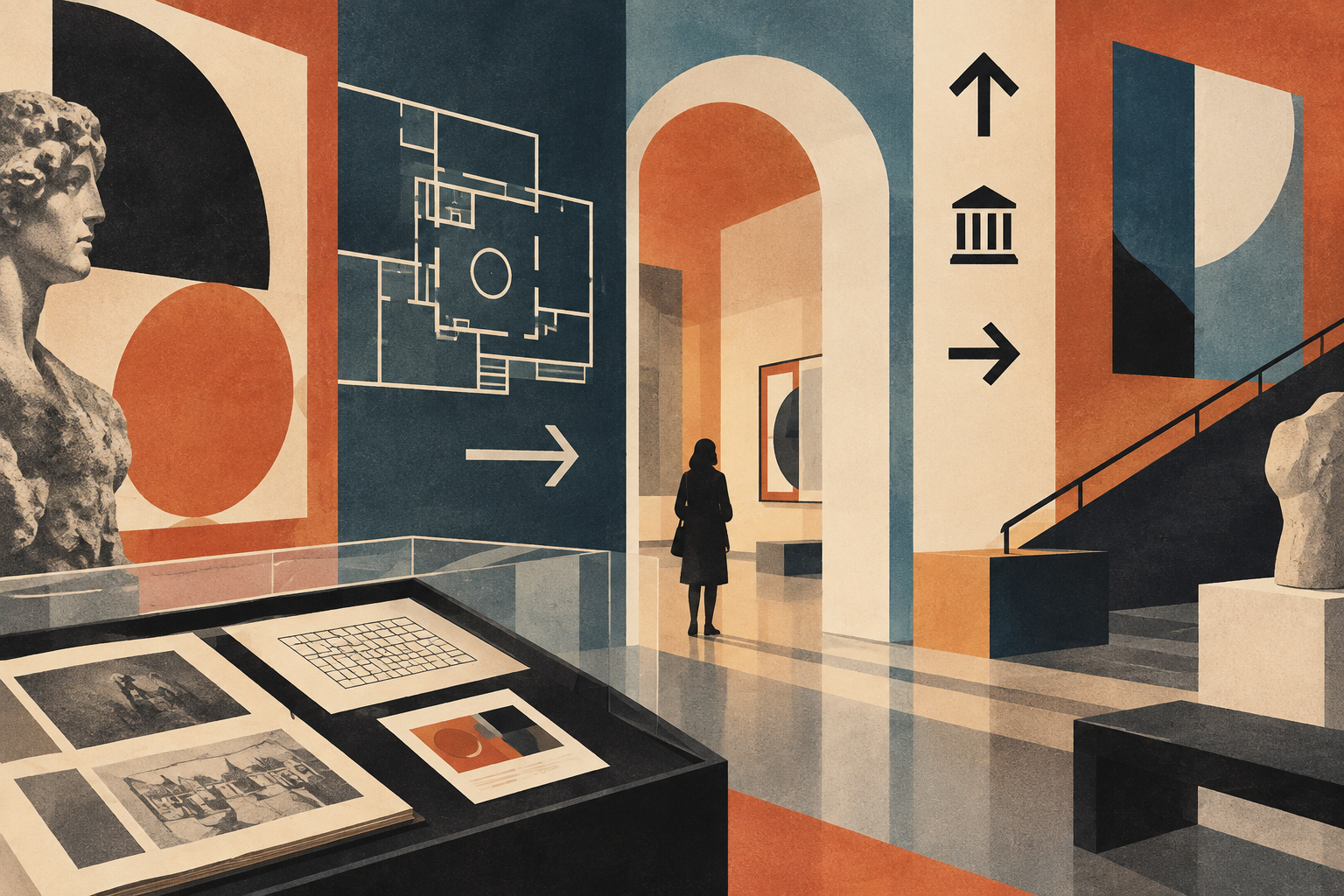
A museum’s visual identity is often associated with posters, leaflets or campaigns. Yet the supplied evidence supports a broader view: design also contributes to the experience inside the museum. A study of seven museums in Valencia examines graphic design across different settings and states that applied graphics are closely linked to each institution’s image. Its authors describe graphic messaging as a stimulus received by visitors and connect design choices with the communicative possibilities of space.
This does not establish a universal visual formula, nor does it show that every visitor interprets the same elements in the same way. It does support a useful way of reading museums: graphics are part of the visit, not merely an advertisement encountered beforehand. Wayfinding, exhibition presentation and institutional communication may form a visual continuity, although the supplied sources do not describe specific systems or attribute quantified outcomes to particular design decisions.
Space organizes a reading
Museography is not simply a matter of placing objects. A reflection published by EVE Museos + Innovación describes the arrangement of objects and artefacts as a practice that can convey narratives and establish relationships between elements. It also presents museum space as a mediator between past, present and future: objects integrated into a contemporary exhibition may acquire new readings.
As an interpretation, this perspective helps explain why graphic design matters. An image, label or guide can direct attention and offer a framework for reading; it does not replace research into the objects, but it takes part in communicating them. The supplied evidence identifies no particular exhibitions and documents no visitor responses, so this general reading should not be mistaken for a demonstrated effect in every case.
Institutional identity communicates too
The academic study of the seven museums in Valencia treats graphic design as part of both museum facilities and promotion. This connection raises an editorial question: how do the identity a museum presents externally and the visual language accompanying a visit relate to one another? The available material supports treating both as subjects within museum design, but it does not provide enough information to compare particular brands, campaigns or communication outcomes.
Visual identity can therefore be read as a mediating tool rather than a merely decorative finish. A graphic choice makes some content visible and establishes an order of attention. This is an interpretation of the communicative role described by the study, not a claim that a particular style is superior. Research into a specific institution would require identified works, dates, authorship and contextual documentation, which are absent from the supplied sources.
Archives: memory and access
Design and public communication also depend on what an institution preserves and how those records can be consulted. An article from SEDIC highlights the existence of unpublished historical archives in state museums and notes objectives concerning cooperation between museum archives and public access to documentary heritage. The supplied Navarre instructions for managing museum archives mention identifying document types, classification schemes, contextual metadata and appraisal and preservation schedules.
These details make it possible to consider the archive as infrastructure for institutional memory. They do not prove that every museum has digitized or publicly available records, or that the cited holdings contain specific graphic campaigns. The supplied museology chapter notes that digitized images can supplement catalogue records and be disseminated; it also observes that radio and television may themselves merit preservation depending on their value. Applied cautiously, this suggests that a museum’s visual history may extend beyond its displayed objects to records and media whose significance must be assessed.
What can be said—and what remains open
The sources support three points: graphics contribute to institutional image and the visitor environment; exhibition arrangements can propose narratives; and archives, their organization and their accessibility matter to cultural management. A UNESCO documentary-processing manual included in the evidence also gives examples of cataloguing fields for documentary heritage and connects documentation with preservation, study, education and public communication.
The evidence is not enough to reconstruct a chronological history of museum design between 1900 and 2009, attribute campaigns to designers or measure the impact of a visual identity. Nor can it identify a particular museum as a model. The strongest conclusion is narrower: studying a museum’s design requires looking together at graphic messages, the space containing them and the records preserving their history. This approach makes graphics part of the public experience and, at the same time, a subject of documentation and memory—without confusing interpretation with verified fact.
- Decade
- Contemporary
- Region
- Global
- Level
- Introduction
- Entities
- Museum, Televisión
Sources and references
- Clip de SEDIC, Revista de la Sociedad Española de Documentación eedicionsedic.es · 2026-09-23
- instrucciones para la gestión y organización de archivos ...www.navarra.es · 2026-09-23
- Diseño Museográfico y Semiótica – EVE Museos + Innovaciónevemuseografia.com · 2026-09-23
- Diseño gráfico del museo como estímulo creativo en educación patrimonial | i2 Investigación e Innovación en Arquitectura y Territorioi2.ua.es · 2026-09-23
- Capítulo 10 - El museo como centro de investigación. La necesidad de documentar las piezas en el museo. Tendencias documentales actuales. Normalización y gestión integral del museo. - Fco Javier Zubiaur Carreñowww.zubiaurcarreno.com · 2026-09-23
- Manual de procesamiento documental para colecciones de patrimonio culturalunesdoc.unesco.org · 2026-09-23