Design does not stop at the entrance
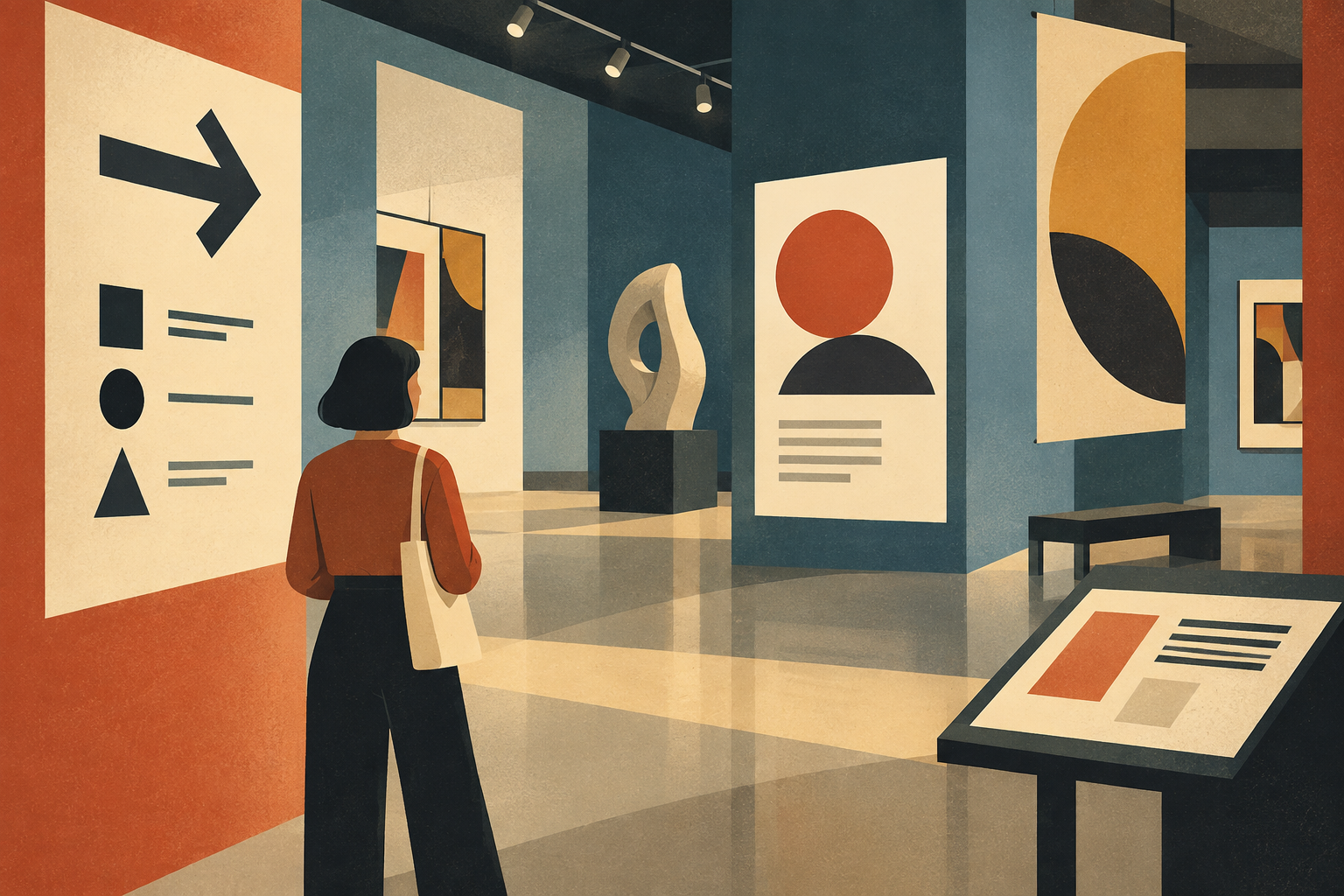
A museum’s visual identity is not limited to its logo or a single campaign. The academic study “Museum graphic design as a creative stimulus in heritage education” argues that graphic resources are part of museum settings and contribute to both public image and promotion. Its analysis focuses on seven museums in Valencia and examines design decisions across different environments from the perspective of visual culture. That scope matters: the source does not offer a general history of museum design or support the claim that all institutions share one aesthetic.
It does, however, pose a specific question: what does a visitor learn to notice when a space, its texts and its images are designed in particular ways? The study suggests that a visit can become a process of learning about the communicative possibilities of space. This is an interpretive proposition with editorial value, not proof that every design has the same effect on every person.
A layer of communication within the visit
Graphic design accompanies the relationship between visitor, work and space. According to the study, permanent collection galleries and temporary exhibitions are settings in which graphic design affects the message received by the public. This encourages us to look beyond the displayed objects: visual organization and the way a museum relates its content to visitors matter too.
The available source information does not name the seven museums, detail the graphic pieces examined or report specific results for each case. It would therefore be wrong to turn the analysis into a catalogue of styles or to claim that particular typefaces, colours or signage systems are more effective. The evidence supports a narrower conclusion: design merits analysis as part of the visitor experience, rather than as an ornament separate from it.
From graphic message to interpretation
A second source, on museographic design and semiotics, describes the museum as a system of signs and argues that the arrangement of objects and artefacts can help construct narratives and relationships. It also presents exhibition space as a mediator between past, present and future, where choices of presentation can prompt new readings. This perspective complements the Valencia study: graphic design does not operate in isolation, but alongside spatial organization and content.
The two kinds of evidence should be distinguished. The academic article examines graphic environments in specific museums; the semiotics text provides a general framework for thinking about exhibitions as communication. Based on the information available, neither demonstrates that a particular graphic solution guarantees comprehension or learning. That would require evidence about audiences, methods and outcomes that is not supplied here.
Promotion and institutional identity
A museum’s visual communication also shapes its public presentation. The Valencia study links applied graphic design with the museum’s image and promotion. This makes advertising relevant, but does not justify conflating promotion with the experience inside galleries. An image that presents an institution externally and a graphic system accompanying an exhibition may share visual decisions while serving different functions.
The supplied evidence includes no identified advertising campaigns, dates, designers or reproduced materials. This article therefore cannot reconstruct a campaign or attribute a visual identity to a particular museum. Its more modest contribution is to treat design as a visible part of how an institution communicates, both during a visit and in its public representation.
Documenting in order to tell
Institutional documentation offers another useful context. Navarra’s museum-archive management instructions refer to identifying document types, classification schemes or series catalogues, metadata and appraisal and preservation schedules. A text on museum documentation explains that digitization makes it easier to circulate images associated with catalogue records, and notes that radio and television can also be documents worth preserving, depending on their value.
These sources are not studies of graphic design and should not be presented as such. They do help identify an important limitation: writing the visual history of a museum requires documents that can be located and contextualized. Posters, leaflets, signage and audiovisual materials should be considered alongside information about their provenance, use and preservation. A text on museum archives also emphasizes inventories, descriptions and preservation measures, underlining the value of organizing institutional records and making them accessible.
What we know—and what remains open
The evidence gathered supports the claim that an academic study examines graphic design in seven museums in Valencia and relates it to communication, promotion and heritage education. It also allows that question to be placed alongside general ideas about museography, semiotics and documentation. It does not allow us to tell the history of a specific campaign, identify the creators of individual designs, measure audience effects or generalize findings to all museums.
That caution does not make the subject less interesting. It offers a more precise way to look at museums. Their graphics and messages may form part of institutional storytelling and the visitor experience, but explaining how they work and with what results requires documented objects and further research. Museums communicate through design; a rigorous history of that communication begins by distinguishing what the evidence supports from what remains to be investigated.
- Decade
- Contemporary
- Region
- Spain
- Level
- Introduction
- Entities
- Museum, Televisión
Sources and references
- instrucciones para la gestión y organización de archivos ...www.navarra.es · 2026-09-24
- Diseño Museográfico y Semiótica – EVE Museos + Innovaciónevemuseografia.com · 2026-09-24
- Archivos de Museo: Funcionamiento - EVE Museos + Innovaciónevemuseografia.com · 2026-09-24
- Diseño gráfico del museo como estímulo creativo en educación patrimonial | i2 Investigación e Innovación en Arquitectura y Territorioi2.ua.es · 2026-09-24
- Capítulo 10 - El museo como centro de investigación. La necesidad de documentar las piezas en el museo. Tendencias documentales actuales. Normalización y gestión integral del museo. - Fco Javier Zubiaur Carreñowww.zubiaurcarreno.com · 2026-09-24