A film is more than its screening
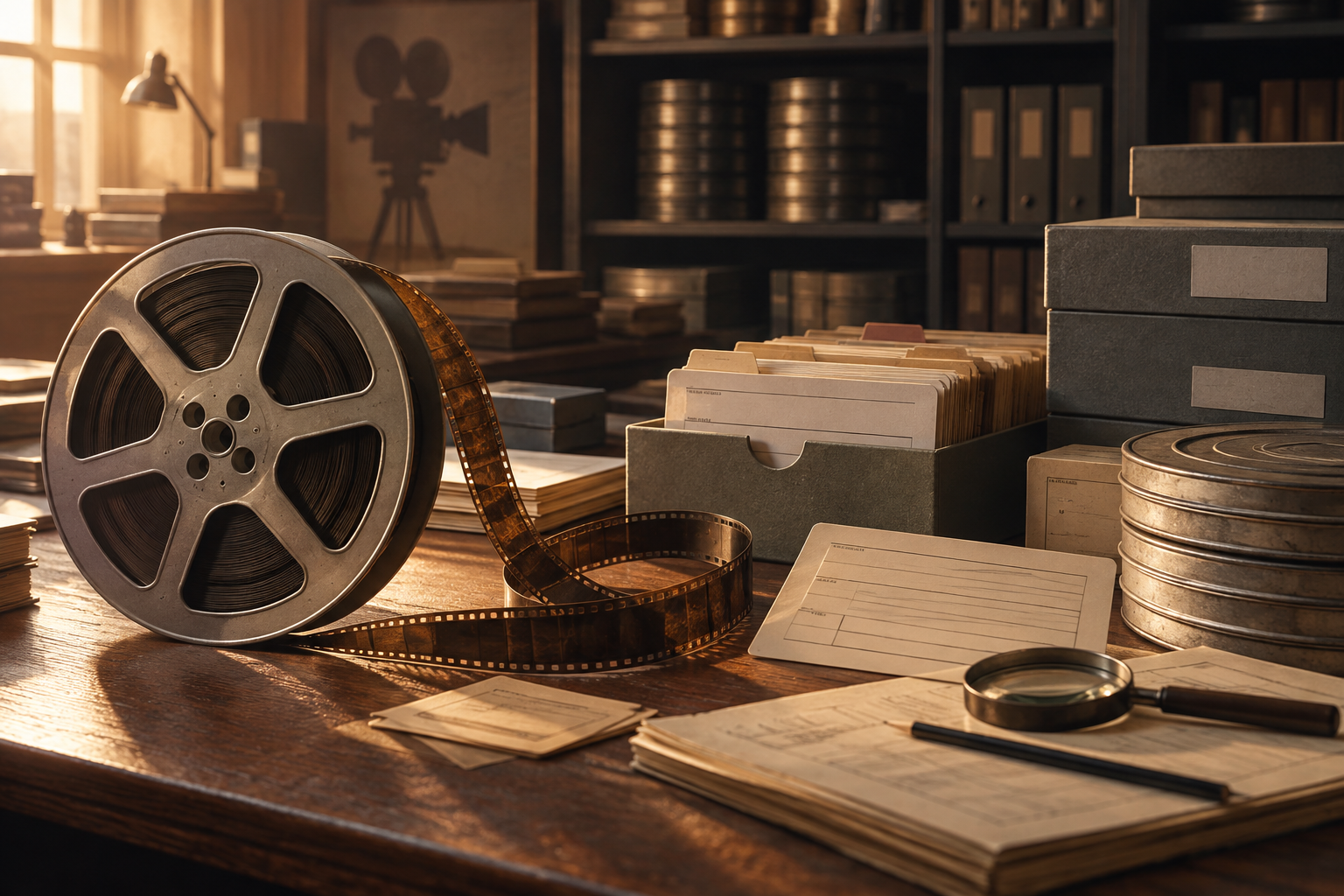
When people speak of film heritage, they often picture a film can on a climate-controlled shelf. The image is useful, but incomplete. Cinema can be an artwork, a public experience and testimony to a cultural moment; it is also a set of materials, procedures and documents that make it possible to identify, study, manage and show that work again. Research on cinema and museums highlights this tension between treating film as a material object and understanding it as an authored work or cultural expression.
This is not merely an academic nuance. It affects what is kept, how it is described and what audiences may be able to see in the future. A copy without provenance data, inspection reports or associated documentation raises difficult questions. Conversely, a contract, licence or poster does not replace a film, but it may explain its circulation, public presentation or context.
Film library, archive and museum: overlapping roles
The terms do not always describe identical institutions. Specialist writing notes that preservation, conservation and restoration have different uses depending on language, country and type of institution. They should therefore not be treated as perfect synonyms.
A film library may hold films and enable study or exhibition. An archive organises and preserves records related to works and to their producers or distributors. A museum may display materials to interpret cinema’s technical, artistic or social history. In practice, those boundaries overlap: one centre may bring together copies, photographs, posters, projection equipment and working papers.
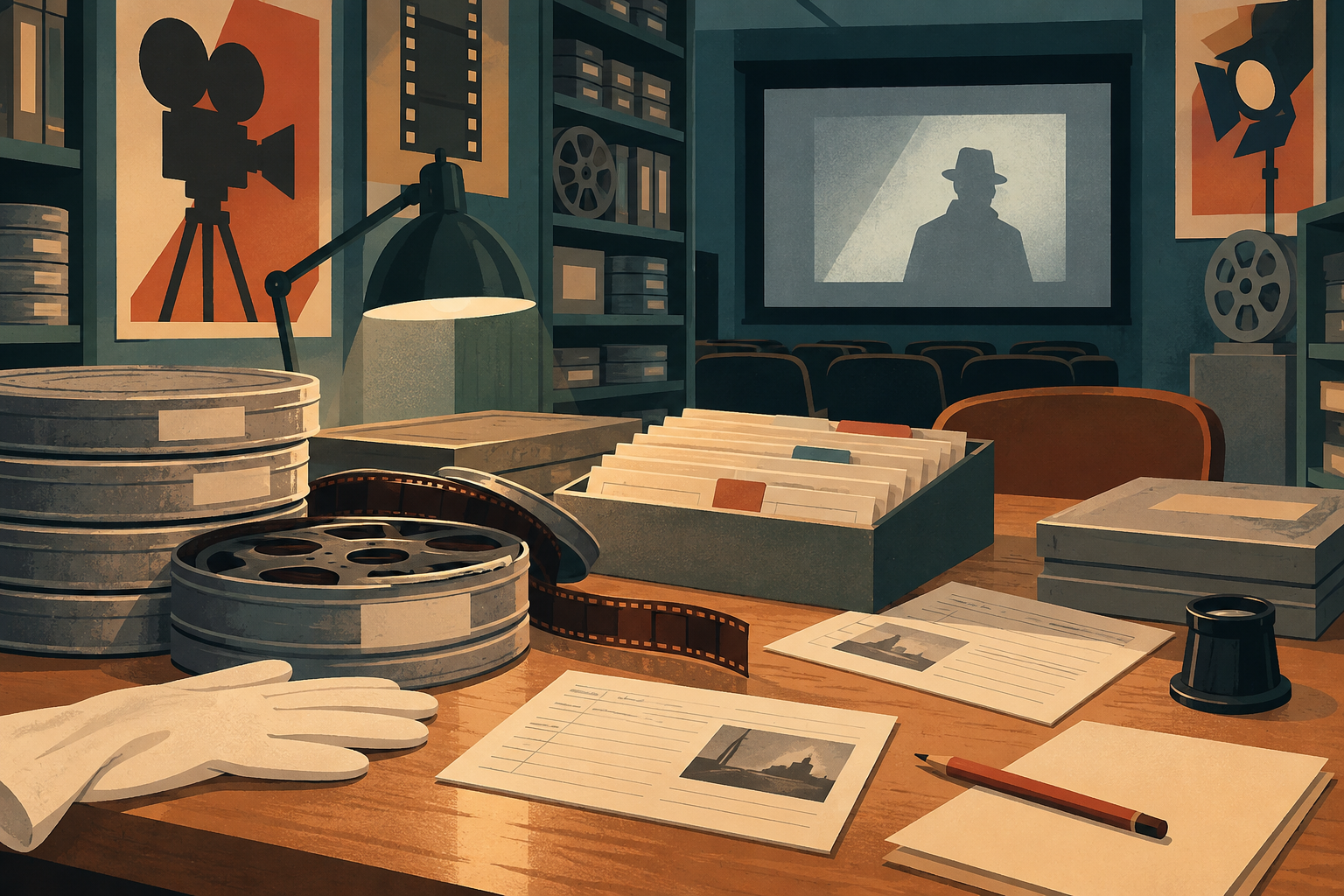
Filmoteca Española’s description shows this documentary breadth. Its archive includes inspection and restoration reports, opening titles, end-credit reels, transfer-of-ownership documents, exhibition licences and censorship bulletins. These are not trivial extras: they support collection cataloguing and operations such as loans, reproductions, digitisation and restoration.
Materiality does not vanish when formats change
The arrival of video formats and digital files does not remove the heritage problem; it changes it. Filmoteca Española states that audiovisual works on video and/or digital-file media exist in many forms, and that their conservation must ensure access to their content regardless of the time elapsed since origin. This shifts attention from a single object to a chain of media, formats and processes.
The institution lists possible media for digitised or born-digital audiovisual files: CD, DVD, Blu-ray, hard drive, USB memory and LTO. Such diversity prevents “digital” from being treated as one final solution. Each medium requires specific management, while access depends on files, equipment, descriptions and workflows remaining usable.
The available evidence does not establish that every medium behaves alike or that every copy is equivalent. It does support a more limited conclusion: audiovisual heritage needs sustained decisions about preservation and access, not simply an initial act of digitisation.
What surrounds a film matters too
A cinema museum need not be limited to screening titles. Academic discussion of Mexico’s Cineteca Nacional stresses the historical value of associated materials: photographs, posters, projection devices and elements of exhibition infrastructure can serve as documents for understanding the technical and material processes of film history.
This perspective broadens the museum visit. A camera, projector or programme leaflet is not merely nostalgic decoration when given context: it can help explain who worked on a production, how a film was seen, what technical conditions it required and what exhibition routes it travelled. Yet editorial caution remains necessary. An isolated object does not by itself prove a universal experience or automatically represent an entire period.
The same caution applies to personal, corporate and institutional records. Collections can illuminate essential parts of audiovisual history without exhausting its contradictions, omissions or unequal representation.
Conservation and dissemination are one problem
Conservation is often imagined as quiet work away from audiences, while dissemination is imagined as its later public phase. Writing on film heritage instead presents film libraries as institutions connecting both tasks. Conservation safeguards the possibility of study and exhibition; dissemination gives public meaning to materials whose survival alone does not guarantee understanding.
The Ministry of Culture’s “Cinema in the Museum” programme proposes discussions between history and archaeology specialists and cinema specialists before screenings. Without treating it as a universal model, its approach is revealing: a film can be revisited through both historical context and fictional narratives. Mediation does not replace a work, but it can keep a screening from becoming decontextualised consumption.
Cataloguing has a public dimension as well. Accurate description helps researchers, programmers and audiences know what exists and under what conditions it can be consulted. What is not identified or contextualised may remain effectively inaccessible even if physically preserved.
Memory, access and verifiable limits
In 2025, Spain’s Ministry of Culture announced a Cinema Museum in the former NO-DO building and stated that nearly 70,000 negatives are deposited at Filmoteca Española’s Conservation and Restoration Centre. The project is presented as a space of memory and interpretation linked to the building, the NO-DO archives and Spanish audiovisual history during the Franco dictatorship. It reminds us that an archive is not neutral simply because it exists: public presentation entails choices about narrative, access and context.
The supplied evidence cannot assess the future museum’s results or determine how its holdings will be displayed. It does allow the narrower claim that conservation, description and interpretation are inseparable when images carry historical weight.
Viewing cinema as complex heritage
Cinema is preserved in films, but also in the documentary and material traces that make them intelligible. Thinking this way does not diminish the emotion of a screening; it makes that experience more readable. Behind an accessible copy may lie inspection, cataloguing, documentation, storage and mediation work that rarely appears on screen.
For viewers, collectors and museum visitors, the practical lesson is simple: ask not only what a film tells, but what materials accompany it, who described it, how it arrived there and what context explains its presence. Such questions do not turn cinema into a display case. They help explain why it can still be watched, debated and made meaningful again.
- Decade
- Contemporary
- Region
- Spain
- Level
- Enthusiast
- Entities
- Museum
Sources and references
- Concepto | Estudios El Patrimonio cinematográfico en el Museodigibug.ugr.es · 2026-09-20
- Cine en el Museo - AGENDA CULTURAL - Ministerio de Culturaagendacultural.cultura.gob.es · 2026-09-20
- 1 Dossiê El cine como patrimonio culturaldialnet.unirioja.es · 2026-09-20
- El nuevo Museo del Cine se ubicará en el antiguo edificio del NO-DO | Ministerio de Culturawww.cultura.gob.es · 2026-09-20
- Departamento de Conservación fílmica - Filmoteca Española | Ministerio de Culturawww.cultura.gob.es · 2026-09-20
- Acerca de los conceptos de preservación, conservación y restauración fílmica en el caso de la Cineteca Nacional de México desde los planteamientos de Paolo Cherchi Usaiwww.scielo.org.mx · 2026-09-20
- Archivo - Filmoteca Española | Ministerio de Culturawww.cultura.gob.es · 2026-09-20