Cinema is often remembered through images: a scene, a face, a dark auditorium, or the design of a video sleeve. Yet when a film enters a film library, archive, or museum, it becomes more than a story made for screening. It also becomes a group of materials, technical decisions, documents, and social uses that can be studied, preserved, and made available again. This broader view is essential to understanding film heritage.
An artwork and a material object
Research hosted by the University of Granada identifies a useful tension: cinema can be understood as art, linked to an author, a movement, or a cultural moment, but that view can push its material condition into the background. A film nevertheless exists on specific carriers. So do the materials that enabled it and accompanied its public life.
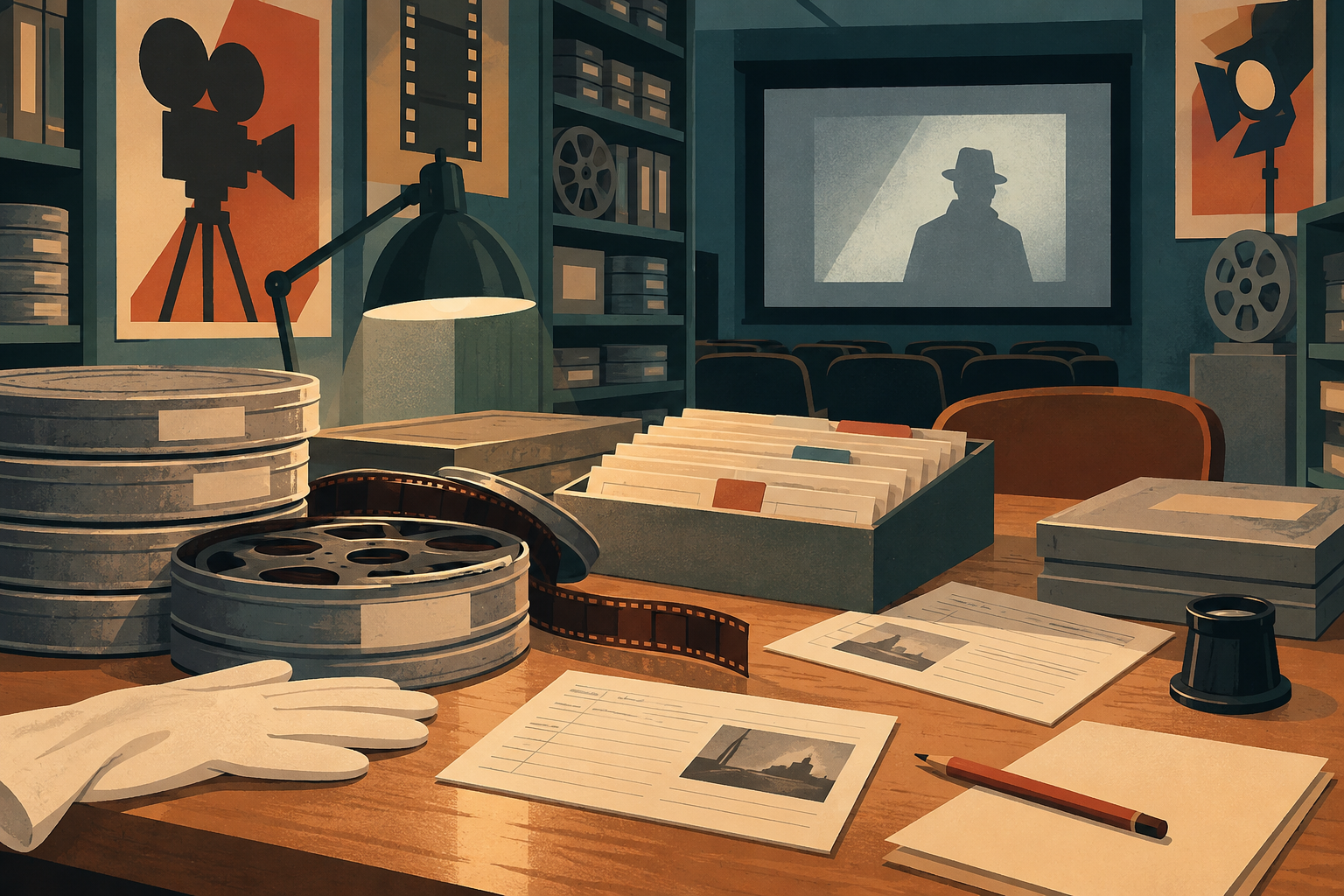
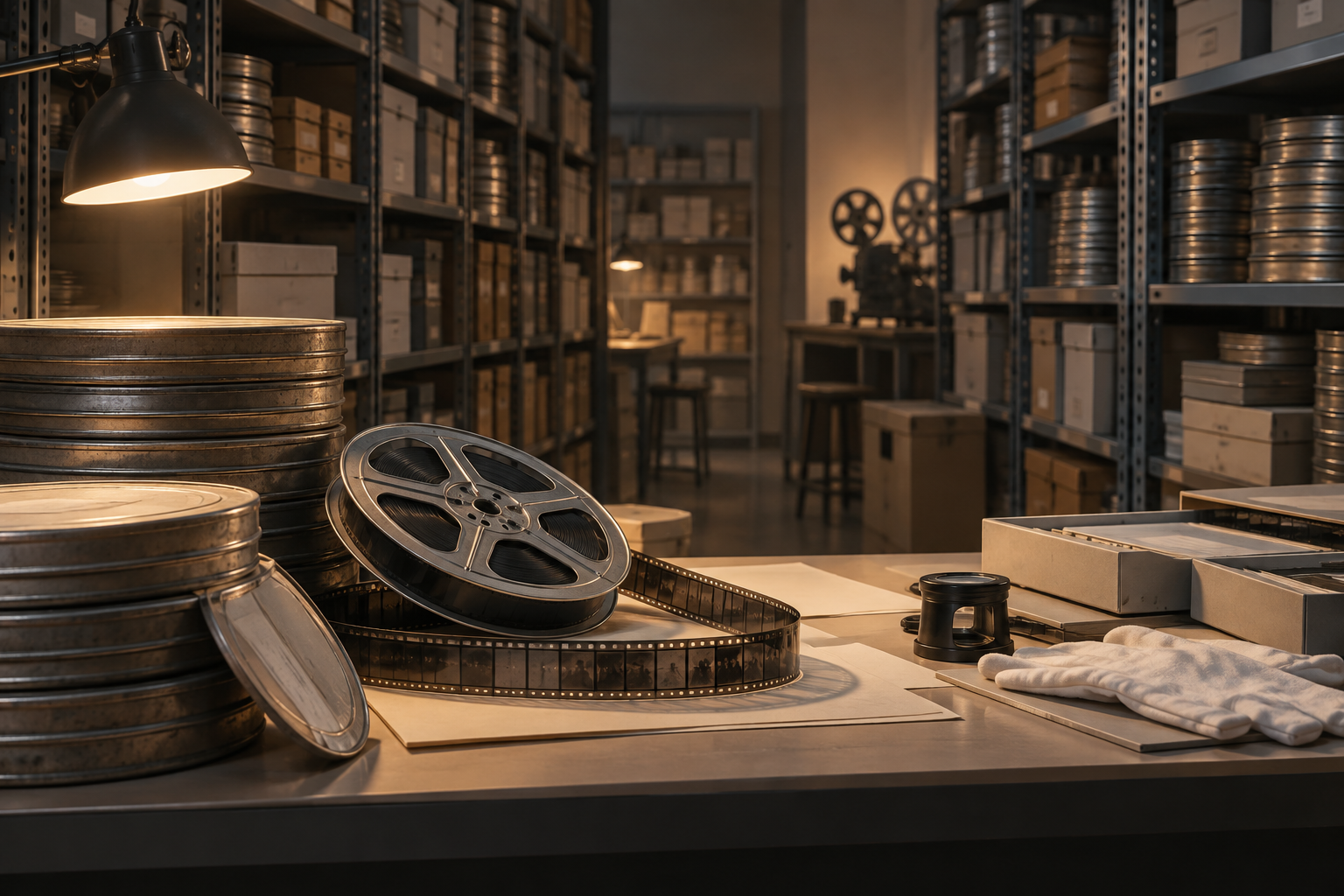
The academic study published by SciELO México notes that film-library and cinémathèque collections may include prints important to film history, especially silent-film prints, as well as photographs, posters, projection equipment, and elements of exhibition infrastructure. These are not merely decorative additions. Each can provide evidence about technical processes, circulation, promotion, exhibition, or reception.
A heritage approach therefore does not require choosing between the film and the object. A print can provide access to a work; a poster can record how it was offered to audiences; a projector can reveal a technical condition of viewing; and a file or specialist publication can place all of this within a cultural setting.
Preservation, conservation, and restoration
Available sources stress that professional vocabulary does not always have fixed boundaries. The SciELO México study says that specialists and institutions have debated preservation, conservation, and restoration, while differences of language, professional traditions, and procedures make a single definition difficult.
These words should not be treated as automatic synonyms. Filmoteca Española describes film conservation as criteria, methods, and techniques for safeguarding audiovisual heritage. For video works and digital files, it also states a twofold mission: conserving works and ensuring access to their contents regardless of the time elapsed since their origin.
That distinction matters because it challenges a common assumption: digitisation alone does not settle a work’s long-term survival. Filmoteca Española itself lists the range of carriers that may hold a digitised or born-digital audiovisual file, including optical media, hard drives, USB storage, and LTO. Variety of formats is part of the custody-and-access challenge; it is not an automatic guarantee.
From chemical risk to obsolescence
The material dimension of film heritage becomes especially clear in the risks described by Colombia’s Fundación Patrimonio Fílmico Colombiano. Its institutional record mentions nitrate-base flammability, decomposition, acetate-related vinegar syndrome, colour degradation, and technological obsolescence. These are different risks and do not call for one identical response.
The same source states that the Archivo Histórico Cinematográfico de Los Acevedo, containing records made between 1915 and 1955, was restored and preserved before being made available to the public in 1987. The case supports a careful conclusion: preserving a collection is not simply keeping it in storage. Its cultural meaning is completed when images can be consulted, researched, or presented to new generations under suitable conditions.
This does not invite home handling of unstable, damaged, or historically valuable materials. Such work requires assessment, infrastructure, and trained professionals. For viewers, the useful lesson is different: film is not an abstract file, and its carrier shapes both its survival and the ways it can be seen.
Film libraries: safeguarding in order to share
An academic article hosted by Dialnet places an early approach to the idea of the film archive in 1898 and discusses film libraries from conservation through dissemination. It also identifies Filmoteca Española as a reference institution within a broader Spanish landscape that includes regional film libraries, universities, libraries, and archives.
Dissemination is not a promotional extra attached to custody. It may take the form of screenings, catalogues, specialist libraries, exhibitions, research, or consultation tools. The Ministry of Culture’s “Cine en el Museo” programme offers a contemporary example: before selected screenings, it proposes discussions involving specialists in history and archaeology and specialists in cinema, addressing both historical context and fictional narrative.
This model avoids two reductions. One is to imagine the archive as a closed space whose sole achievement is storage. The other is to turn every heritage screening into a lesson with one correct answer. A more productive practice provides access to works and their material traces while offering frameworks through which audiences can ask questions.
The film museum as an interpretive space
A film museum may display objects, but its role is not exhausted by display cases. Research on film museums points to collections that bring together moving-image and non-film materials documenting the medium’s technical and cultural history. Encadenados cites the Deutsche Kinemathek, founded in February 1963 from Gerhard Lamprecht’s collection; its later museum presents part of that archive through a chronological account of German cinema.
In Spain, the Ministry of Culture announced a new Museo del Cine in 2025 for the former NO-DO building. The official note says the project will include a space for memory and interpretation and seeks to exhibit and conserve Spanish film heritage. It also states that nearly 70,000 NO-DO negatives are held at Filmoteca Española’s Conservation and Restoration Centre.
The announcement does not establish what the final exhibition will look like or which narratives it will prioritise. It does confirm a meaningful direction: audiovisual heritage can be understood as a history of images, institutions, professional work, and collective imaginaries. The building and its archive become part of the account, not merely containers for films.
What can be verified, and what remains open
The sources support the view that film libraries, archives, and museums perform connected tasks of conservation, documentation, access, and dissemination. They also show that film heritage includes more than canonical titles, and that analogue and digital carriers present specific problems.
They do not support a universal recipe, a definitive hierarchy of formats, or an automatic equation between digitisation and preservation. Definitions vary with institutions and with the material circumstances of each collection. That uncertainty does not weaken the heritage idea; it requires greater precision.
Conclusion
Thinking of cinema as heritage means looking beyond the screen without abandoning the experience of watching films. It means attending to prints and negatives, posters and equipment, archives and theatres, audiovisual memory and the conditions that make future consultation possible. Film libraries and museums do not only keep old objects: they organise evidence so that images remain debatable, accessible, and culturally legible. That is the value of preserving cinema—not freezing it, but sustaining its capacity to meet audiences again.
- Decade
- Contemporary
- Region
- Spain
- Level
- Enthusiast
- Entities
- Fundación Patrimonio Fílmico Colombiano
Sources and references
- Concepto | Estudios El Patrimonio cinematográfico en el Museodigibug.ugr.es · 2026-09-18
- Cine en el Museo - AGENDA CULTURAL - Ministerio de Culturaagendacultural.cultura.gob.es · 2026-09-18
- 1 Dossiê El cine como patrimonio culturaldialnet.unirioja.es · 2026-09-18
- El nuevo Museo del Cine se ubicará en el antiguo edificio del NO-DO | Ministerio de Culturawww.cultura.gob.es · 2026-09-18
- fundación patrimonio fílmico colombiano (bogotá, colombia)censoarchivos.mcu.es · 2026-09-18
- Museos de cine | Encadenados - revista de cineencadenados.org · 2026-09-18
- Departamento de Conservación fílmica - Filmoteca Española | Ministerio de Culturawww.cultura.gob.es · 2026-09-18
- Acerca de los conceptos de preservación, conservación y restauración fílmica en el caso de la Cineteca Nacional de México desde los planteamientos de Paolo Cherchi Usaiwww.scielo.org.mx · 2026-09-18