A sticker may look like a tiny object: a printed image, a reverse side, sometimes self-adhesive and sometimes meant to be glued down. Yet its history cannot be separated from the goods that carried it, the albums that assigned it a numbered space, and the people who turned duplicates into an opportunity to talk and bargain. In Spain, the material gathered for this article traces a path from pictures included in product wrappers to packs sold independently. This is not a linear evolution or the story of one company; above all, it is the transformation of a promotional item into a collecting system.
Before the pack: images travelling with goods
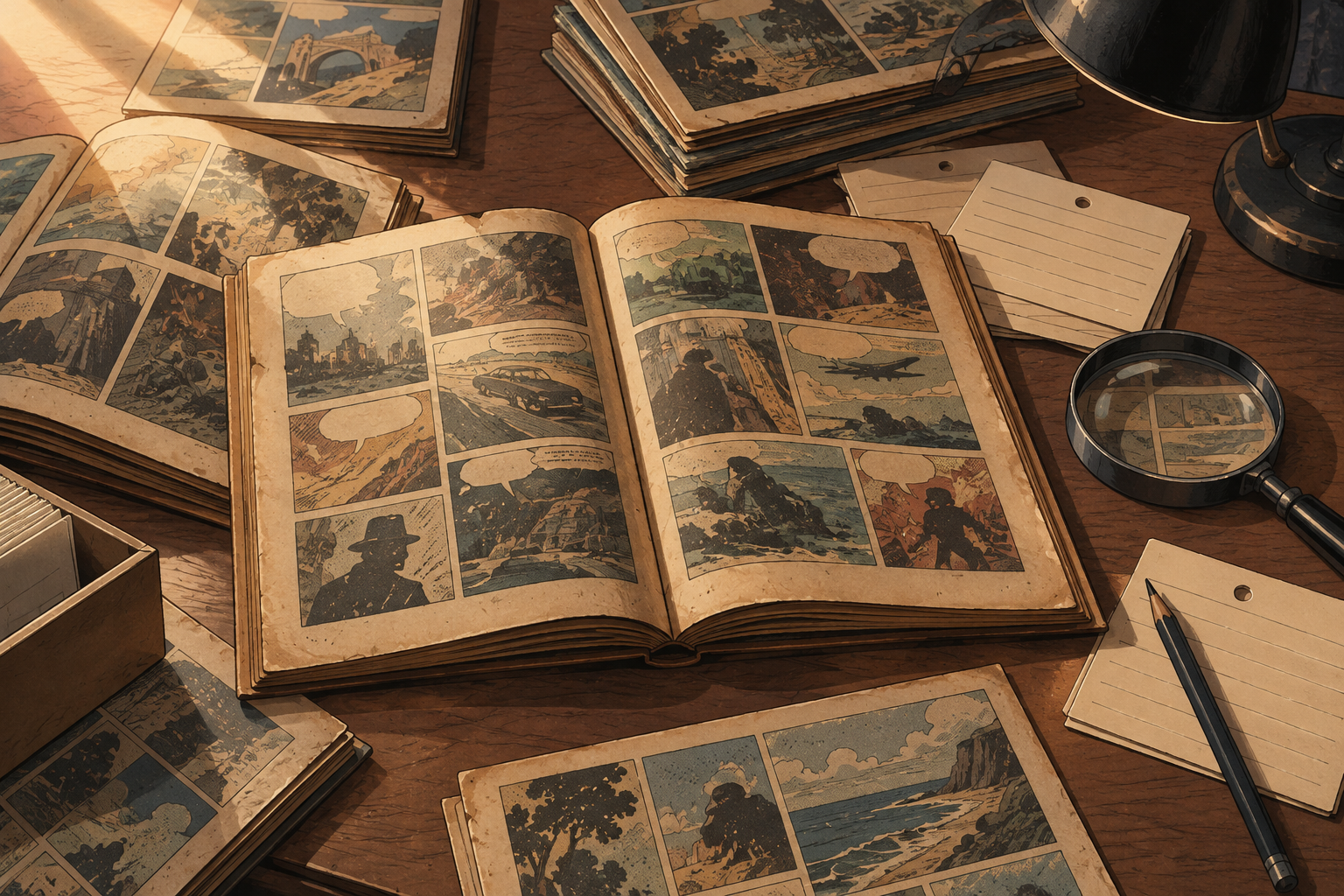
The Museo del Álbum de Cromos de la Villa de Estadilla places the earliest known Spanish albums at the end of the nineteenth century. Its account says that they arrived through ports with overseas products such as dates, cocoa and vanilla, whose wrappers carried multicoloured pictures that children began to keep. At that stage, the sticker did not necessarily drive the purchase. It was part of packaging and a commercial strategy attached to everyday consumption.
The same source later notes pictures from matchboxes, especially prominent at the beginning of the twentieth century. It also places a proliferation of stickers tied to tobacco brands, broth-flavour tablets and chocolate in the 1920s. The catalogue of El Coleccionista Ecléctico preserves the material trace of this world by referring to matchbox phototypes and prints marketed by chocolate and tobacco businesses. Together, these indications show that paper collecting moved through several channels before the pack became dominant.
Printing made seriality possible
Any collection needs images that can be reproduced regularly. The Museo del Juego document dates the appearance of chromolithography to 1837; other popular accounts describe the technique as reducing costs and making colour images available to broader audiences. The link must be handled carefully: lower-cost printing alone does not prove how every Spanish collection was organised. It does, however, provide a credible material context for the spread of small, colourful and serial printed items in the nineteenth and early twentieth centuries.
Technique did not entirely define the object. A sticker could be a promotional print, a cut-out, a phototype or a piece made for an album. What joins these forms is seriality: one isolated unit gains meaning because it belongs to an unfinished set. Absence becomes part of the experience. The empty box is not the album’s failure; it is an invitation to continue looking.
From commercial gift to independent purchase
The clearest shift described by the Estadilla museum came in the post-war period: packs began to be sold so that children could buy them without first purchasing the consumer goods that had included stickers as a gift or inducement. The nuance matters. Independent sale separated the collectible from food or household merchandise and made completion of the set the main reason for buying.
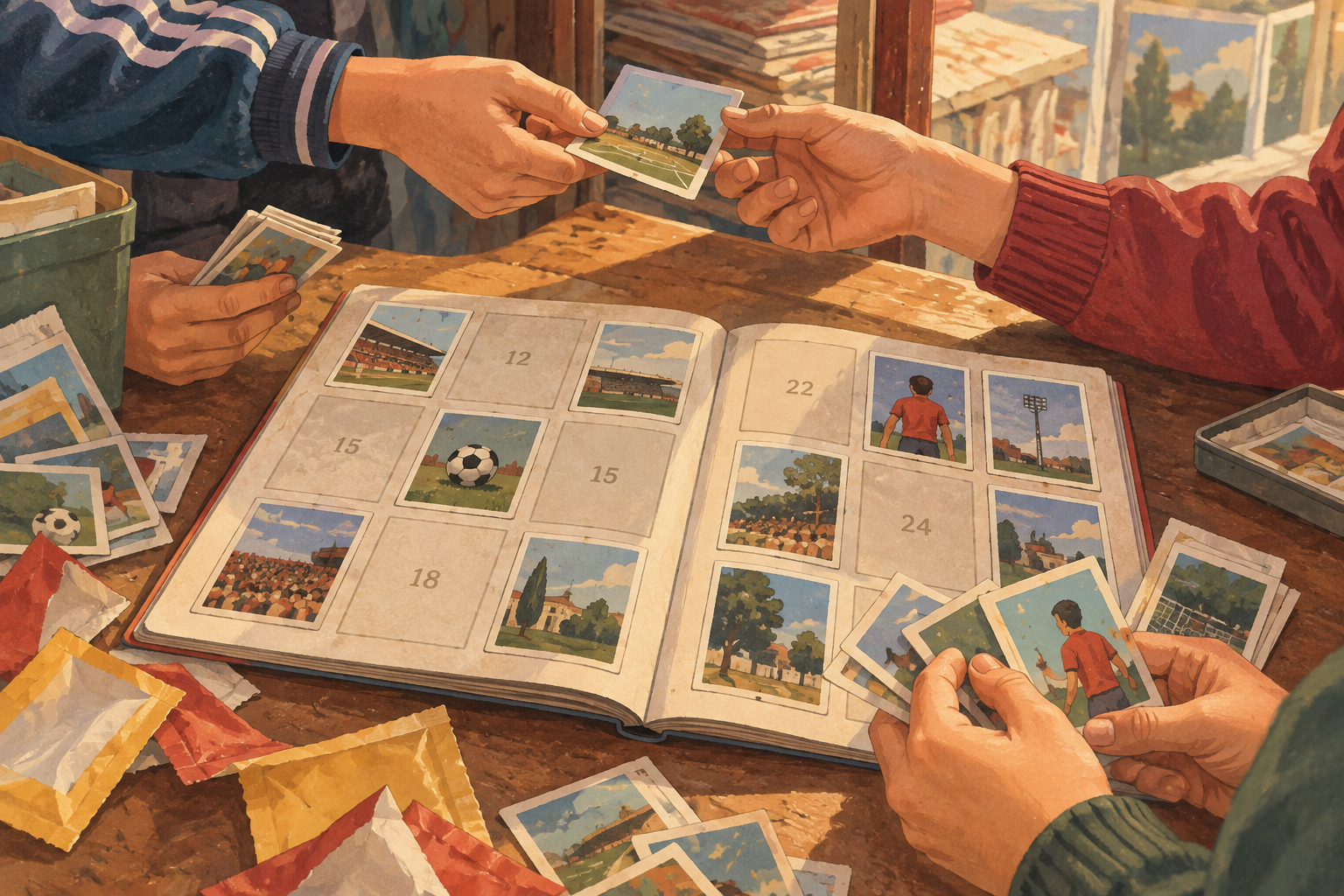
This does not mean commercial or promotional links vanished at once. Rather, the balance changed. The pack introduced uncertainty: it did not guarantee a particular picture and could produce duplicates. That uncertainty made social circulation necessary. Swapping was not merely a nostalgic extra; it was a practical answer to distribution that collectors could not control.
Album, order and duplicates
An album is more than a container. By numbering spaces and linking them to particular images, it orders a collector’s time: a first purchase, a search, a build-up of duplicates and a moment—never always reached—of completion. Newspaper reporting on Panini in Spain in 2009 described a web service allowing buyers to order up to 40 stickers to complete a collection. The solution shows that, decades after the pack became widespread, empty spaces remained structural.
Cinco Días also reported that Panini, founded in Italy in 1961 according to the newspaper, had been present in Spain since the mid-1970s and displayed releases from 1962 onward. Its examples included football, film and popular-character collections such as Fútbol 82, Transformers, Los disfraces de Mortadelo, The Lion King and Harry Potter and the Half-Blood Prince. The range confirms that the format depended on no single subject: sport, television, animation and fiction could all use packs, albums and duplicates.
Swapping as social infrastructure
Sticker swapping is often remembered as a playground scene. The evidence supports a more precise statement: it was an informal infrastructure for solving unequal distribution within a set. Each duplicate could become a bargaining unit; every gap could be a reason to ask another person what they had. Value lay not only in the picture, but in its place within a set and in the difficulty of obtaining it.
The practice should not be romanticised or assigned universal effects. In 2009, Cinco Días quoted a Panini executive saying stickers had social, playful and educational effects. That is a corporate statement, not an academic demonstration. Still, it fits the format’s observable structure: completing an album can require interaction when buying alone does not work or produces too many duplicates.
Football, publishers and the format’s persistence
Football became especially visible in this history. ABC places the first LaLiga albums in the 1940s and 1950s and says that Colecciones Este and Panini changed the landscape during the 1970s. The same report dates Panini’s first LaLiga album to the 1979/80 season, under the CromoCrom name, after an earlier approach to the Spanish market with the 1974 Germany World Cup album. These claims date a particular stage of football collecting, not the absolute origin of every Spanish album.
The medium’s continuity also matters. The Estadilla museum explains that, for organisational and space reasons, its display contains very few post-1980 collectibles, except examples showing later changes in paper formats. A museum visit can therefore illuminate the earlier historical period especially well, but cannot replace a complete inventory of the later market.
What can be said—and what remains to be researched
The available sources support the view that stickers circulated in Spain with packaging and brands from the late nineteenth century; that they spread through several promotional supports in the early twentieth century; and that post-war pack sales established an independent purchasing model. They also document the importance of albums, duplicates and swapping, along with the later strength of themed and football collections.
There are clear limits. The sources combine institutional explanation, journalism, specialist commerce and popular writing; they do not provide consistent statistics on print runs, historical prices, territorial distribution or the habits of all families. Nor do they allow shared memories to become universal rules. The soundest conclusion is more specific: stickers endured because they brought together three elements at once—a reproduced image, an incomplete series and a network of exchange. From wrapper to album, the object changed its sales channel but retained the promise behind every collection: finding the missing piece.
- Decade
- Before 1950
- Region
- Spain
- Level
- Introduction
- Entities
- No linked entities
Sources and references
- Una historia de cromos | Pixartprintingwww.pixartprinting.es · 2026-09-19
- Museo del Álbum de Cromos de la Villa de Estadillaturismosomontano.es · 2026-09-19
- Los cromos resisten el auge de las videoconsolas | Empresas | Cinco Díascincodias.elpais.com · 2026-09-19
- Cromos Y Albumes Antiguos | El Coleccionista Eclécticowww.elcoleccionistaeclectico.com · 2026-09-19
- Cromos imposibles, 'repes' y demás mitos sobre la colección de LaLigawww.abc.es · 2026-09-19
- COLECCIÓN DE JUEGOS INFANTILES: LOS CROMOSmuseodeljuego.org · 2026-09-19