The format was not merely a wrapper
To describe comic magazines as a vanished format oversimplifies their history. Jot Down Cómics, drawing on the Royal Spanish Academy, defines a magazine as a periodical publication with text and images about several subjects or one specialized subject. In comics, periodicity shaped more than an object’s dimensions: it set reading rhythms, serialization practices, purchasing expectations, and a recurring relationship with the newsstand.
The Calahorra Library places the emergence of the Spanish tebeo virtually at the beginning of the twentieth century. Its chronology cites Chiquilín, issued in Madrid in 1924 as advertising support for Federico Bonet, and Pinocho, edited by Saturnino Calleja in 1925. It also states that the latter brought major American comics to Spanish readers. These examples do not describe the whole industry, but they show that the press, advertising, children’s publishing, and imported material soon coexisted in the medium’s history.
Periodicity, installments, and waiting
Magazines encouraged installment reading. Alberto Albarrán notes that a work may be dated by a character’s first appearance or by the later collection of parts into a book; he also recalls that comics were often published in chapters in magazines before being gathered in an album or graphic novel. Publication, therefore, does not always mean one single editorial moment.
For readers, serialization made the interval between issues part of the experience. For creators and publishers, it created room for continuity alongside short pieces, sections, advertising, and other material. The magazine form does not itself define quality, audience, or genre, but it does affect how work arrives: in fragments, repeatedly, and alongside other proposals.
From prominence to a smaller place
The bibliography summarized by Jot Down Cómics argues that comic magazines adapted their form and contents for more than a century. At the same time, its article says that in recent decades the format has occupied a very small market position. It notes the 2019 appearance of Alta Tensión and Planeta Manga, and the closure of La Resistencia with its tenth and final issue. These are individual examples rather than a complete statistic, yet they prevent two opposite errors: claiming that new magazines do not exist, or assuming that they automatically retain an earlier centrality.
The change also requires separating comic magazines from publications containing comics. Manuel Barrero’s Tebeosfera study stresses that the boundary is not always easy to draw: some magazines and books are not conceived as comics but include a complete, self-contained comic within their pages. In Spain in 2020 and 2021, the study also identifies children’s magazines built around characters and licences as possible bridges to new readers, without simply equating them with traditional comics.
Change did not lead to one replacement
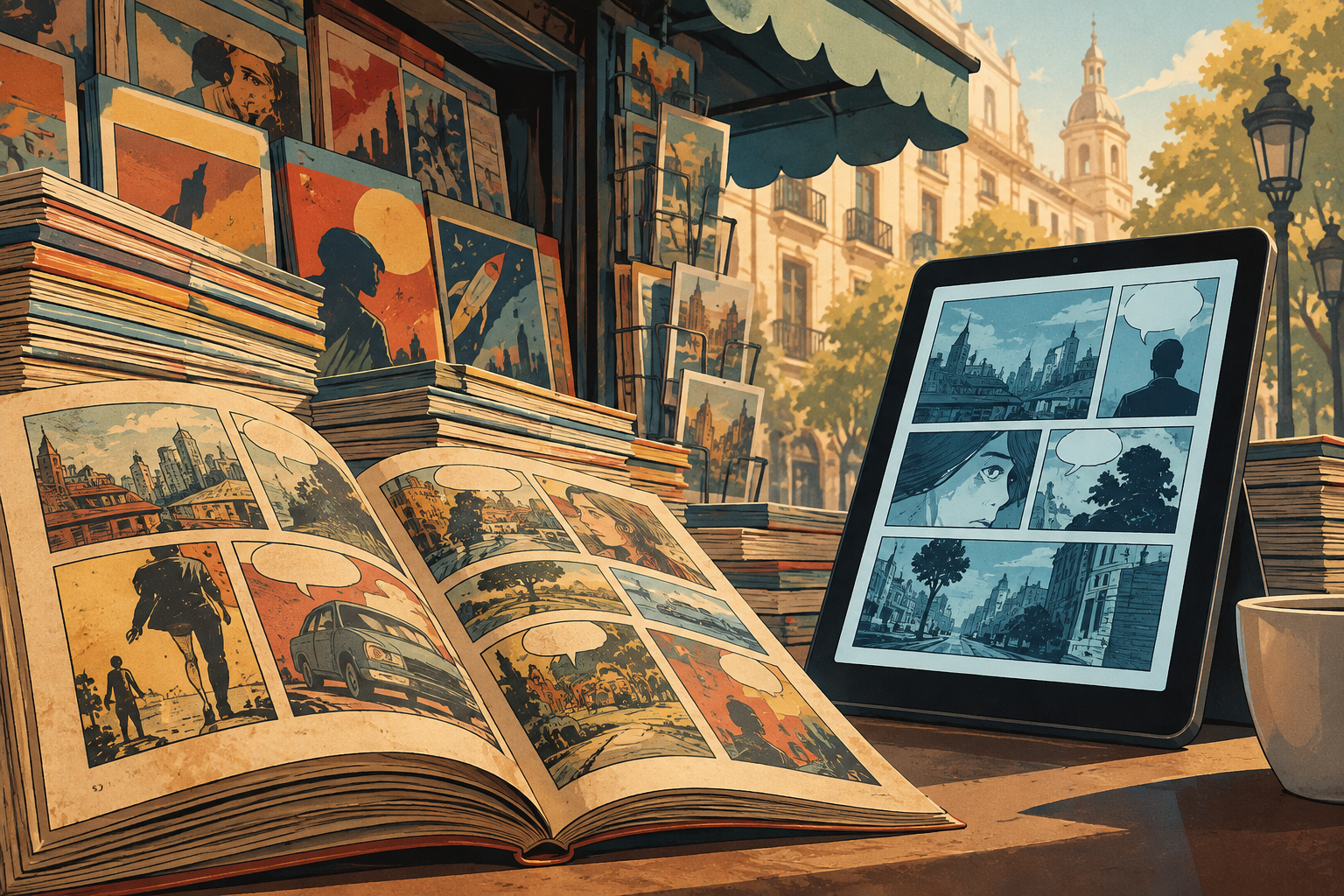
The present cannot be reduced to a linear handover from paper to screen. Albarrán distinguishes webcomics, made for online distribution and reading through platforms or an author’s own site, from digital comics distributed as downloadable files for offline reading. He further notes reading resources tied to online methods, such as scrolling and screens.
That distinction matters because each route entails different material and narrative choices. A digital file may move a work to another support without necessarily changing its pagination; a work designed for online reading can build its rhythm around the screen and scrolling. Albums, graphic novels, and magazines may also remain later destinations for serialized work. Rather than a neat succession of technologies, the sources describe coexisting circuits.
Paper also gains documentary value
As a format becomes less dominant, individual issues may attract documentary, collecting, and museum attention. The Museu del Còmic i la Il·lustració says its holdings include satirical press, weeklies, children’s press, girls’ and adventure booklets, magazines, graphic novels, and original art. That list shows that a comics collection is not limited to isolated masterpieces; it also preserves channels of circulation, audiences, and editorial practices.
M. Peña Méndez’s academic work on comics exhibitions adds a useful caution. Its title frames a history and global context of exhibitions, shifting the question from what is shown to how the medium enters artistic and museum institutions. Displaying magazines can aid study and preservation, but it does not completely recreate the ordinary act of buying, reading in installments, or exchanging them.
Limits of this comparison
The available sources support a history of changing formats, not a universal verdict on the magazine’s end. Nor do they permit calculations of print runs, sales, market shares, or precise dates for every change discussed. The continued existence of printed comics should not be confused with the continued existence of any particular title.
What can be verified is more modest and more useful: magazines were a central periodical form through much of comics history; their present market place is smaller according to the cited journalistic source; and they now share the ecosystem with albums, graphic novels, hybrid publications, webcomics, and digital files. In Spain, libraries, specialist research, and a museum show that magazines remain important documents for telling this history.
Conclusion
The magazine is neither a relic that must oppose the screen nor is digital a uniform solution. Every support shapes how a work reaches readers and how it is preserved. Looking from the newsstand to the pixel shows that comics history changes not only through titles and characters, but also through schedules, distribution channels, reading methods, and objects that eventually move from editorial routine into the archive.
- Decade
- Contemporary
- Region
- Spain
- Level
- Enthusiast
- Entities
- Museum
Sources and references
- Historia visual del cómic, la novela gráfica, el manga y los tebeos – Alberto Albarránwww.albertoalbarran.com · 2026-09-19
- Las exposiciones de cómics. Historia y contexto global ...ebuah.uah.es · 2026-09-19
- Manuel Barrero (2022): "La industria del cómic en España en 2020 y 2021", Documento en Tebeosferarevista.tebeosfera.com · 2026-09-19
- Inicio - Museu del Comic i la ilustraciónmuseudelcomic.org · 2026-09-19
- Historia del cómic - Bibliotecas de la Riojabibliotecas.larioja.org · 2026-09-19
- Pasado y presente de las revistas de cómic – Jot Down Cómicscomics.jotdown.es · 2026-09-19