A garment does not arrive at the display case alone
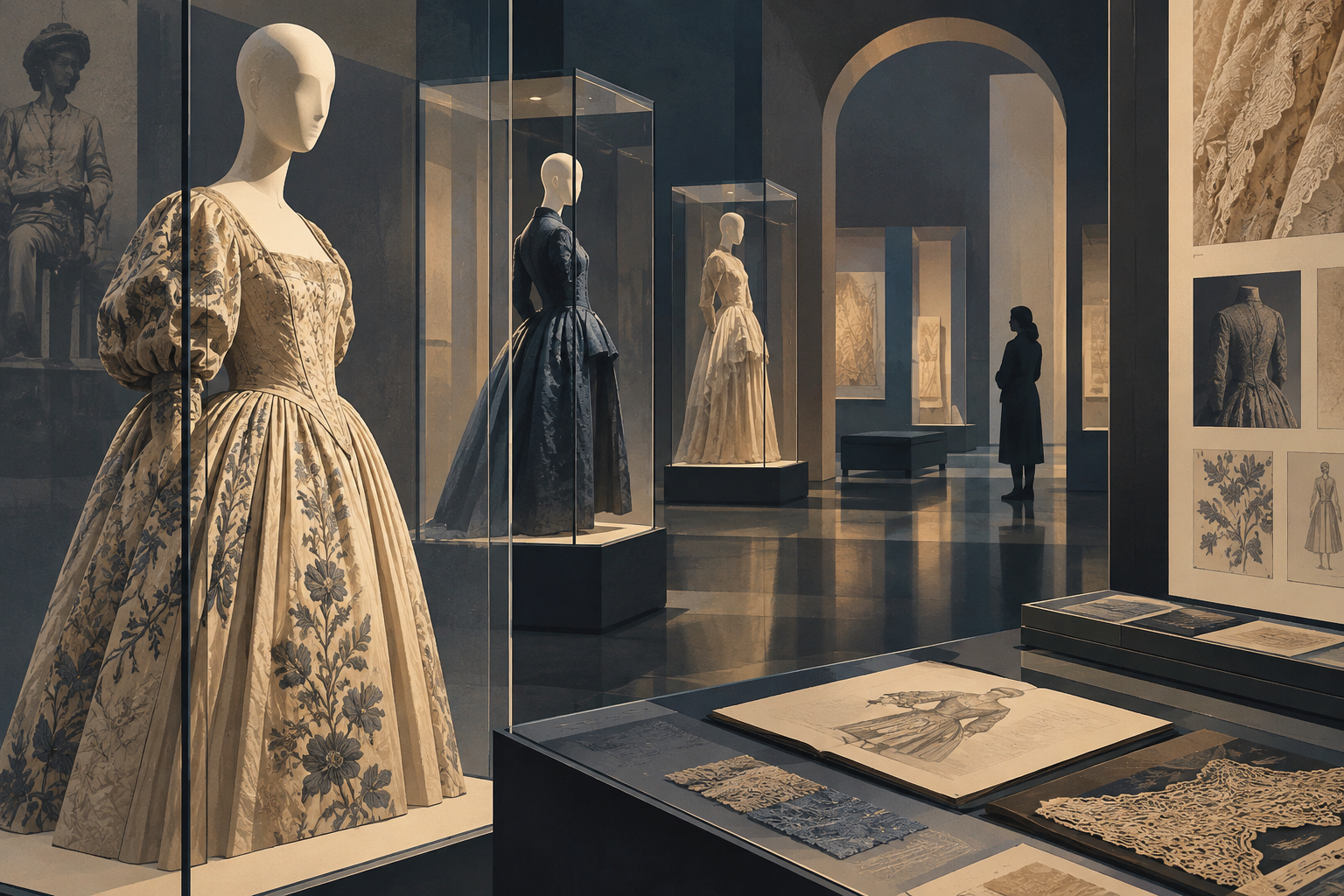
A dress, a hat or a pair of gloves may seem immediately readable: their silhouette, materials and decoration invite us to see them as signs of an era. Yet once they enter a museum, they cease to be clothing alone. They become heritage objects, and displaying them requires decisions about how much can be shown, for how long, and with what information. That transformation affects the history received by visitors.
Spain’s Ministry of Culture states that the Museo del Traje holds nearly 30,000 items of dress and fashion, as well as jewellery and accessories, and presents the collection as a characteristic manifestation of contemporary culture. The point is not the number in isolation, but what it suggests: a fashion collection brings together garments, techniques, social uses, provenances and documentary archives. In the case of Pedro Rodríguez, the museum says it preserves an archive covering his work from 1940 to 1978. A rigorous display needs to connect an object, where documentation permits, to that network of information rather than reduce it to an image of style.
From ethnological heritage to cultural expression
Fashion’s arrival in museums has been accompanied by a change of interpretive framework. Research listed by Dialnet describes a tendency to understand fashion as cultural expression, and often artistic expression, beyond its former exclusive association with anthropological heritage. It also identifies Fashion: An Anthology, organised by Cecil Beaton in 1971, as one of the significant steps in bringing contemporary fashion into exhibition galleries.
This shift does not require a choice between art, design, everyday life and social history. It calls instead for recognising that a garment can activate several readings at once. Its cut and ornament may matter for formal reasons; its materials and construction for technical history; its use for social conventions; and its provenance for the trajectory of a person, workshop or collection. Cultural interpretation becomes richer when these dimensions are connected without turning any one of them into a complete explanation.
The same source notes the March 1982 Artforum cover featuring Rattan Body, a wearable piece by Issey Miyake made with bamboo artist Koshige Shochikudo. This example shows that museum recognition of fashion was also linked to collaborations, materials and formats that challenged conventional limits of dress. It cannot by itself stand for the entire history of fashion in museums, but it does remind us that institutions have had to respond to objects whose bodily and material condition does not fit traditional categories easily.
Conservation is not an invisible formality
A historic garment is vulnerable to light, dust, handling, environmental fluctuation and stresses caused by unsuitable support. The Complutense University of Madrid study on textiles in Spanish collections summarises an essential principle: treatments should respect the original as fully as possible, be supported by scientific and technical studies, and preserve not only material but also the history it carries.
This principle changes how exhibitions are conceived. Not every object can remain on view continuously, and not every garment can accept the same posture, lighting or mannequin. Conservation does not intervene only after curators have chosen a narrative: from the beginning, it affects which objects can be loaned, handled, mounted and displayed. Culturas de Moda discusses debates in which conservators’ and restorers’ knowledge often determines what can actually reach an exhibition and how it can be presented.
The editorial consequence is significant. An absence does not necessarily mean a lack of historical relevance. It may result from textile fragility, a need for rest, or the lack of safe display conditions. Explaining that limit does not weaken an exhibition; it enables visitors to understand that a case is not a commercial shop window, but an environment of care and interpretation.
Rotate, document and explain
Rotation is one tool that brings preventive conservation into public space. The National Museum of the American Latino explains that museums protect collections from risks including light, water, fire, human contact, humidity, temperature and pests, and that light-sensitive objects are periodically removed from display. In its example, dresses associated with Oscar de la Renta are rotated about every six months.
That interval should not be turned into a universal rule for every collection. The source presents it as a practice applied in that case and to light-sensitive objects. What can be established is the underlying logic: an exhibition can change in order to protect objects while also enlarging the story. Replacing one object with another can compare different silhouettes, techniques or moments; it also makes clear that collections exceed the selection visible on a particular date.
Documentation is the essential counterpart to rotation. Catalogue records, detail photographs, information on materials, provenance and conservation condition can keep a garment’s story accessible when it cannot be shown. A reproduction may serve an interpretive purpose, but it must be clearly identified as such. Culturas de Moda describes a Brazilian dress too fragile for display for which a reproduction and digital materials about the process were made. The resource does not replace the original: it makes communication possible without concealing the authentic object’s material condition.
The display case also makes an argument
According to EVE Museos + Innovación, early dress exhibitions tended to present costumes from specific periods alongside ornaments and references to behavioural rules and life rituals. That model remains useful if context is not treated as mere decoration. An accessory is not simply an aesthetic addition: it may reveal gestures, fastening methods, social protocols, access to materials, and relations between body and garment.
At the same time, fashion exhibitions carry debates that the thesis circulated by Dialnet identifies clearly: the relationship between fashion business and the museum institution, curatorial autonomy, and the demand for research, archives, documentation and educational purpose. These questions are especially relevant for objects associated with brands, designers or private collections. A responsible exhibition should distinguish documented information from promotion; recorded provenance from plausible attribution; and the prestige of a name from an object’s demonstrable historical value.
Looking at fashion more patiently
The museum’s greatest contribution is not making a garment into an untouchable relic, but creating conditions for looking at it slowly and in context. The Museo del Traje collections, the respect-for-the-original criteria described by textile research, and the rotation practices outlined by the Smithsonian converge on one idea: conservation and display are inseparable tasks.
Fashion can speak of creativity, but also of labour, technique, material circulation, identity and daily life. For that conversation to be honest, an exhibition must acknowledge its limits: not everything can be shown, not every absence is forgetfulness, and no visible item exhausts a collection’s history. The most valuable display case is not the one that promises unlimited access, but the one that explains why caring for an object also means caring for the stories it can still tell.
- Decade
- Contemporary
- Region
- Global
- Level
- Enthusiast
- Entities
- Museum, Museo del Traje
Sources and references
- Moda e indumentaria - Museo del Traje | Ministerio de Culturawww.cultura.gob.es · 2026-09-22
- Los tejidos en las colecciones de los museos españoles, una ...revistas.ucm.es · 2026-09-22
- Resumen de La articulación de la moda en el espacio museístico en el cambio de milenio - Dialnetdialnet.unirioja.es · 2026-09-22
- Moda – EVE Museos + Innovaciónevemuseografia.com · 2026-09-22
- Una historia de la moda en los museos – Culturas de Modaculturasdemoda.com · 2026-09-22
- Nuevos objetos, nuevas historias | National Museum of the American Latinolatino.si.edu · 2026-09-22