Food is not only what is eaten
Food disappears, but the social traces around it do not necessarily vanish. An annotated recipe book, a tin, a label, a shopping list or a household document may retain clues about practices, tastes, celebrations and ways of presenting food. Food can therefore enter a museum without becoming either a cabinet of curiosities or a collection of pleasant memories.
The starting point is twofold. There are material supports—publications, packaging, documents and industrial objects—and there are associated forms of knowledge and use: recipes, table customs, ways of giving and celebrating. Gerardo Jesús García Olivares’s work on food museums and food heritage explicitly places this field alongside intangible heritage and examines food museums in Spain. Keeping an object, however, does not automatically preserve all of its meaning.
A document opens a story; it does not finish one
Xercode’s piece on Christmas and archives illustrates the potential of a specific document. Document ALMODÓVAR,C.150 records information about aguinaldo and sweets consumed in an aristocratic household linked to Valencia: lemon, cherry, peach and Muscat grape preserves, as well as cinnamon, Soconusco cocoa, azúcar florete and cascas. The source identifies cascas as a traditional Valencian and Mallorcan sweet made from almonds and sugar.
This record permits precise questions: which products are named, in what festive setting they appear, and what kind of household the text documents. It does not, by itself, describe what an entire region, class or period ate. Archives supply situated evidence. Responsible interpretation keeps that boundary visible.
Domestic recipe books: use, image and memory
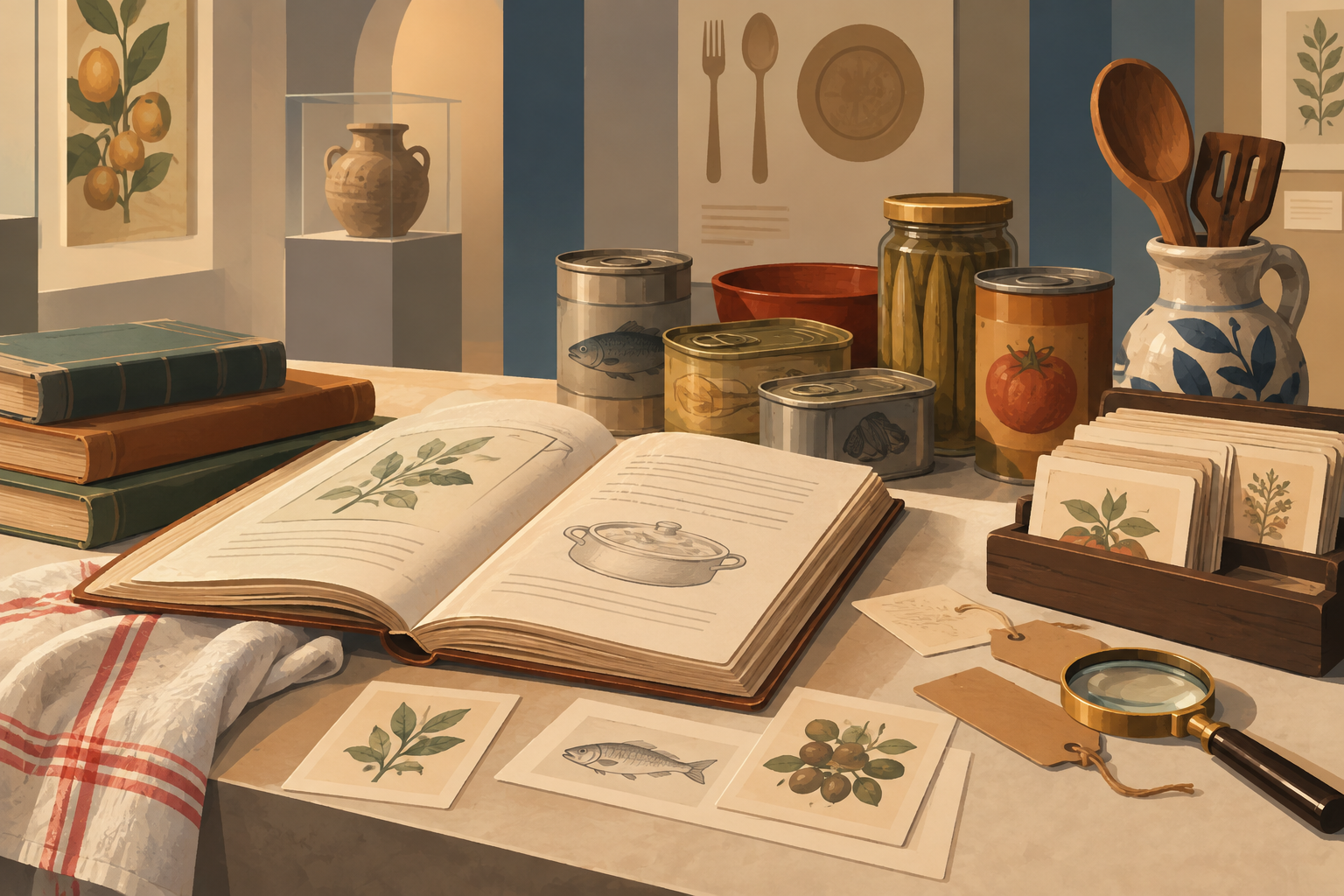
Museo da Conserva’s #ComidaViejuna campaign recovered domestic recipe books from its collection. The museum states that these publications retain recipes as well as ways of life, visual habits and cultural memory. A recipe book is thus more than a cooking manual: it has a format, design, language, instructions and sometimes signs of use.
Yet an object should not be assigned an undocumented biography. A stain or note may suggest use, but cannot by itself prove who cooked, for whom, or when. The museum’s invitation to reinterpret or recreate recipes points to a productive contemporary mediation: activating a collection without treating a present-day recreation as an exact recovery of the past.
Tins, labels and industrial scale
Food objects are not only domestic. FUNPROMAR describes Museo da Conserva as promoting the cultural, industrial, artistic and bibliographic heritage of the seafood-processing industry. It mentions original tins, labels, documents and other material. Together, they enable questions that a tin alone cannot answer: how a product was presented, what graphic resources were used and how objects relate to industry.
A label is part of how a product communicates visually, but packaging alone does not establish commercial reach, public reception or an exact date. Industrial and domestic objects should therefore be connected through explanation rather than assumption.
Interpretation without freezing food culture
EVE Museos + Innovación recommends beginning with one’s own collection and community before widening research toward specific contextual resources. For food heritage, this means first establishing what the institution actually holds: provenance, dates, authorship, links between materials, testimony and gaps.
The same source notes that what people eat and how they obtain, prepare and consume it is shaped by cultural, social and personal norms. The National Archaeological Museum similarly frames eating as something that gathers people around a table and nourishes society as well as bodies. These are prompts for contextual questions, not licenses to turn every culinary object into a universal symbol.
Conservation and access
Conservation gives sources continuity; interpretation gives them public access. Definitions gathered by EVE describe museums as permanent institutions that acquire, conserve, research, communicate and exhibit collections for study, education and contemplation. FoodCultura, a non-profit organization devoted to food culture through art and research, also signals that food knowledge can be developed beyond a conventional display.
Conclusion: from nostalgia to method
Archive-listed sweets, domestic recipe books and canning collections show that food can be a rigorous entry point into material culture and memory. Their value does not lie in automatically producing nostalgia. It lies in connecting documents, designs, practices and questions of context.
The working rule is simple: state what objects and sources support, separate evidence from interpretation, and name what remains unknown. Then a tin is not merely retro decoration, and a recipe book is not merely evocation. Both become evidence for studying how food was recorded, presented and shared.
- Decade
- Contemporary
- Region
- Spain
- Level
- Enthusiast
- Entities
- Museum
Sources and references
- Navidad en los archivos, historia y tradición - Xercodexercode.com · 2026-09-22
- Museos, Interpretación y Gastronomía – EVE Museos + Innovaciónevemuseografia.com · 2026-09-22
- Directora Nuria Ramón Marqués Septiembre de 2021 Gerardo Jesús García Olivaresriunet.upv.es · 2026-09-22
- Home - funpromarmuseoconserva.com · 2026-09-22
- Entre recetas, memorias y apellidos - funpromarmuseoconserva.com · 2026-09-22
- Archivowww.foodcultura.org · 2026-09-22
- Del neandertal al supermercado. Dieta y evolución cultural - | Ministerio de Culturawww.man.es · 2026-09-22