Heritage That Does Not Fit on a Shelf
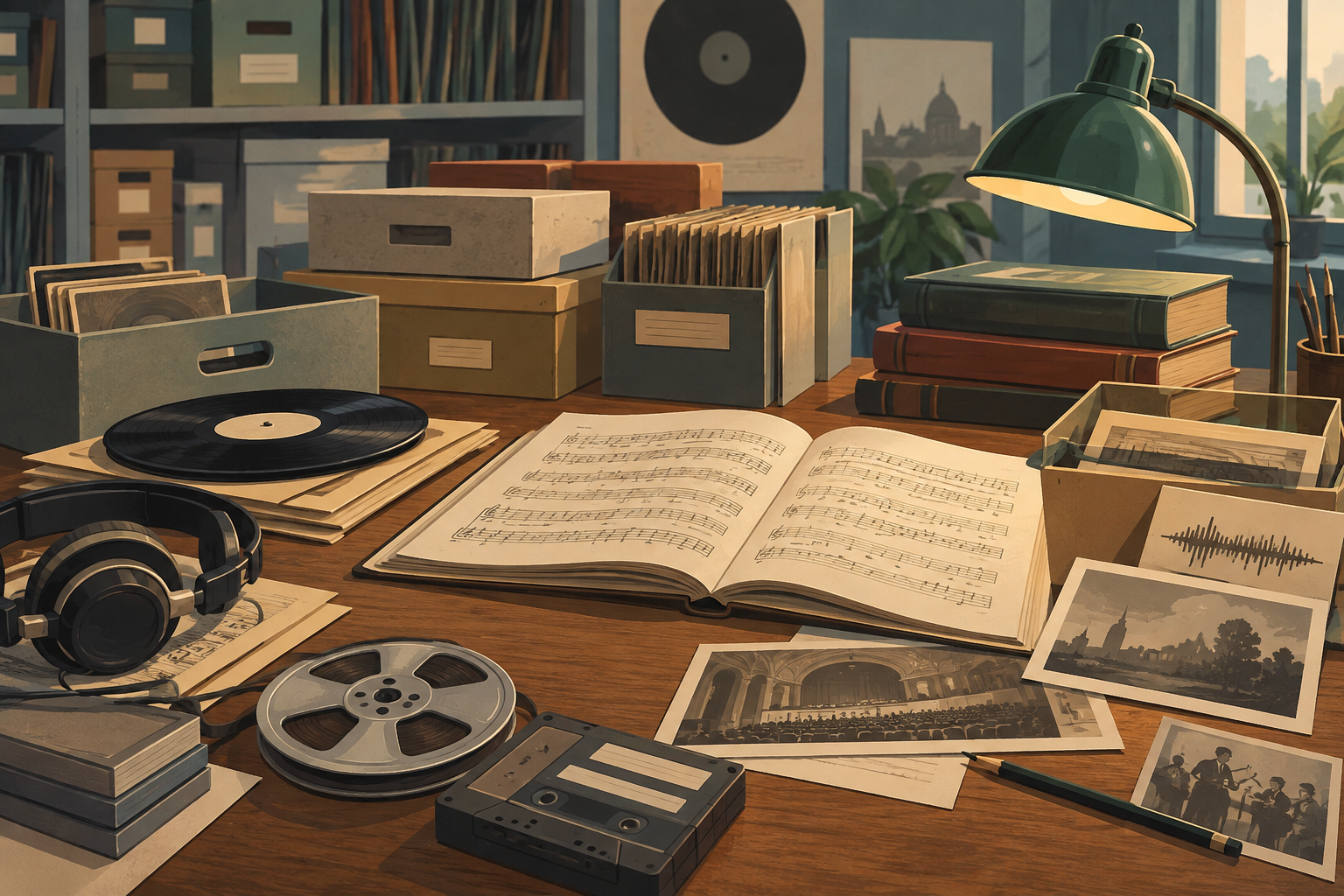
A music archive may contain scores, programmes, correspondence, recordings, photographs, press cuttings, administrative files, or material linked to concerts, choirs, bands and other institutions. Yet none of those items alone explains what music meant to the people who made it, heard it, organised it or kept it. That is the starting point: preserving music is not merely collecting objects or transferring sound from one format to another.
The literature assembled for this article stresses that the musical document is cultural and intellectual heritage, as well as written testimony to a culture. It also frames music as a social practice: a phenomenon that may be studied through physical, psychological, aesthetic and cultural dimensions. This breadth matters especially to a retro perspective. A record, tape or score may trigger material memory, but its historical value also depends on who produced it, how it circulated and in what setting it was used.
From Document to Cultural Practice
The idea of a musical document is broader than that of a score. Bibliopos distinguishes, among other areas, book-based documents and notated music, while noting that sound and audiovisual material also demands attention. The University of Navarra, meanwhile, lists historical holdings, contemporary compositions, records from choirs, bands, orchestras, theatres, auditoriums, cultural and educational societies, as well as archives generated by musical events.
That list has a practical consequence: an archive should not isolate a work from the traces that make it understandable. A programme may provide a date or repertoire; a letter may reveal the working network behind a performance; a recording may preserve an interpretation; an inventory may show how an institution described its own holdings. No single document type replaces the others.
Research on musical heritage also challenges overly rigid divisions between historical musicology and ethnomusicology, and between writing and orality. This does not mean that methodological or source differences disappear. Rather, a collection is understood less well when it is wholly separated from the social life that produced it. For an archive, this suggests that description should address both the item and its provenance, relationships and documented uses.
A Carrier Fixes a Trace, Not the Whole of Music
Music preservation has been closely connected to formats. The Suburbano essay notes that fixing musical practice on a carrier changed the ability to manipulate its chronological axis, and lists wax cylinders, vinyl, compact discs and digital files. The observation is useful because it avoids two common simplifications: treating carriers as neutral containers, or assuming digitisation alone solves every preservation problem.
Every carrier brings material and access conditions. Yet the fact that a recording can be copied does not ensure that it remains intelligible. If it is unknown who made it, when it entered a collection, how it was originally titled, or which rights and cultural ties affect its circulation, a copy preserves a signal while losing part of its capacity to be understood responsibly.
Nor should archives be presented as motionless stores. Preservation can support new access, research and listening, but those possibilities need mediation. Cataloguing, contextualising and making a collection visible are separate but complementary tasks. SIBE’s account of musical-heritage management brings together libraries, archives, museums, foundations and private individuals: a heterogeneous network, rather than one institution or one procedure.
Prioritising Is Not Abandoning
With limited resources, no institution can act on everything at once. The proposal presented by the University of Navarra calls for cataloguing and digitising historical holdings while setting priorities according to condition and source singularity. It is a measured idea: prioritising does not declare what must wait to be irrelevant; it recognises that decisions need to be explained and documented.
Priority may rest on physical fragility, rarity, a lack of known copies, the relevance of a documentary group, or the urgency of recording contextual information. The available sources do not offer a universal formula. The University of Navarra itself warns that the outlines of musical heritage are not always clearly defined, a difficulty affecting the planning of preservation and dissemination.
A useful policy therefore needs to leave a record of its criteria. What has been identified? What has been described? What remains pending? What relationship exists between an item and its creator? Transparency does not remove limitations, but it lets future custodians understand earlier decisions instead of mistaking untreated material for material without value.
Access, Collaboration and Cultural Responsibility
Preserving material that no one can consult does not exhaust an archive’s public purpose. The sources present dissemination as part of heritage work, alongside protection and cataloguing. Yet opening collections is not the same as extracting content from its history. Suburbano notes that several sound archives have promoted joint publications with states or cultural groups connected to recorded material and, in some cases, heritage-repatriation programmes. The text interprets this as a shift: preservation ceases to be an end in itself and becomes a means for dissemination and the defence of musical diversity.
This perspective is particularly useful for oral repertoires or recordings made under historically unequal conditions. An archive can be a tool for research and access, but it may also preserve power relationships, old terminology or insufficient descriptions. Revising those elements does not erase a holding’s history; it allows it to be described more accurately and acknowledges the limits of the institution holding it.
Cooperation, mentioned by SIBE alongside acquisition, cataloguing, preservation and dissemination, is therefore more than an administrative solution. It can connect technical knowledge, community memory, musical research and documentary responsibility.
What Can Be Verified—and What Still Requires Research
The available sources support the claim that musical heritage brings together diverse goods and practices, that its preservation depends on identification and prioritisation policies, and that dissemination must attend to cultural context. They do not, however, turn these principles into universal technical instructions for every carrier, collection or community. Nor do they permit assumptions about the contents, provenance or condition of a specific archive without consulting its catalogue and records.
The Censo-Guía de Archivos de España e Iberoamérica, for example, records the Archivo del Conservatorio Profesional de Música Jerónimo Meseguer. Its entry confirms the existence of an identified archival institution, but the available extract does not provide a detailed inventory of its holdings. The difference between knowing that an archive exists and knowing its collections is essential to rigorous editing.
Conclusion
Preserved music is not only retrievable sound, nor simply an object that must remain unchanged. It is a web of documents, carriers, institutions, memories and cultural practices. Seeing a music archive through that complexity does not diminish material preservation; it gives it meaning. Cataloguing, recording provenance, prioritising through explicit criteria, collaborating and enabling contextualised access keep open the possibility that music may still be heard, studied and debated without being detached from the histories that made it meaningful.
- Decade
- Contemporary
- Region
- Global
- Level
- Enthusiast
- Entities
- No linked entities
Sources and references
- Acervos de Documentos musicales - Bibliopos: Biblioteca de recursos para Bibliotecarios y Opositoreswww.bibliopos.es · 2026-09-21
- Censo-Guía de Archivos de España e Iberoaméricacensoarchivos.cultura.gob.es · 2026-09-21
- El patrimonio musical en la convergencia entre musicología y ...revistas.ucm.es · 2026-09-21
- El patrimonio musical: de la conservación a la difusión - Cátedra de Patrimonio y Arte Navarro - Universidad de Navarrawww.unav.edu · 2026-09-21
- por hacer cubierta La gestión del patrimonio musical.www.sibetrans.com · 2026-09-21
- La necesidad de protección de la música como patrimonio ...nuevaepoca.revistalatinacs.org · 2026-09-21
- La conservación de la música - SUBURBANOsuburbano.net · 2026-09-21