Heritage does not fit a single definition
To speak of preserving music can initially suggest a technical operation: storing a recording, copying a file or placing a record on a shelf. The sources examined describe a much broader field. The musical document serves to preserve and disseminate knowledge, to provide written testimony of culture and to form part of intellectual heritage. At the same time, music is studied as a physical, psychological, aesthetic and cultural phenomenon, and as a social practice. That double condition means musical heritage cannot be reduced to one kind of object or one method.
The University of Navarra notes that musical heritage is rich and varied, yet its boundaries have not always been clearly defined; that lack of definition complicates preservation and dissemination policies. This is not a marginal issue. Before deciding what to catalogue, digitise or make public, an institution needs to know what it understands as heritage and what information must remain with each item.
From fixed sound to situated document
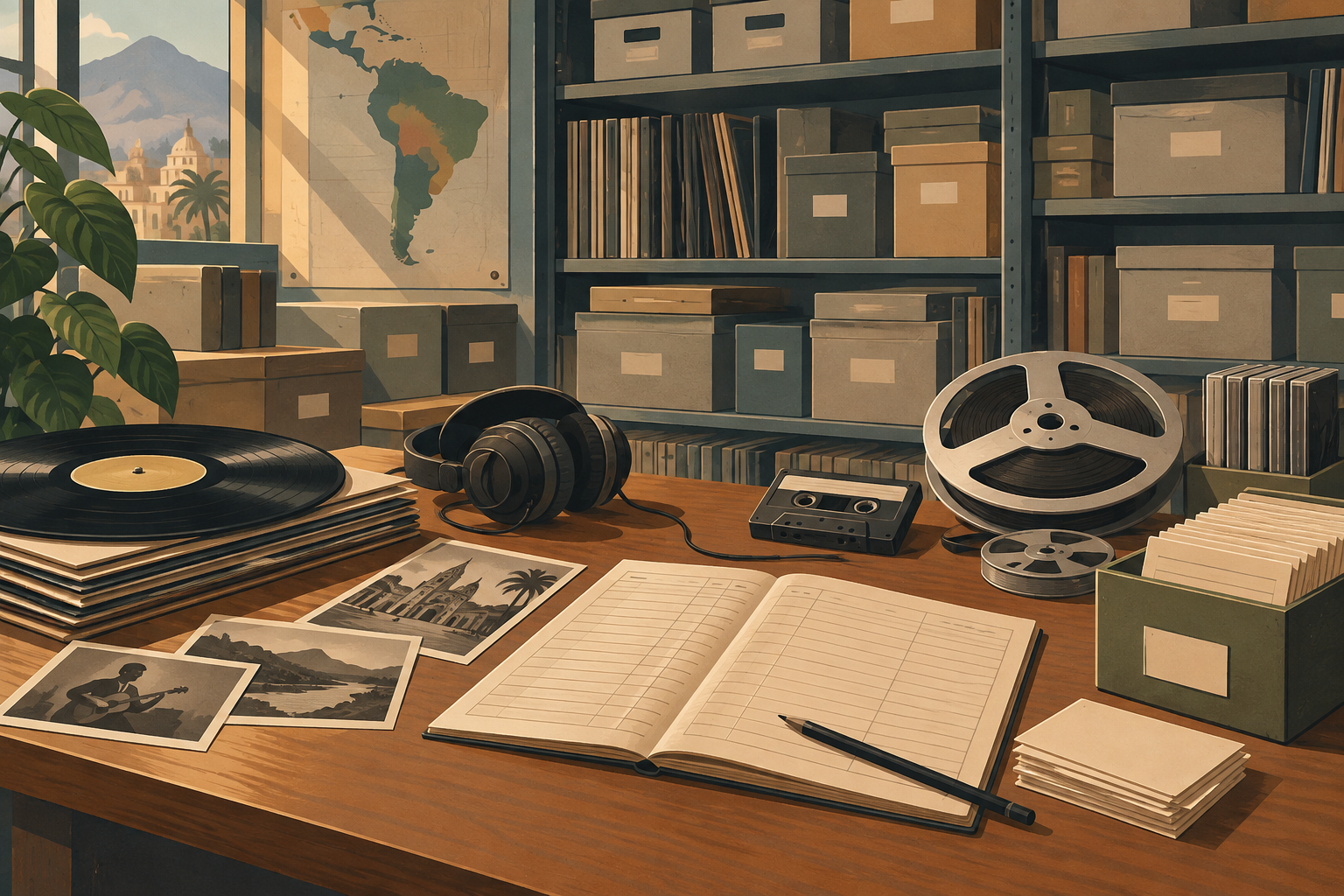
A text by Julio Mendívil recalls that fixing music onto media changed the relationship with a practice previously dependent on memory. Since then, wax cylinders, vinyl records, compact discs and digital files have all been connected to musical preservation. The point is useful because it displaces a common assumption: a carrier is not music in the abstract, but a particular means of recording, reproducing and transmitting a practice.
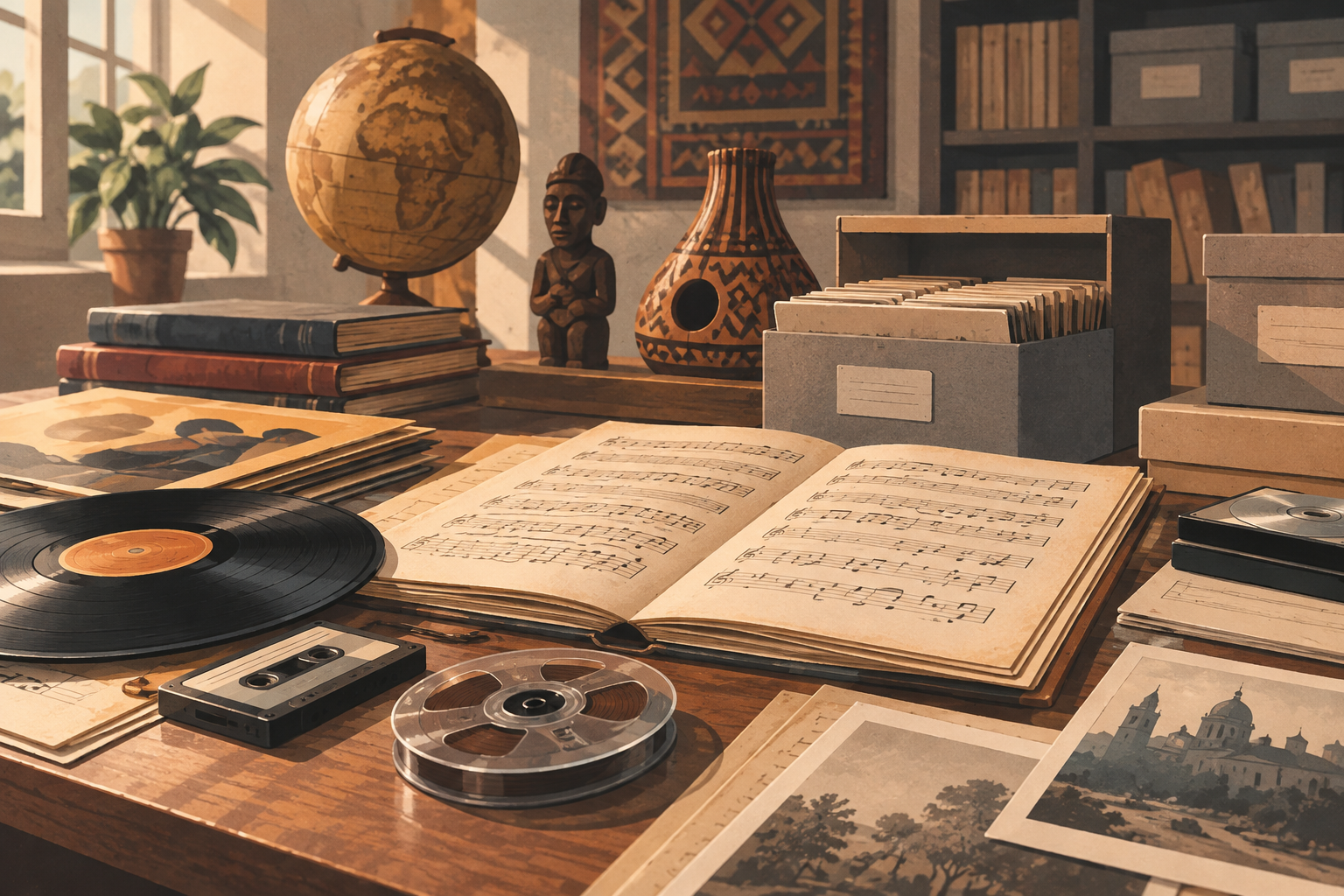
Yet the carrier does not exhaust meaning. A score may point to a work, but also to an institution, performer, commission, edition or specific use. A tape may contain a performance, but its documentary value changes when one knows who recorded it, when, for what purpose and under what conditions it circulated. The academic article on musical heritage and the convergence of musicology and ethnomusicology challenges rigid divisions between writing and orality, as well as between music history and social context. For an archive, that warning has direct consequences: preserving an object without its relationships can make it harder to understand.
Cataloguing creates possibilities for reading
Cataloguing can seem invisible beside exhibition or listening. Nevertheless, Navarra’s proposal places the cataloguing and digitisation of historical holdings among necessary actions, with priorities set by the condition and singularity of sources. Cataloguing is not the assignment of absolute value, nor the conversion of a collection into a mere database. It is the construction of description that makes materials locatable, comparable and interpretable.
The same proposal includes recent or still-forming holdings: contemporary compositions; records of choirs, bands, orchestras, theatres, auditoriums, cultural, recreational and educational societies; and archives created by events whose documentation is not always kept systematically. This broadens the focus. Musical heritage does not begin when a work becomes old, nor does it end with established repertoire. It also includes traces of musical life that may vanish for lack of an admissions, identification or custody policy.
Institutions, collections and layers of provenance
The holdings of the Musical Archive at Spain’s National Museum of Performing Arts offer a tangible instance of this documentary plurality. According to the museum, much of its heritage comes from the Teatro Real Museum-Archive, created in 1919 from musical holdings organised between 1850 and 1952. The archive separates broad Spanish and international music sections and brings together manuscripts, bequests and materials linked to theatrical repertories.
This case need not be treated as a universal model to yield a careful lesson: institutional provenance belongs to a collection’s history. Knowing that holdings were organised for a theatre museum-archive, or belonged to particular chains of custody, guides an understanding of their silences and concentrations. It also prevents the archive from appearing as a neutral storehouse. Collections reflect the decisions, capacities and priorities of those who assembled, described and maintained materials.
Digitisation does not replace preservation or context
Digitisation provides a route to access and can be part of a preservation strategy, but the sources do not present it as self-sufficient. The Navarra lecture places it alongside cataloguing, preservation of developing holdings, donations and the need for stable infrastructure staffed with musicological, archival and documentary expertise. It is a programme of work, not an isolated gesture.
Moreover, a digital copy alone cannot answer every cultural question. Mendívil writes that several sound archives are reshaping their relationships with cultural groups that own recorded material through joint publications, collaboration with states or, in some cases, repatriation programmes. His argument moves preservation away from mere rescue towards dissemination and the defence of musical diversity. Every archive has its own legal and community framework, but the principle is clear: access and interpretation require attention to the people and contexts connected with documents.
A heritage activated with care
Preserving music means maintaining future possibilities: listening, studying, performing, attributing and debating. Those possibilities depend on retaining the information that connects materials, practices and institutions. It is therefore insufficient to oppose “material” and “intangible” heritage as sealed compartments. The sources gathered instead point to a network of written documents, sound recordings, memories, living practices and custodial structures.
The limits of what can be verified matter. These sources do not provide one technical recipe for every format, measure the actual condition of each collection or determine from outside what should represent a community. They do support a more modest and useful conclusion: preserving music requires care for materials, sustained description, awareness of provenance and responsible dissemination strategies. When those elements are brought together, an archive ceases to be only the place where something remains; it can become a place from which a musical culture becomes legible, discussable and shareable.
- Decade
- Contemporary
- Region
- Spain
- Level
- Enthusiast
- Entities
- Museum
Sources and references
- Censo-Guía de Archivos de España e Iberoaméricacensoarchivos.cultura.gob.es · 2026-09-22
- Acervos de Documentos musicales - Bibliopos: Biblioteca de recursos para Bibliotecarios y Opositoreswww.bibliopos.es · 2026-09-22
- El patrimonio musical en la convergencia entre musicología y ...revistas.ucm.es · 2026-09-22
- El patrimonio musical: de la conservación a la difusión - Cátedra de Patrimonio y Arte Navarro - Universidad de Navarrawww.unav.edu · 2026-09-22
- La conservación de la música - SUBURBANOsuburbano.net · 2026-09-22
- Archivo Musical - Museo Nacional de Artes Escénicas: Almagro, Ciudad Realmuseodeartesescenicas.inaem.gob.es · 2026-09-22