An arcade machine does not begin with its screen
When an arcade machine enters a collection, the usual impulse is to test whether it works. For an archive, display, or inventory, however, the first task is not switching it on. It is establishing what object is present and what information accompanies it. Documentation does not automatically turn a machine into heritage, but it prevents study, conservation, and interpretation from depending solely on the memory of the person who received it.
The museum sources consulted offer a useful principle: a catalogue places an object in its historical, technical, or cultural framework and should record, among other matters, condition, biography, and relevant incidents. For an arcade machine, this means looking beyond visual appeal. The cabinet, labels, photographs, provenance documents, and associated testimony form an information set that needs careful distinction.
Begin with what can be observed
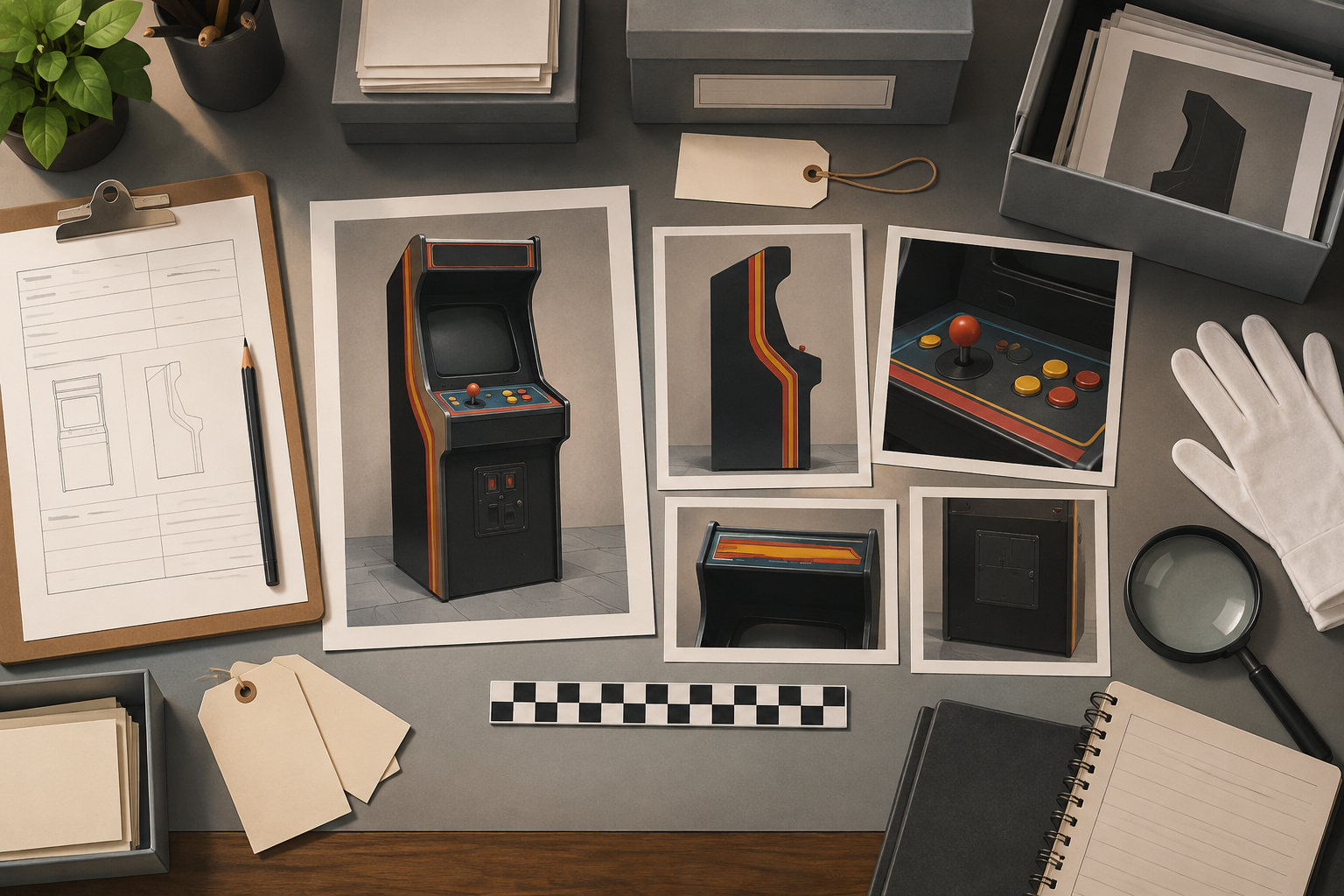
The first record should separate observation from interpretation. Observation includes directly verifiable information: dimensions, apparent materials, visible inscriptions, present or missing elements, observed damage, and dated photographs of the whole object and its details. The record should also state where the machine is, who made the entry, and when.
Interpretation must be labelled as interpretation. Someone may recognise a model, associate a cabinet with a particular arcade, or remember its use. Such testimony may help reconstruct context, but it is not automatically documentary identification. Record the attribution, its source, and its degree of certainty rather than turning a hypothesis into a catalogue fact.
Provenance is information too
Museums preserve more than objects; they preserve relationships between objects, people, institutions, and activities. The Historical Archive of Spain’s National Archaeological Museum describes museum documentation as a reflection of the people who shaped the museum, the history of its collections, and its cultural activity. This is especially helpful for recent material culture.
An arcade machine’s provenance may include acquisition papers, images of its former location, correspondence, loan notes, private inventories, or owners’ testimony. These sources do not carry equal evidential weight, but each can be retained with a clear account of its origin. If an object’s route is unknown, the record should say so. A documentary gap is not solved by a persuasive story.
Describe condition before proposing action
Preventive conservation aims to eliminate or reduce risks before they cause serious deterioration. Spain’s Ministry of Culture describes an approach based on analysing the item and its context, evaluating threats, adopting technical or organisational measures, and creating monitoring procedures.
For arcade collections, the responsible editorial outcome is not a repair recipe but a record of needs: which elements appear vulnerable, which parts require specialist assessment, which documentation is missing, and what changes have been observed over time. A condition report should not masquerade as a technical diagnosis. “Visible wear” is different from claiming an unverified cause.
Archive the context, not only the cabinet
Archive management can strengthen museums’ ability to tell stories and share knowledge. An arcade machine can therefore be an entry point to photographs, plans, manuals, maintenance records, advertising, collector notes, or audiovisual material—provided that their relationship to the object is documented.
This is not an invitation to gather papers without method. Each document needs a reference explaining what it is, where it came from, what connection it has to the object, and whether that connection is confirmed or provisional. Museum documentation of an object’s external environment helps clarify its context of origin. That caution protects future research and the visitor experience alike.
A narrative with visible limits
A display may discuss an arcade machine as an object of design, technology, leisure, or social memory, but it should make clear where certainty ends. Cultural institutions conserve, document, research, and communicate; none of those functions requires filling gaps with nostalgia.
An honest label can distinguish a visible inscription from a pending attribution, or oral testimony from archival information. Such transparency does not weaken the story. It shows how knowledge about an object is built and leaves room for revision when evidence emerges.
Conclusion
Documenting an arcade machine creates a basis for deciding, cautiously, what is known, what should be preserved, and what still requires research. Before a public demonstration or any intervention, a clear record, consistent photographs, accurately described provenance, and a condition log provide something more durable than a first impression: an object that can continue to be studied and interpreted rigorously.
- Decade
- Contemporary
- Region
- Spain
- Level
- Enthusiast
- Entities
- Museum
Sources and references
- Museum Internacional No 201 (Vol LI, n° 1, 1999) Conservación preventivawww.ibermuseos.org · 2026-09-21
- Introducción a la Gestión de Archivos en Museos – EVE Museos + Innovaciónevemuseografia.com · 2026-09-21
- Profesionales de la conservación-restauración: la conservación preventiva - Bellas Artes y Patrimonio Cultural | Ministerio de Culturawww.cultura.gob.es · 2026-09-21
- Archivo histórico - | Ministerio de Culturawww.man.es · 2026-09-21
- Capítulo 10 - El museo como centro de investigación. La necesidad de documentar las piezas en el museo. Tendencias documentales actuales. Normalización y gestión integral del museo. - Fco Javier Zubiaur Carreñowww.zubiaurcarreno.com · 2026-09-21