The visible image and the missing history
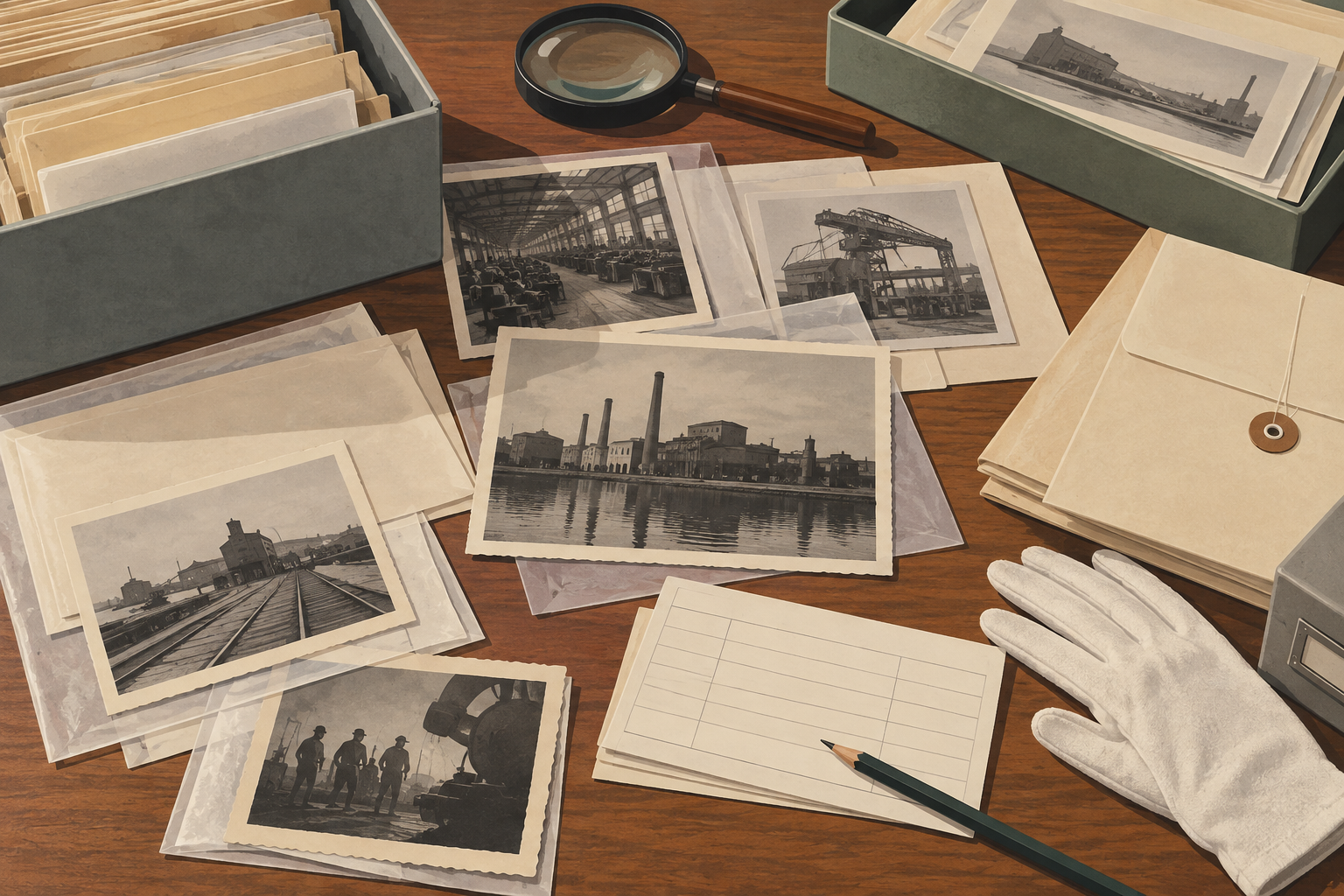
A photograph seems to offer an immediate answer: we see a building, a machine, a vehicle or people posed before a camera. Yet what is visible does not explain who commissioned the image, who took it, or what purpose it served. A study of archival photographic documents stresses precisely this distinction: knowing the subject, date and even the names of the people shown is not enough to establish a photograph’s archival character if its producer is unknown.
That distinction changes how we look. The image is no longer a transparent window onto the past; it is also an object made under specific circumstances. This reading does not invalidate what it depicts. It helps establish what can be claimed and what remains unverified.
Provenance is part of the document
In the study’s example, a photograph of a bus may come with information about its route, date and the people pictured. Yet if the person, company or union that produced it cannot be identified, its archival context remains incomplete. The crucial question is not only what appears in the image, but what activity generated the record and why it was kept.
This is particularly relevant to business history. Photographs may record workplaces and industrial sites, but they can also show how an organization chose to represent itself, document its work or preserve a record of its activity. The study of images of Argentine companies mentions research on photographs produced by the Witcomb Photographic Studio and the Argentine Society of Amateur Photographers. The interest lies not only in identifying the buildings shown, but also in establishing who made the images and how they fit into a documentary collection.
From a scene to a collection
An isolated image supports limited observations. A group of images, if its relationships and provenance information survive, can help researchers study processes, commissions and practices of representation. The article on industrial photographic documents emphasizes two dimensions: the photograph as a visual record of what it depicts, and as evidence of the everyday work involved in producing those images.
This second dimension broadens the historical question. Alongside “What do we see?” we can ask “Who arranged the photograph?”, “For whom was it made?” and “What role did it play in the organization’s activity?” These are interpretive questions that require documentary support; a photograph alone cannot necessarily answer them all.
Institutional archives and public memory
Mexico’s Museum Archive of Photography offers another example of the relationship between images and institutional activity. The description in the Censo-Guía says the museum was created to bring together images related to local administrations, public services and infrastructure projects. It also describes the archive’s mission as organizing, preserving, managing and sharing this graphic memory. The source reports a collection of more than two million items and photographs with date ranges from 1905 to 2006.
In Spain, a Ministry of Culture document describes photographic holdings in state archives. Among other details, it notes the acquisition of the Alfonso Archive in 1992 and the deposit of negatives and prints at the General Administration Archive in 1992 and 1993. Such details show that a collection’s history includes transfers, custodial decisions and systems of description, as well as the photographs themselves.
Cataloguing is also interpretation
Archival description determines which details remain attached to a photograph and which can later be retrieved. An academic text on press photographic archives lists fields such as a descriptive summary, format, condition and observations about exhibitions or uses. The example makes clear that documenting a photograph is not simply a matter of storing it: it requires recording information that helps identify, contextualize and handle it carefully.
The management of historical photographic archives also faces digitization. Spain’s National Museum of Natural Sciences notes that advances in digital technology coincide with growing public interest in old photography and require new strategies for managing historical-documentary collections. Digitization can improve access, but it does not automatically replace information about provenance, physical support or relationships between records.
Limits of what can be verified
The sources available here cannot reconstruct the full history of every collection or establish the authorship of specific photographs without consulting their original records. Nor do they justify treating every digital reproduction as equivalent to the preserved document. These are important limits: an image may circulate separately from its description, and a description may retain uncertainties that should not be filled with assumptions.
The most responsible reading combines what a photograph shows with verifiable information about its production, preservation and organization. When such information is missing, acknowledging the gap is more rigorous than turning a visual impression into certainty.
Conclusion: preserve relationships, not just images
An archival photograph is a visual record, but it is also the result of an activity and part of a documentary collection. Its historical value grows when it can be connected to producers, institutions, uses and preservation histories. Looking at an image this way does not make it less evocative; it helps us understand more clearly what evidence it offers and where its answers end.
- Decade
- 2000s
- Region
- Global
- Level
- Enthusiast
- Entities
- Museum
Sources and references
- Documentos fotográficos de archivo: extendiendo los ...dialnet.unirioja.es · 2026-09-24
- Censo-Guía de Archivos de España e Iberoaméricacensoarchivos.cultura.gob.es · 2026-09-24
- 165 5.3. Fondos y colecciones fotográficas en Archivos Estataleswww.cultura.gob.es · 2026-09-24
- Gestión de los archivos de fotografía historica por Gabriel Betancor Quintana | Museo Nacional de Ciencias Naturalesmncn.csic.es · 2026-09-24
- 1 ARCHIVOS FOTOGRÁFICOS DE PRENSA Juan Miguel Sánchez Vigilrevistas.ucm.es · 2026-09-24
- ISSN: 1578-4282 ISSN (cd-rom): 1695-9884 Deposito legal: J-154-2003revistaselectronicas.ujaen.es · 2026-09-24