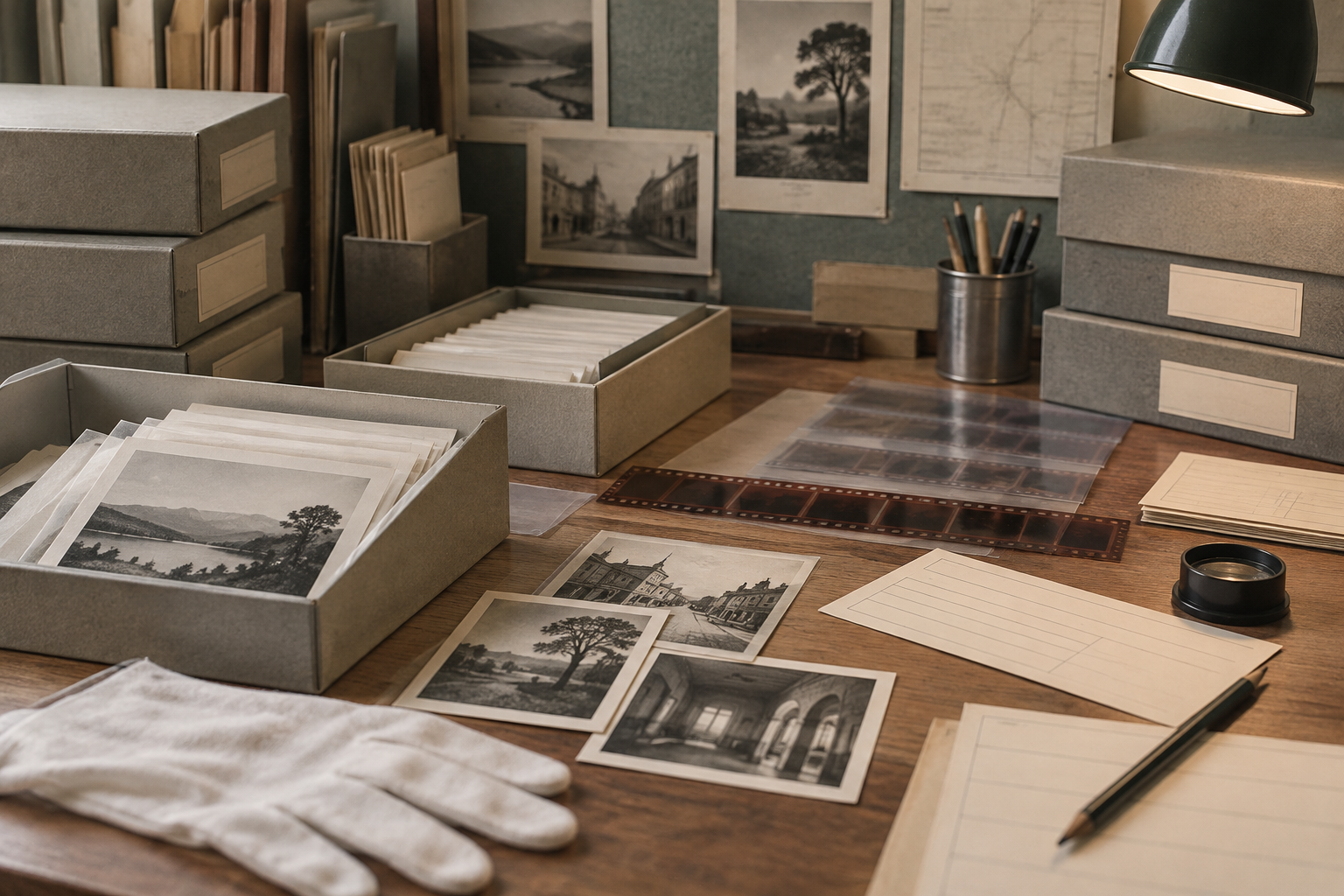
The Image and Its Provenance
An old photograph can appear self-sufficient. We see a building, a vehicle, a public work, a group of workers, or a transformed street, and the image seems to grant direct access to the past. Yet the evidence gathered on photographic archives calls for an essential caution: an image does not automatically become an archival record merely because it is old, precise, or visually eloquent.
The study on archival photographic documents and industrial heritage states the issue plainly. Even a photograph of a bus from the 1930s, with its route, exact date, and the names of the people pictured known, cannot be fully understood as an archival document if its producer is unknown. It may have been made by an individual, a transport company, or a drivers’ union. Each possibility changes the image’s meaning, original purpose, and the questions it can answer.
Why the Maker Matters
Provenance is not administrative detail added after the exposure. It helps distinguish a photograph commissioned to record construction work from a corporate image meant to present a company, or from a print kept by a collector. A record does not only report what stood before the camera: when its context can be reconstructed, it also preserves a relationship with the activity of its producer.
This approach is especially valuable for industrial and corporate photography. The cited work on Estudio Fotográfico Witcomb and the Sociedad Fotográfica Argentina de Aficionados describes a catalogue project focused on industrial and commercial establishments. Such images can help us observe buildings, machinery, or urban settings, but they also raise questions about commissions, institutions, and everyday work behind their production.
From Urban Views to Institutional Memory
According to the research provided, photographs of buildings and public spaces took part in the creation of visual imaginaries of national identity. Some answered commissions from municipal or national authorities; others were requested by private bodies, companies, and industries in urban and rural settings. That variety prevents us from treating every photographic holding as a uniform collection of picturesque views of the past.
Mexico’s Museo Archivo de la Fotografía provides a concrete institutional case. The Spanish Censo-Guía source states that its creation was published in the Gaceta Oficial del Distrito Federal on 6 December 2006. Its mission is described as organizing, preserving, administering, and disseminating a visual memory connected, among other subjects, with urban change, public services, and infrastructure. The same entry gives the cited collection’s date range as 1905 to 2006 and reports more than two million items.
Description Is Also Interpretation
Preservation is not simply storage. Documentation guidance for press photo archives recommends recording the author or producer, description, genre, format, recto, and condition, among other data. These tasks do not replace the photograph; they make it possible to find, compare, and explain its limits.
Attribution can be difficult. The producer may be the author, but may also be an heir, collector, or custodian of a collection. A responsible catalogue record must therefore distinguish documented information from conclusions drawn by looking. Identifying a street or a visible technology does not by itself reveal the image’s original destination.
Digitisation Does Not Remove the Need for Archives
Digitisation broadens access, but it does not erase the need to describe provenance and material form. The Museo Nacional de Ciencias Naturales includes resolution, histograms, colourimetry, densitometry, output formats, cataloguing, and metadata among its historical-photography management topics. A digital archive is therefore more than a set of image files: it depends on technical and descriptive decisions.
Supports matter too. Direct positives, negative plates, albumen prints, gelatine materials, clichés, and slides do not require identical treatment or invite identical readings. The copy seen on screen is a useful derivative, not a complete replacement for the object or its context.
What a Photograph Can Claim
Photography is an exceptional source, but it does not speak in one voice. It can inform us about what it depicts and, at the same time, about the institution, commission, craft, or practice that produced it. This double condition explains why photographic archives matter so much to industrial, urban, and press history.
For anyone exploring retro collections, the lesson is simple: before turning an image into final proof, ask who made it, for whom, when it entered a collection, and which data accompany the original. Context does not diminish a photograph’s evocative power. It makes the image more legible—and more honest—as history.
- Decade
- Before 1950
- Region
- Global
- Level
- Enthusiast
- Entities
- No linked entities
Sources and references
- (PDF) Documentos fotográficos de archivo: extendiendo los límites del patrimonio industrialwww.researchgate.net · 2026-09-19
- Documentos fotográficos de archivo: extendiendo los ...dialnet.unirioja.es · 2026-09-19
- Censo-Guía de Archivos de España e Iberoaméricacensoarchivos.cultura.gob.es · 2026-09-19
- ISSN: 1578-4282 ISSN (cd-rom): 1695-9884 Deposito legal: J-154-2003revistaselectronicas.ujaen.es · 2026-09-19
- Gestión de los archivos de fotografía historica por Gabriel Betancor Quintana | Museo Nacional de Ciencias Naturalesmncn.csic.es · 2026-09-19
- 1 ARCHIVOS FOTOGRÁFICOS DE PRENSA Juan Miguel Sánchez Vigilrevistas.ucm.es · 2026-09-19