The Image and Its Provenance
A historical photograph may show a building, a street, a family, a factory, or a public-works project. Yet what is visible does not exhaust what the document can tell us. A study of archival photographic documents makes a crucial point: even when the date, place, or people depicted are known, an image cannot be fully understood as an archival document if its producer and the circumstances of its creation are unknown. That producer may have been an individual, a company, a trade union, or a public institution.
The practical consequence is both simple and far-reaching. Looking at an old photograph is not only a matter of recognising what is inside the frame. It also means asking who commissioned or made it, for what activity, which documentary series it relates to, how it entered an archive, and which information accompanied its preservation. This shift moves photography away from the notion of an isolated illustration and returns it to a network of work, administration, memory, and social use.
Context Changes the Reading
An image of an industrial site may be compelling because of its machinery, architecture, or clothing. But a photograph made for a company is not necessarily equivalent to one made by a visitor or a newspaper. The study on industrial heritage notes that company photographs can provide information about what they depict while also showing how everyday tasks were carried out within those organisations.
Those two dimensions should remain distinct. The first is descriptive: what is shown. The second is documentary: why the image was made, who assembled it, and what function it had. A photograph commissioned to record a construction project, for instance, may visually document urban change; it may also belong to an institutional practice of monitoring, communication, or administrative memory. There is no need to assign intentions that the documentation does not prove. It is enough to recognise that origin shapes the questions we can reasonably ask.
From Album to Archive
An archive is not simply a large collection of photographs. Writing on photographic documentation highlights such elements as author or producer, document description, genre, format, recto, and condition. These may seem technical details, but they make it possible to recover the link between an image and its material history.
For a collection user, it is useful to distinguish between what is written in a record and what is inferred from the photograph itself. An exact date in a catalogue record does not have the same degree of certainty as an approximate date suggested by clothing or vehicles. Likewise, a documented author name should be kept separate from a traditional attribution or an illegible signature. This discipline does not diminish the image’s appeal; it prevents an attractive hypothesis from becoming a stated fact.
Archival context also helps explain absences. The fact that a collection preserves particular views of a city does not, by itself, prove that they were the most important in its history. It may indicate that they were the views an office produced, selected, or transferred. Gaps are therefore part of a critical reading of a photographic holding.
An Institutional Case: Museo Archivo de la Fotografía
The Censo-Guía de Archivos de España e Iberoamérica records that the creation of the Museo Archivo de la Fotografía in Mexico City was published in the Gaceta Oficial del Distrito Federal on 6 December 2006. The institution brings together images connected with local administrations and with efforts involving public services, infrastructure, and urban improvement. The same record says that its mission includes organising, preserving, administering, and disseminating this graphic memory.
This case is valuable because it shows that a photographic collection can be both visual heritage and institutional documentation. Its images may help researchers study urban change, but they also point back to the practices of those who produced and preserved them. According to the census record, the holdings exceed two million items and span dates from 1905 to 2006. These are statements about the declared scope of the collection, not a guarantee that every item is individually identified, dated, or digitised.
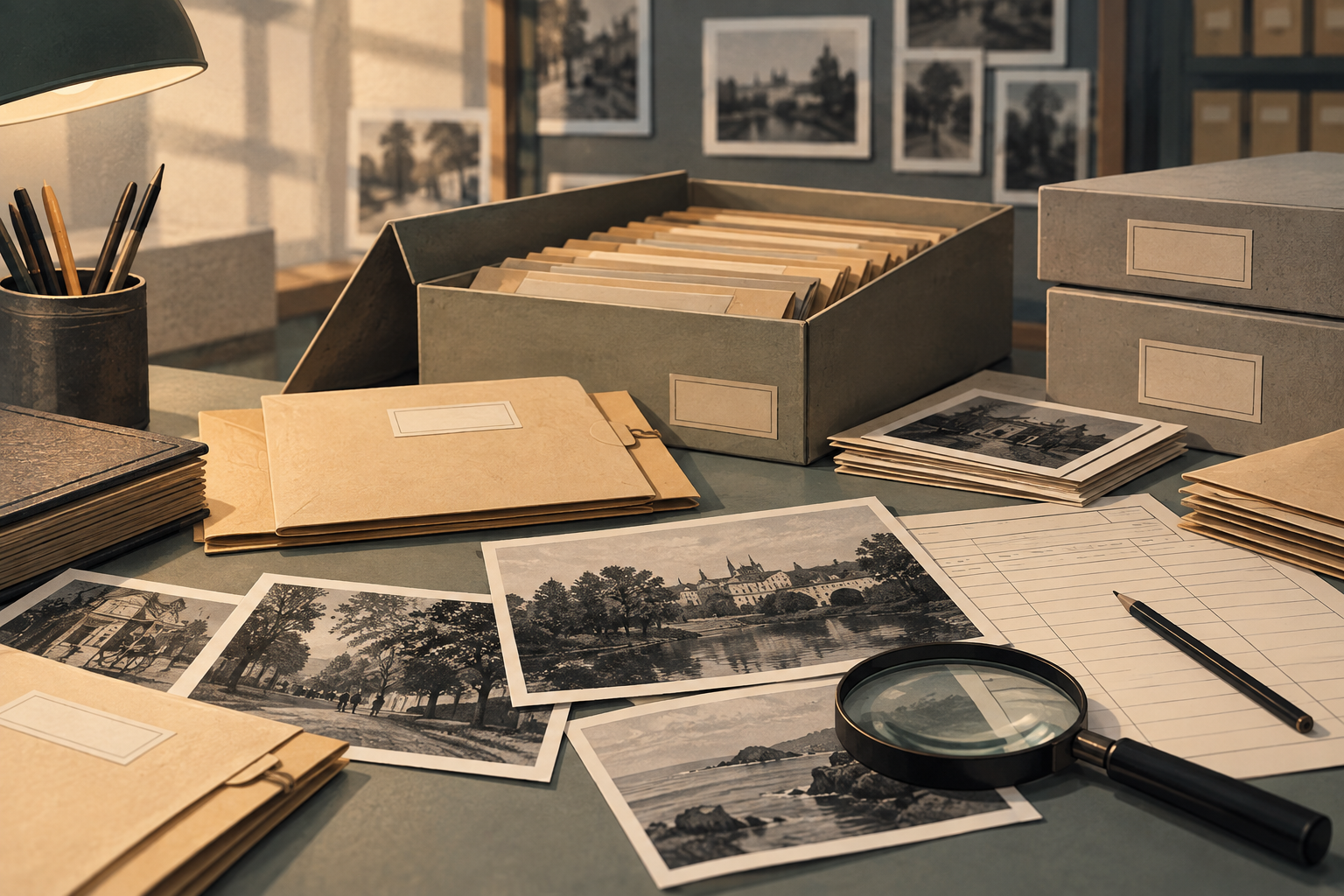
The record adds an especially revealing detail: the museum was to begin classifying its holdings in 2008, and the collection was kept in cardboard boxes. This is not a minor point. Intellectual access depends on sustained processes of arrangement and description. An archive does not become usable merely by gathering objects; it needs structure, criteria, and resources.
Digitisation Does Not Remove Context
Digitisation can broaden access and create consultation copies, but it does not eliminate the need to manage originals and their metadata. A programme on historical photographic archives from the Museo Nacional de Ciencias Naturales addresses resolution, histograms, colourimetry, densitometry, digitisation, cataloguing, and metadata. The list makes clear that a digital image is not an automatic substitute for the physical document. It is a derivative whose usefulness depends on how it was created and described.
Put simply, a reproduction may make content easier to inspect, while the original retains information about its support, markings, reverse side, deterioration, and physical arrangement. Nor does every digitisation serve the same purpose. It may be intended for access, preservation, dissemination, or technical documentation. Confusing these aims can lead users to expect results that do not correspond to an archive’s project.
The same museum material observes that the digital transition overlaps with growing social interest in old photography. This coexistence of public interest, technical management, and historical memory is one of the defining features of contemporary photographic archives.
How to Look and What to Ask
When approaching a historical photograph, begin with a set of questions: who is listed as author or producer? What date is supplied, and how precise is it? Is the item part of a fonds, a series, or an album? Which support and format are described? Are there notes on condition, prior uses, or provenance? These questions do not require laboratory knowledge; they require attention to the available documentation.
The image can then be observed carefully. Visual details may help formulate hypotheses about places, objects, or practices, but they need to be checked against records, catalogues, and other sources. Research on photography and history stresses that constructing a historical account from images requires a combination of bibliographical, press, archival, iconographic, and oral sources.
Conclusion
The most useful lesson of a photographic archive is not that an image “speaks for itself.” It is that it speaks more clearly when its relationship with its producer and with the documentary group to which it belongs is retained. The Museo Archivo de la Fotografía demonstrates the institutional scale of that work; writing on cataloguing and digitisation reveals the labour that makes it possible.
For enthusiasts, this approach turns contemplation into critical reading. A photograph remains a window onto what it depicts, but it is also a documentary object with a biography. Learning that biography—only as far as the records allow—is the most responsible way to approach its memory.
- Decade
- 2000s
- Region
- Global
- Level
- Enthusiast
- Entities
- Museum
Sources and references
- Documentos fotográficos de archivo: extendiendo los ...dialnet.unirioja.es · 2026-09-22
- Censo-Guía de Archivos de España e Iberoaméricacensoarchivos.cultura.gob.es · 2026-09-22
- ISSN: 1578-4282 ISSN (cd-rom): 1695-9884 Deposito legal: J-154-2003revistaselectronicas.ujaen.es · 2026-09-22
- Gestión de los archivos de fotografía historica por Gabriel Betancor Quintana | Museo Nacional de Ciencias Naturalesmncn.csic.es · 2026-09-22
- 1 ARCHIVOS FOTOGRÁFICOS DE PRENSA Juan Miguel Sánchez Vigilrevistas.ucm.es · 2026-09-22