A transformation identified from the present
Board games did not begin in the 1990s, and that decade did not erase family games, card games, or earlier local traditions. Yet the sources assembled for this article repeatedly identify that period as a turning point for the industry. Shangrila describes the 1990s as the stage of the sector’s “greatest transformation,” linked to popularization and a larger supply of games. That wording is not a sales figure and cannot measure the phenomenon country by country, but it offers a useful starting point: the change concerned both available variety and the ways games were discussed.
Long history places that claim in perspective. Popular accounts remind us that boards, dice, and counters long predate the modern industry. They also show why caution matters when discussing ancient games: Senet’s rules are conjectural, while the Royal Game of Ur has been researched and deciphered by Irving Finkel according to the cited sources. The gap between surviving objects and actual play is crucial. A game is not only its board; it also consists of rules, players, and the settings through which it circulates.
More supply, more possibilities
When a source speaks of an expanded supply, it means more than a larger pile of boxes in a shop. Greater variety opens choices of theme, duration, player count, and interaction. It also makes clear that players do not all seek the same experience. One group may prefer conversation and negotiation; another calculation, chance, cooperation, or historical setting.
Diplomacy, described by El Correo as an experience of verbal agreements without dice, illustrates one such possibility: conflict can depend principally on what participants say to one another. This does not make it representative of the entire decade, nor does it demonstrate a market trend by itself. It does, however, show that tabletop design can organize social relationships very differently from a race game determined solely by dice rolls.
Plurality should not be mistaken for an automatic hierarchy. The emergence of more proposals did not make earlier formats obsolete. More cautiously, the transformation can be understood as an expansion of the repertoire available to players and of the audiences able to recognize themselves within it.
Eurogame as a cultural marker
Shangrila’s blog identifies the popularization of eurogames from the 1990s and names Settlers of Catan, Carcassonne, and Ticket to Ride as reference points in that conversation. The available evidence does not provide complete records for each title, publication dates, or distribution data. It would therefore be inappropriate to turn the mention into an exhaustive chronology.
What matters is the term’s use. Naming a family or tendency allows players, media, and retailers to discuss expectations of design. A shared name can help people find games, recommend experiences, and debate mechanisms, even when its boundaries are disputed. The source itself notes the terminological conflict surrounding so-called modern board games. That warning is valuable: labels guide discussion, but seldom fully describe a diverse cultural practice.
Corvus Belli likewise calls the release of Catan, designed by Klaus Teuber, a fundamental milestone. Within this article, that statement is evidence of the game’s later significance rather than an independent measurement of its impact. Even so, it helps explain why certain titles became landmarks in discussions of change.
From toy to specialized leisure
Another recurring idea in the evidence is a gradual separation between board games and the category of toys. Corvus Belli states that these products increasingly came to be perceived as independent entertainment for a diverse public, including adults and committed players. This does not mean children stopped playing, or that every title became aimed at specialists. It describes a shift in perception.
That shift matters because it changes cultural mediation. If games are understood as an activity for distinct audiences, more specific recommendations, demonstration spaces, specialist coverage, and design conversations can emerge. Expectations can also grow around physical components, rule clarity, and replayability. Shangrila places materiality and physicality among the necessary subjects for studying the medium.
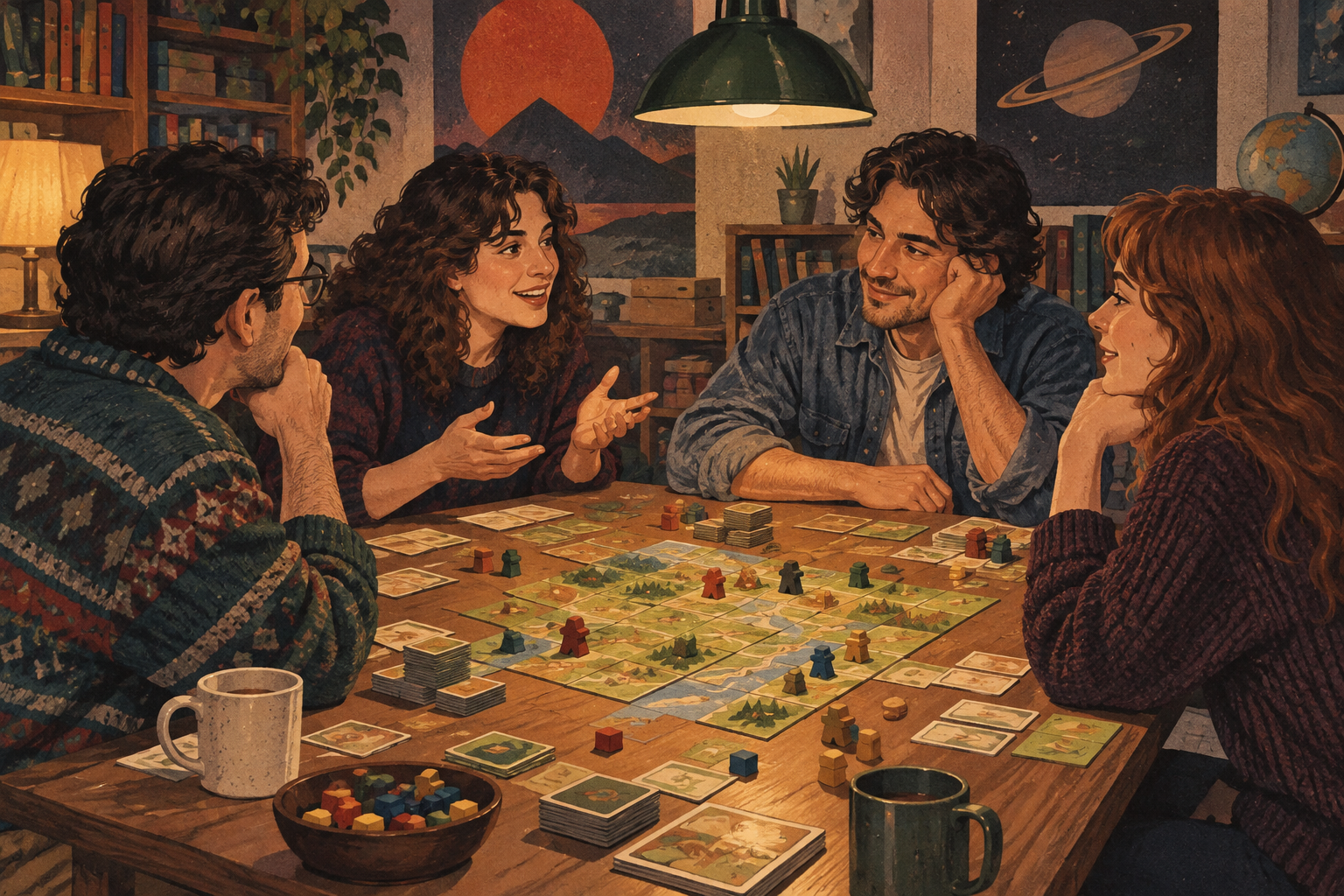
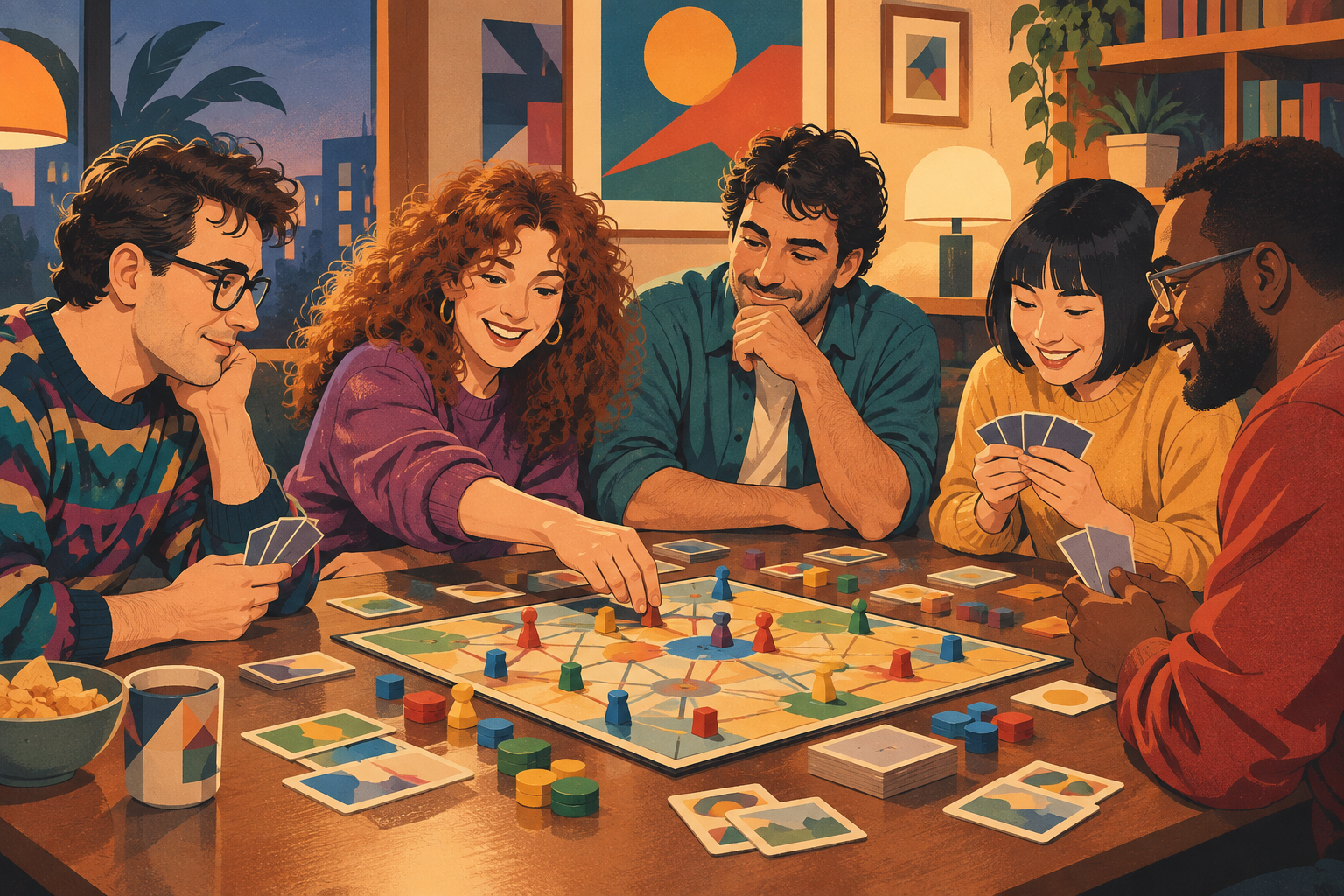
Playing remains embodied and situated: someone opens a box, sets out components, explains rules, negotiates an interpretation, and shares a table for a certain period. Even a competitive design requires a minimum degree of coexistence. That quality explains why industry alone cannot account for a game’s cultural value.
Fairs, publishing, and crowdfunding
Shangrila’s sources connect the new context with festivals such as Internationale Spieltage in Essen and with the popularization of projects through crowdfunding platforms. They also identify authors, publishers, and consumers as necessary actors for understanding markets and their territorial contexts.
The supplied material is not sufficient to reconstruct these developments year by year or to assign them a single cause. It does support an analytical consequence: board games can no longer be explained only through their rules. Their circulation depends on who designs, publishes, translates, sells, reviews, and plays them. In this reading, fairs and platforms are sites or mechanisms of visibility. They do not replace the experience at the table, but they can change which works reach it.
Physical play and digital supports
The book presented by Shangrila proposes studying the movement from the importance of physical materiality toward its transformation into digital supports. This framing helps avoid two simplifications. One is that digital formats necessarily eliminate the board. The other is that boards remain unchanged in the face of new ways to discover games, read rules, or converse with players.
The available evidence cannot establish a precise timetable for this digital transformation. What can be verified is that contemporary game studies include this relationship between supports. The question is not merely what is played, but where games are discovered, how people learn them, and what is preserved when a design moves from physical components to a screen.
Limits and legacy
The available documentation comes from popular writing, journalism, and editorial reflection; by itself, it is not a global statistical record of the industry. Nor does it allow every change to be dated, national markets to be compared, or one game to be assigned the origin of a complex transformation. Those limits should remain visible.
With that caution, the resulting picture is consistent: the 1990s appear as a crossroads at which supply expanded, new labels became recognizable, and board games gained visibility as leisure for diverse audiences. Their legacy is not an absolute break with the past, but a broader vocabulary for designing, choosing, and discussing what happens around a table.
- Decade
- 1990s
- Region
- Global
- Level
- Enthusiast
- Entities
- No linked entities
Sources and references
- Encrucijadas del juego de mesa. Historia, cultura e industria – Shangrilashangrilaediciones.com · 2026-09-20
- Historia de los juegos de mesa: desde los orígenes hasta nuestros tiemposwww.tiratu.com · 2026-09-20
- Evolución de los juegos de mesazacatrus.es · 2026-09-20
- Juegos de mesa: Evolución Históricacorvusbelli.com · 2026-09-20
- textos en red - shangrila-blog: II. ENCRUCIJADAS DEL JUEGO DE MESA. HISTORIA, CULTURA E INDUSTRIA", Jan Gonzalo Iglesia (ccord.), Valencia: Shangrila, 2024.www.shangrila-blog.com · 2026-09-20
- Los mejores juegos de mesa para amantes de la historia | El Correowww.elcorreo.com · 2026-09-20